Glossary
Analyse musicale
Musical analysis is a discipline that involves studying a musical work in order to understand its genesis, structure, and design. In ethnomusicology, analysis is one of the tools used to highlight musical systems specific to the musical culture in question.
Articulation
Articulation is the art of imitating the inflections of the human voice when playing a musical instrument. Articulation essentially consists of mastering the attack of notes, as well as managing the micro-silences between notes (articulation rests), which give clarity to the musical message. In the era of early music, nuances were much less developed than they are today, but articulation was then one of the primary means of expression.
Authente
(see also plagal) The term authente (authentic) is defined in relation to the term plagal. These terms originate from plainchant (sacred chant for one voice in the Roman Catholic liturgy). Today, when these terms are used to describe other modal music, for example, the folk music of France, we could say: "which are similar to the authentic and plagal forms": - the authentic form starts from the final note, what we now call the tonic, but which, to complicate matters, can descend by one degree; thus the mode of D, which normally extends from D to D, can descend to C. - The plagal form starts a fourth below. The name is preceded by "hypo," for example, if the authentic form is the Dorian mode (from D to D), the plagal form will be the Hypodorian mode, which extends from A to A. (According to Alain Lefébure, "Les anciens modes d'église,"
Âvâz
In Iranian classical music, this refers to a long modulation or secondary (or intermediate) maqam. The term literally means voice, song. See also gushe, sho’be, dastgâh.
Battue
Beating is the physical manifestation of the pulse, through a gesture or a sound. To beat time is to express the pulse of a regular or irregular rhythm. Conversely, musical phrases can be unmeasured, that is, free from any pulse. It is impossible to beat time with them.
Bourdon
A drone is a musical technique in which a note is played continuously throughout a musical performance, accompanying a melodic part (for example, in the playing of the zurna oboe, the hurdy-gurdy, most bagpipes, the Indian tampura, and in the singing of many polyphonic pieces). For some musicologists, the drone is a defining element of modal music. However, this is not the case for many modal musical traditions, primarily those related to the maqam system (“maqamic music”).
Bourrée
The name of a family of fairly diverse dances (for 2, 3, 4, 6 or more dancers), found in the Massif Central, Central France, and surrounding regions. There are two distinct musical types, in duple and triple time, with very different histories and distribution. Before the very end of the 19th century, the term "bourrée" referred exclusively to the duple-time forms, while the triple-time forms were called "montagnarde" (mountain form).
Catalogue Coirault
The researcher Patrice Coirault (1875-1959) produced a monumental and unparalleled study of early and traditional French song. To this end, he created a typological catalog of these songs, based on a survey of traditional versions collected from the vast number of historical sources he consulted. This catalog, initially a personal research tool, was revised and expanded by several researchers and published in three volumes by the Bibliothèque Nationale (National Library of France) starting in 1996 under the title "Répertoire des chansons françaises de tradition orale" (Directory of French Songs of Oral Tradition). It is an indispensable resource for anyone interested in traditional song.
Cent et savart
A cent is a mathematical division of an interval, equivalent to one-hundredth of an equal-tempered semitone. A tone = 200 cents, a three-quarter-tone interval = 150 cents. A savart, like the cent, is a unit of measurement for musical intervals based on a logarithmic scale relative to the fundamental frequency of a musical note. A savart is approximately 4 cents.
Centonisation
A method of musical composition consisting of using melodic fragments from different pieces.
Collectage
Collecting involves gathering, most often using an audio or video recorder, music, songs from oral traditions, and dances from elders or other knowledgeable individuals, with the aim of preserving them. Databases of collected materials exist and are easily accessible to musicians.
Comma
A comma is defined as the interval between two sequences of pure intervals. It generally varies between one-tenth and one-fifth of a tone, depending on the type of comma being considered (Pythagorean, Zarlinian or syntonic, enharmonic, etc.).
Corde de récitation
The recitative string, also called the dominant, is, according to René Zosso, "the other organizing axis" of the melody, the second drone, above that of the tonic (final). In the cantillation that characterizes psalmody (the singing of psalms), the recitation is done on a single note called the "recitative string." (Larousse - Dictionary of Music) This term designates the note on which the majority of the recitation takes place. It is also called the tenor, dominant, or tuba. (Music Science - edited by Marc Honegger - Bordas).
Coupe poétique
The system of poetic rhythms describes the structure of a poem or song lyrics, that is: the number of lines in a verse; the number of feet (syllables) in each line; and the masculine or feminine form of the line ending. The feminine form ends with a syllable with a silent "e," that is, an unstressed syllable that still corresponds to a musical note in a song. The masculine form ends with a stressed syllable. For example, a masculine ending is "pe-tit"; a feminine ending is "pe-ti-te." Thus, for example, the opening line break of "Au clair de la lune" would be written 5555 FMFM or 5FMFM, corresponding to: "Au clair de la lune 5F (five syllables + feminine ending) / Mon ami Pierrot 5M (five syllables + masculine ending) / Prête-moi ta plume 5F (five syllables + feminine ending) / Pour écrire un mot" 5M (five syllables + masculine ending). This system of analyzing and notating line breaks is very useful in the study of song history, for identifying similarities and exchanges of texts and melodies.
Dastgâh
In Iran and Azerbaijan, a dastgâh is a modal system, that is to say a maqâm developed by integrating intermediate (also called secondary) modulations or maqâms such as sho'be (large melodic types gushe) and gushe (small melodic types) in the Azerbaijani system, âvâz and gushe in the Iranian system.
Degré
The position of a note on a scale, whatever it may be.
Dromos
Dromos, or dromoi in the plural (Greek: δρόμοι "ways"; singular: δρόμος), is the term used to define the types of melody in the Greek musical system. In Byzantine musical theory, the "dromos" is characterized not only by a sequence of phonemes, ΠΑ-ΒΟΥ-ΓΑ-ΔΙ-ΚΕ-ΖΩ-ΝΗ - Pa-Vou-Ga-Di-Ke-Zo-Ni, but also by individual characteristics such as specific degrees that attract neighboring degrees and concrete means of transitioning from one dromos to another. The temperament of Byzantine music is close to that of Ottoman music.
Échelle défective (défectivité)
Some musicologists describe scales, such as pentatonic scales, as defective because they do not use all seven degrees of the basic scale. This definition of a defective scale (or the quality of being defective) is based on the assumption that a scale has seven degrees.
Echelle occidentale tempérée ou tempérament égal
A scale in which only whole tones and semitones exist, all intended to be equal. Equal temperament is the most widespread tuning system in the West, dividing the octave into twelve equal semitones. Unlike Pythagorean, meantone, or unequal temperaments, which sacrifice a perfect fifth, called the wolf fifth, to prioritize the accuracy of fifths, thirds, or both, equal temperament results from reducing each perfect fifth by one-twelfth of a Pythagorean comma, thus distributing the Pythagorean comma equally. The interval of twelve perfect fifths exceeds that of seven octaves by approximately 23.46 cents; this difference is called the Pythagorean comma. Although this tuning is unsatisfactory, as the major thirds are too large compared to the harmonic third with a ratio of 5/4, it is the one that has prevailed in Western music since the Classical period (late 18th century), because it allows playing in all keys, making all transpositions, modulations, and changes of tonic and reference note possible. While modulation differentiates modal music from tonal music in Western and Indian music, this is not the case in Eastern modal systems (maqam, radif). Indeed, Indian and Western music use modes spanning an octave as a reference, while maqam operates on smaller cells—trichords, tetrachords, or pentachords—leading the sequences of these cells to adopt a new reference point.
Echelle structurante
This is the first structuring of the mode: the structuring scale (sometimes called a range) employs a given melodic scale, often using so-called non-tempered degrees. It offers important pivotal degrees in the structuring of melody, improvisation, or composition.
Ensemble
Un ensemble musical est un groupe de musiciens habitués à pratiquer ensemble, en amateurs ou professionnellement, ou un rassemblement de musiciens créé pour les besoins d’un travail spécifique
Entendement modal
A way of conceiving music horizontally, of hearing and privileging a melodic line in composition, variation, improvisation… (modal understanding can be contrasted with harmonic understanding from tonal music).
Fondamentale
(voir aussi tonique) Première note d’une gamme ou d’un mode, établissant le degré de référence.
Ghazal
In Turkish and Persian poetry, a ghazal is a lyric poem with a mystical or amorous theme. In Afghanistan and Tajikistan, the term also refers to musical repertoires, vocal or instrumental, of semi-classical form (inspired by the scholarly repertoire) in Afghanistan, and based on ghazal singing.
Gushe
In Iranian and Azerbaijani classical music, a gushe (literally: “corner”) is a modal material in the form of a short “melodic type,” serving as the basis for secondary modulations or maqams such as the sho’be (Azerbaijan) and the âvâz (Iran), sometimes also referred to as grand gushe.
Gwerz
(pl. gwerzioù): Breton song telling a story, from a news item to a historical or mythological epic.
Heptatonique
(échelle) Une échelle heptatonique (hepta = 7) utilise 7 degrés.
Hétérophonie
A method of simultaneously playing a melodic-rhythmic theme and variations, often improvised, of that theme. These variations constitute deviations (inflections, ornaments, rhythmic shifts) from the melodic line. Heterophony differs from counterpoint, which is a completely independent melodic line.
Hexatonique
(scale) A hexatonic scale (hexa = 6) uses 6 degrees in the octave.
Hijaz
Hijaz (also spelled Hidjaz, Hicaz, Hejaz, etc., depending on the language and transcription) is a degree, a tetrachord, and a mode in the maqam systems of Eastern music. The name refers to the mountainous region of western Arabian Peninsula. The Hijaz tetrachord, easily identifiable by ear, is the quintessential, instantly recognizable sound of Eastern music. Described in tempered terms, it consists of the sequence of intervals: a semitone, a tone and a half, and a semitone. In the Balkans, it serves as a key for modulation, which is why modes incorporating the Hijaz tetrachord are favored there.
Improvisation
In music, improvisation is the process by which a musician creates or produces a personal musical moment in the moment. To do this, they draw upon their creativity in the instant, their technical and theoretical knowledge, and sometimes even chance. Whether individual or collective, improvisation always adheres to conventional rules of musical language, without which the resulting sound remains unintelligible. In modal music, the improviser generally respects the structure of the mode and the codes of the relevant tradition (adherence to one or more scales and their pivot notes, a succession of modes organized according to scholarly theories, etc.).
Incipit
The “beginning” (in Latin), that is to say the first words of a sung musical work or a literary work.
Intermezzo
An instrumental interlude, generally between two vocal pieces.
Intervalle
An interval is a difference in pitch between two degrees, or the distance between two sounds. The perception of intervals varies across musical cultures; some are structured around characteristic intervals.
Intonation
Musical intonation, or intonation accuracy, defines the precision of the pitch of musical notes played or sung, by comparison with a reference tuning system.
Kanaouenn
(pl. kanaouennoù) Song in the sense of text, poem, in Lower Brittany.
Khayâl, khyâl
The principal vocal genre of Hindustani music.
Maître
In traditional music, the term master can refer to: • a musician recognized by their peers and the community as the keeper of the knowledge of a tradition, a repertoire, or a given musical expression, and competent in its transmission (here the word tradition is used in its broadest sense) • or a very talented musician, whose talent and original creative ability are recognized by their peers and their community. A master can, of course, embody both of these qualities.
Majeur, mineur, médian
(note, interval) Tonal music (that is, Western classical music and its derivatives such as jazz or pop music) uses only whole tones and semitones. An interval of a whole tone is called major, an interval of a semitone is called minor. In many classical and popular modal musics, intermediate notes are used. Some musicologists call these "neutral," meaning they carry neither a major nor a minor feeling. We prefer the term "median," which corresponds to an intermediate pitch or interval, for example, a half-flat (often notated by a barred b). These notes are often referred to as "quarter tones," but the reality is much more nuanced.
Maqâm
Maqam in Arabic, makam in Turkish, mugam or mugham in Azerbaijani, maqom in Uzbek and Tajik, avaz in Persian, muqam in Uyghur. Maqam is an Arabic term that literally means "station" or "place." In music, it refers to a modal structure consisting of a scale (not necessarily an octave), a hierarchy of degrees with specific functions, but above all, obligatory motifs, directions for development, and possibilities for modulation. The structure and the scale from which it derives are named (the various maqams or maqamat, such as Rast, Bayati, Hijaz, etc.), with the term maqam being commonly translated as "mode." The general system corresponding to this organization of modes, their art and science, is designated here by the term Maqam (with a capital M), which is expressed differently according to the musical traditions of the Arab, Turkish, Iranian, Azerbaijani, Central Asian, etc.
See the description and practice of the Arab maqam system by Fawaz Baker.
See the analysis of the Segah makam (Ottoman makam tradition, Turkey) by Ruben Tenenbaum.
See the study of Ottoman makams in the Bulgarian traditions by Laurent Clouet.
See the study of the Mugam Bayati Isfahân (Azerbaijan) by Jean During.
Mazurka
A 19th-century couple dance. The original Polish mazurka was a difficult dance, so Parisian teachers developed and disseminated a simpler version following the popularity of the polka in the 1840s. This new mazurka and its variations also became an important part of the dance hall until the First World War, before being superseded by a further simplification, the java from the musette ball.
Microtonalité
Any system that takes into account the use of intervals not referring to equal temperament.
Mineur harmonique
This is one of the three forms of the minor scale in Western classical music theory. Based on the minor scale pattern (intervals: 1 - 1/2 - 1 - 1/2 - 1 - 1), the harmonic minor differs by a semitone between the 7th degree (leading tone) and the 8th degree, following the model of the major mode. This leading tone, which forms a major third with the 5th degree (dominant), creates an augmented second between the 6th and 7th degrees. In popular tonal music or swing, the harmonic minor scale is a suitable tool for improvising over a minor cadence.
Mode
A way of organizing and often ranking the degrees of a scale (or range). This organization gives each mode its own "personality".
Mode authente
Authentic or principal mode. This refers to the four principal modes of Gregorian chant, corresponding today to the modes of D, E, F, and G. The four authentic modes of the Octoechos correspond in terms of their range to the Dorian (D), Phrygian (E), Lydian (F), and Mixolydian (G) modes as they are defined today. They are numbered as odd-numbered modes (1, 3, 5, and 7), from which the corresponding even-numbered modes are derived. The fundamental note is the first degree of the scale, and the tenor (dominant) is at the fifth, except for the Phrygian mode (3), which is at the sixth.
Mode de ré
Deuxième mode issu de la gamme majeure, en commençant par le deuxième degré. On l’appelle aussi mode dorien. Il se distingue du mode mineur naturel par sa sixte majeure.
Mode mixolydien
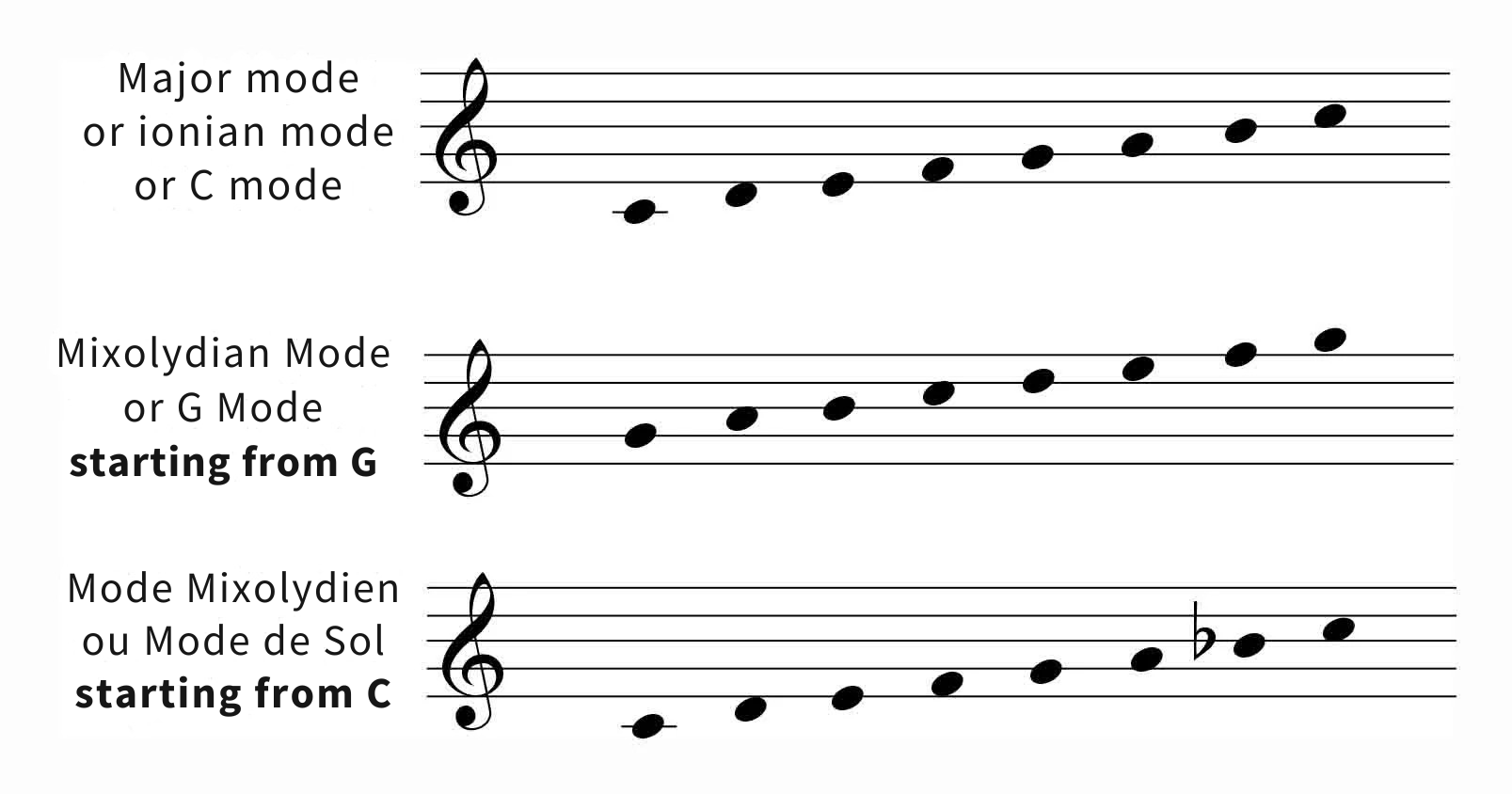
The Mixolydian mode is frequently used in Bulgarian music, likely due to the use of instruments like the gaida or the zurna, originally designed to play diatonic modes. The most straightforward term is to call the Mixolydian mode the "G mode," or the mode of the fifth degree, that is, in C major, the scale derived from G. From a harmonic perspective, it can also be referred to as the "major 7" scale, corresponding to the principal scale that can be played over the dominant seventh chord.
Mode plagal
This refers to a Gregorian musical mode derived from an authentic mode and beginning a fourth below it. Plagal modes are derived from the four authentic modes of the Octoechos and are numbered as even-numbered modes: Hypodorian (2), Hypophrygian (4), Hypolydian (6), and Hypomixolydian (8). Their range begins a fourth below the fundamental, and their tenor (dominant) is either a third above (modes 2, 6) or a fourth above (modes 4, 8). Formally, they correspond respectively to the ranges of the Aeolian, Locrian, major, and Dorian modes, except that their fundamental is not the tonic but the fourth.
Modes diatoniques
Today, when we talk about modes in Western classical music, we are referring to what are commonly called "diatonic modes." These correspond to the seven modes built from each note of the diatonic scale. They can be named either using medieval and Renaissance terminology with words of Greek origin, or by their first degree.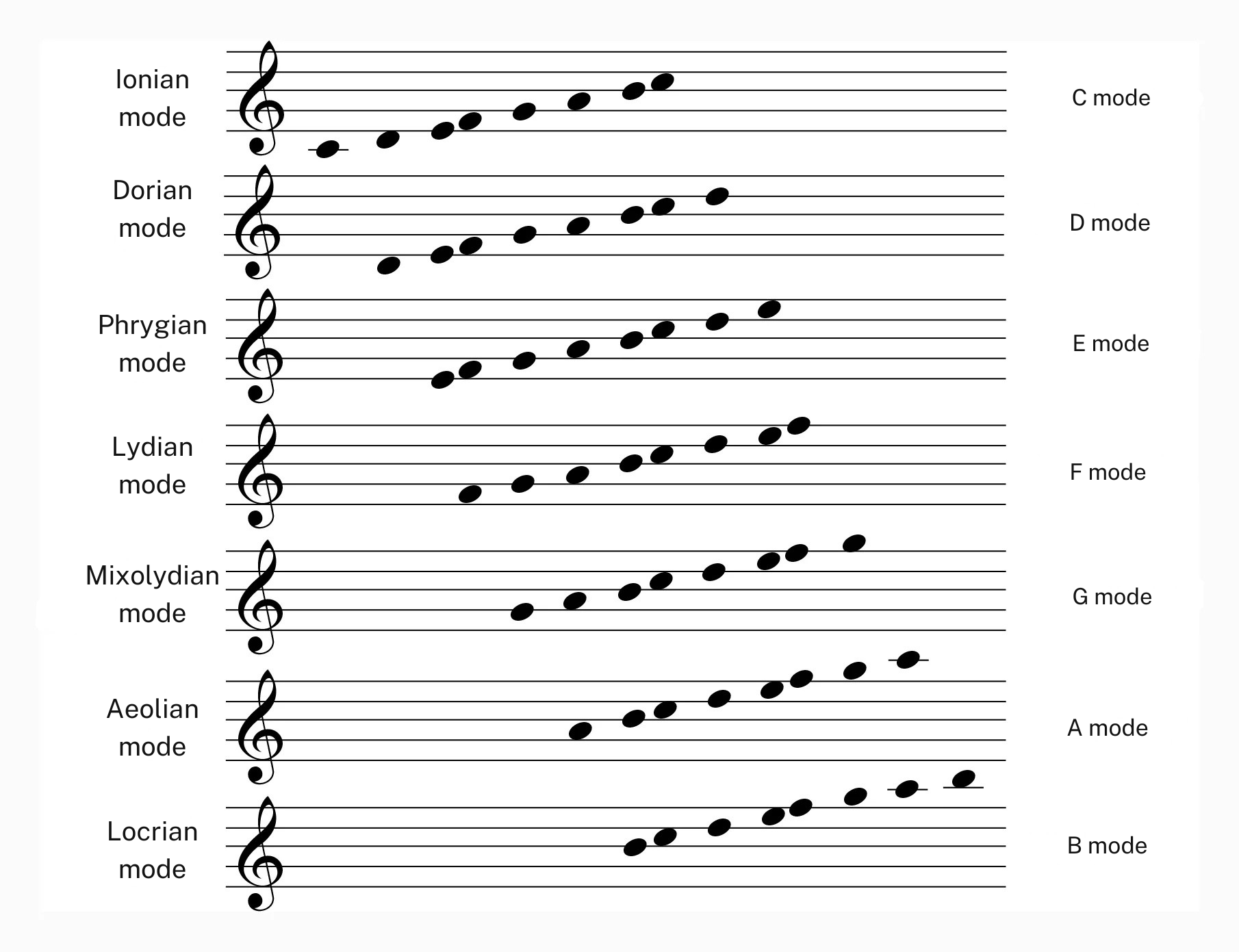
Modulation
The meaning of the term modulation is not exactly the same in modal music as in Western tonal music. In so-called makamic music or in traditional Western folk music, modulation refers to the use of degrees different from those of the basic scale (major second then middle second, for example) or the shifting of the root note (tonic). In tonal music, modulation consists of moving from one key to another, and not necessarily from one mode to another, contrary to what the terminology might suggest.
Musique carnatique
Music of South India. Musical system governing and theorizing the music of South India. Unlike North India, the classification of modes is not based on 10 thaat (fundamental modes), but on 72 melakarta (fundamental musical scales) classified logically.
Musique hindoustani
Classical music of North India.
Musique non tempérée
Music in which the use of temperament is not essential. Note that music using unequal temperaments should not be classified as untempered.
Nuances
From pianissimo to fortissimo via mezzo forte. A term that gives the musician an indication of the variations in intensity (volume) of sounds when played on a musical instrument.
Pentatonique
(scale) A pentatonic scale (from the Greek penta = 5) uses 5 degrees (notes) within an octave. Example: C Eb F G Bb C; or C D F G A C.
Plagal
See also authente. The term plagal is defined in relation to the term authente. These terms originate from plainchant (sacred chant for one voice in the Roman Catholic liturgy). Today, when these terms are used to describe other modal music, for example the popular music of France, we could say: "which are similar to the authente and plagal forms": - the authente form starts from the final, what we now call the tonic, but which, to complicate matters, can descend by one degree; Thus, the mode of D, which normally extends from D to D, can descend to C—the plagal form starts a fourth below. The name is preceded by "hypo," for example, if the authentic form is the Dorian mode (from D to D), the plagal form will be the Hypodorian mode, which extends from A to A. (According to Alain Lefébure, "Les anciens modes d'église,"
Polarisation
The emphasis on a note around which the musician revolves: the note is at the center, but without necessarily being played extensively itself. The polarized note is thus the center, more or less explicit or implicit, of a space in which one moves, in a way comparable to the solar system where a planet and its moons move.
Polka
A ballroom couple's dance, adapted by Parisian dance masters based on possible Central European (Bohemian) antecedents. It enjoyed explosive popularity in 1844, spawning a host of other similar dances, often drawing on Slavic influences (real or imagined). Like the waltz, it then spread rapidly throughout the provinces and among the working classes.
Quarts de ton
Intervals derived from dividing the octave into 24 quarter tones. This system may have aimed, particularly in Egypt (Cairo Congress, 1932), to rival the 12 semitones of Western equal temperament. This division, finer than the 12-semitone system, remains an approximation compared to the subtle richness of intervals used in modality. The use of successive quarter tones is virtually nonexistent in modal music; moreover, some of these 24 quarter tones are never used (for example, the fifth plus a quarter tone, or the fifth minus a quarter tone). Quarter tones are sometimes used in contemporary music.
Raga
The raga refers to the melodic universe of the Indian classical musical system. Each raga is defined by: - an ascending (āroha) and descending (avaroha) scale, sometimes different; - dominant notes called vādī (speaking) and samvādī (co-speaking); - a hierarchy in the importance of the notes; - characteristic movements (calan) and melodic phrases (pakaḍ). Each raga is also associated with a time of day (prahar) or a season, as well as a dominant feeling (rasa). A raga is presented as a musical entity endowed with its own personality and character.
Raga heptatonique
Raga using the seven notes of a scale in both ascending and descending directions. North Indian ragas are described according to their jati – caste – depending on whether their ascending and descending scales are pentatonic (audhav jati), hexatonic (shadhav jati), or heptatonic (sampurna jati). Thus, a raga that is pentatonic ascending and heptatonic descending is called audhavsampurna jati. There are a few rare ragas whose scale has fewer than 5 notes: Gorakh Kalyan, whose ascending tetratonic scale (surtar jati) is called surtar-audhav jati.
Scottish
Launched in 1849 in Paris, this dance, related to the polka, is believed to have originated in Germanic countries (the spelling used in France until the beginning of the 20th century was "schottische"). Its repertoire in traditional music includes the recycling of older tunes.
Sho’be
In Azerbaijani classical music, this refers to a long, intermediate, or secondary, modulation or maqam. The term sho'be literally means "annex." See also gushe, âvâz, dastgâh.
Solmisation
The act of naming musical notes with syllables, such as do, re, mi, etc., or in Indian music (sargam): sa, re, ga, etc. Another example is the system used by several musicians (for example, Nando Aquaviva, Thierry Robin, Erik Marchand – link to the Erik Marchand notation system): 1, 2, 3, 4. The Kodály system, on the other hand, uses a movable-scale solmization system. Solmization is relative when it does not refer to absolute pitches: in the solfège of Western classical music (do, re, mi, fa, etc.), solmization is not relative, since the syllables refer to the pitches corresponding to a specific key on the piano, in relation to the tuning fork.
Syllabique
(song, melody) A type of singing in which each syllable is carried by a single note. In traditional French singing, however, in several regions, syllables may be carried by two or three notes (melisma). In melismatic singing, a syllable may carry several successive degrees of pitch.
Tahrir
In Iranian music, this is a vocal melisma without text, which, although it has ornamental value, is nonetheless fundamental in the appreciation of a singer and, for the classical repertoire, essential to its interpretation. According to Jean During (liner notes for the album *Les Voix du monde. Une anthologie des expressions vocales*, vol. II, Musée de l’Homme - CNRS, 1996), “The vocal melisma of classical Persian music is distinguished by two features, one technical, the other aesthetic. The notes, which follow one another rapidly and are often doubled or tripled, are attacked with an appoggiatura situated approximately a fourth above and sung with a different vocal timbre. This vocal technique is sometimes close to yodeling, with a very brief passage in head voice; at other times, the appoggiatura is sung with the same vocal delivery as the melodic line. The first technique is called "the nightingale" (bolboli), the other, when it is heavy and hammered, is called "the hammer" (tchaqoshi). Between these two extremes, there are nuances that have not been classified or studied. However, it is clear that the tahrir technique is specific to classical singing (or popular urban) Persian and (with nuances) Azerbaijani; it is also found among some Iraqi singers whose style is linked to a great multicultural tradition stretching from the Caucasus to Baghdad”.
Taqsim ou taksim
Taksim (in Turkish) or taqsim (Arabic and Persian) is a solo improvisation. In maqam music, modal improvisation, taqsim (literally: "division, fragmentation, distribution," plural taqasim), constitutes a major genre, that of individual improvisation. Generally in the Near East (except in Ottoman music), the term taqsim also refers to an improvised and unmeasured instrumental piece; in the case of a measured improvised instrumental piece, it is called taqsim muwaqqa'. The different forms of vocal improvisation are named according to the poems being performed (layali, mawwal, qasida, etc.). In Ottoman music, taksim designates a vocal or instrumental improvisation. Different variants are distinguished according to the repertoires and regions; for example, taqsim muwaqqa' can also refer to free singing over a rhythmic background.
Tasnif
In Iranian music, a tasnif is a classical song.
Tempérament
A way of adjusting the pitches of a musical scale.
Tempérament égal
Widely accepted as the standard for Western art music and its derivatives since at least the 19th century, equal temperament tends to divide the octave into 12 equal semitones. Equal temperament was politically chosen, with adaptations, as is the case with many modal musics around the world.
Tempérament inégal
Any temperament other than equal temperament.
Tétratonique
A tetratonic scale (tetra= 4) uses 4 degrees.
Thème
“A theme is a melodic, rhythmic, or melodic-rhythmic motif, sometimes harmonic, sufficiently distinctive to be easily recognizable, and sufficiently rich to be developed, varied, transposed, or transformed.” Source: Encyclopaedia Universalis, article “Thème, Musique”.
Ton (breton)
(plural tonioù) A tune, a musical theme that can carry different kanaouennoù (songs, poems).
Tonalité
The key of a piece of music is defined by its tonic (or fundamental) and by a specific color given by the mode. According to Jacques Siron: “Key is based on the existence of a principal sound, the tonic, which maintains dynamic relationships of proximity or distance with other sounds. In the major-minor tonal system, the number of modes has been reduced to two.” (The Inner Score. Jazz, Improvised Music, Paris: Outre Mesure, 2001 (5th edition), p. 367)
Tonique
see also fundamental. First note of a scale or mode, establishing the reference degree.
Tradition
A musical style supported by a set of rules or codes, stated or unstated, in which music-loving listeners find themselves.
Valse
A ballroom dance of Germanic origin, stemming from the "Deutscher Tanz" and the "Ländler" at the end of the 18th century. Its position, in a closed couple, was sometimes shocking at the time. Its popularity truly began in France at the beginning of the 19th century, and it subsequently gained widespread acceptance. Like other ballroom dances adopted in popular and regional dances, its musical repertoire includes a number of recycled melodies from various sources.
Zarbi
In Iranian music: a measured instrumental piece.