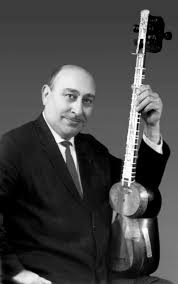
A tar performance of the mugam Isfahan by Bahram Mansurov of Baku, recorded for Azerbaijani television in the late 1970s and released on DVD around 2010.
In Azerbaijan, as in Iran, modality is embodied by the concept of mugam.
What is a mugam?
Mugam (also spelled mugham or muqam in Azerbaijani) is the equivalent of maqam in Arabic, makam in Turkish, and avaz in Persian. It is a modal structure consisting of a scale (not necessarily an octave), a hierarchy of degrees with specific functions, but above all, obligatory motifs, directions for development, and possibilities for modulation. When developed through modulations (called shu'be), the mugam becomes a dastgah, a system.
A dastgâh is a maqâm that develops by integrating intermediate or secondary maqâms (sho'be and gushe in the Azerbaijani system, âvâz and gushe in the Iranian system). This term appeared in Persia around 1800, replacing the term 4 shadd, and was later extended to 12 and then to 7 + 5 âvâz.
Mugam also refers to the art or science of mugam, that is, Azerbaijani classical music, which we propose to write with a capital letter in French.
Presentation by Jean During of the mugam recording Bayati Isfahân and the musician Bahram Mansurov
Introduction: Introduction or därämad / maye, fundamental modal "substance"
Intermezzo: Instrumental intermezzo or reng, a classical form inspired by dance tunes, timed 6/8
Gushe Mowlavi: Gushe Mowlavi, a melody in poetic meter.
There is a strong polarization on the G (5th degree). In a second, almost obligatory phase characteristic of this mugam, it is the A (6th degree) that is polarized, then the instrument moves up an octave.
The Isfahan Mugam's scale can be notated as follows: D E F# G A Bb C D Eb
1 - 1 – ½ - 1 – ½ - 1- 1 – ½
These notes follow Azerbaijani solfège conventions, but in practice, the instrument is tuned approximately 150 cents below standard pitch. The third degree of the scale (E) is very prominent and acts as a stopping note at the end of a phrase. The E "half-flat" is raised and approaches or reaches the harmonic E (5/3) relative to C. At the very beginning, one hears the pattern D-Eb D-Eb > G.
The Isfahan is a small mugam, not suited to extensive development. Azerbaijani Isfahan is likely a borrowing from the Persian modal repertoire, dating back to the mid-19th century. The Azerbaijani school can be considered, in part, a branch of the Persian school.
For reasons that remain unclear, the technical name of this mode is Bayât-i Isfahan (Turkish pronunciation of Bayât-e Esfahan), perhaps alluding to a connection with the maqam Bayât.
Azerbaijani scholarly tradition distinguishes 12 principal modes (mugam) and 10 secondary ones, but other classifications are also accepted. In addition to these, there are a number of smaller mugams, generally played within the context of a larger mugam.
These major mugam are called dastgâh (“systems”) when they incorporate a number of secondary mugam, sho’be, or gushe.
Any mugam can serve as a model for modal compositions such as songs (tasnif) and measured melodies (räng, däramäd).
A mugam has a maye, or fundamental modal “substance,” and “aspects” (sho’be, “additions,” or gushe, “corners”) that appear during its development. There are approximately 150 of these melodic types (sho’be or gushe), each designated by a name.
In B. Mansurov's repertoire, Isfahân can be extensively expanded by incorporating the following sequences (sho'be): Bardâsht, Gardâniye, Nashib o Faraz, Isfahânak, Bâyât-i Isfahân, Nahoft, Hâjiâni, Nâle-i zambur, Ma'navi, Pahlavi, Bâyât-i Kurd, Qatâr, Bâyât-i 'Ajam, Gabri, Bâbâ Tâher, Arménieri, Abol Chap (or chasb), Bâyât-i Shirâz, Khâvarân, Uzzâl, Dilrubâ. However, this list appears to be entirely theoretical, as in practice, this mugam (religious group) is not very extensive.
The difficulty of improvisation lies in developing coherent motifs based on short melodic-metric formulas; these formulas have no name. Lacking inspiration, one simply strings together, more or less freely, a few sho'be, each freely interpreted.
Presentation of the characteristics of the Isfahan mugam by Jean During
The specialist in the tradition in question: Jean During's perspective
This piece was chosen because it exploits a very limited modal space, a characteristic of ancient Azerbaijani and Persian styles.
Compared to current trends, the performance is not virtuosic, partly due to the musician's age, but also because the ancient style did not demand displays of virtuosity, and because this is a teaching model.
The musician plays standard versions that the students can learn almost verbatim. However, during the performance, he allows himself some room for interpretation.
Introduction to the Musical World of Mugam Bayati Isfahan
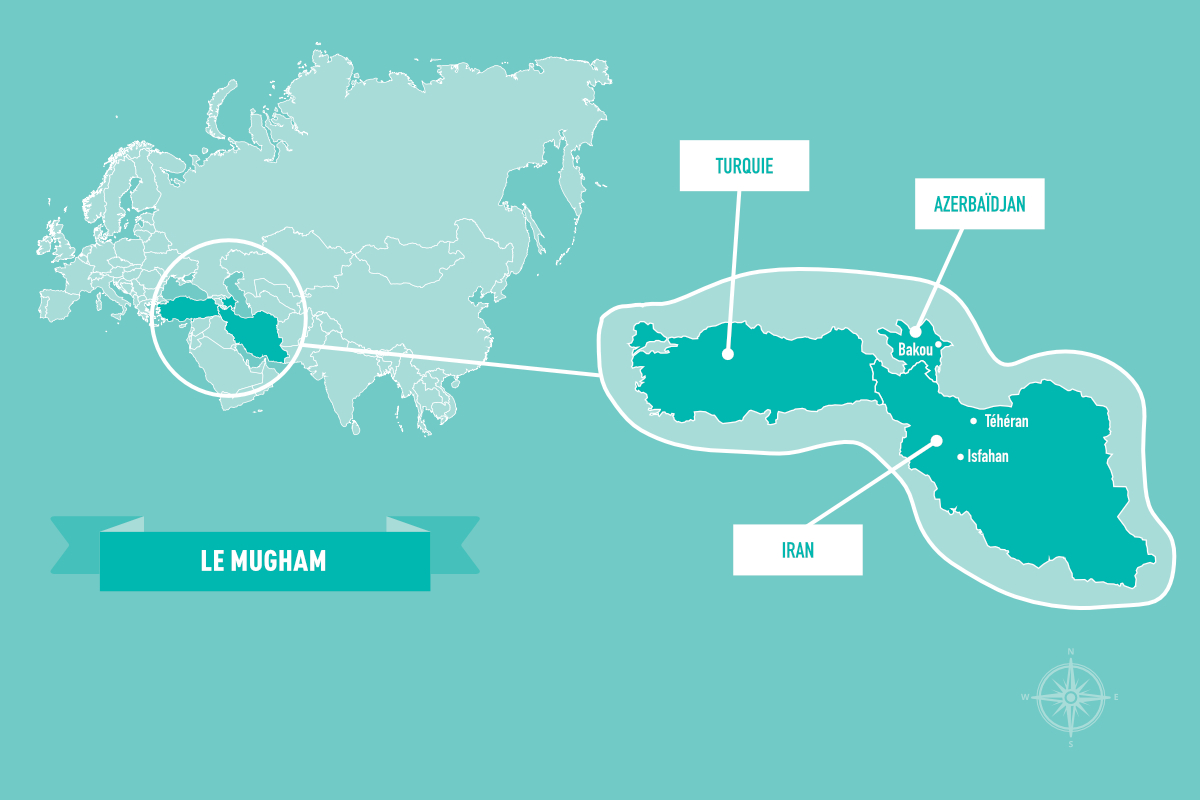
Azerbaijan refers to a large province in western Iran, and the Republic of Azerbaijan (a former Soviet republic) has been fully independent since 1991.
The musical cultures of both parts of this region share many common elements, but in the classical realm, the mugam (maqam, modes, dastgah) of the Azerbaijani school distinguishes itself from the Persian school through its style and modal choices.
The mugam uses (at least for the past century) more intervals closer to the Western tempered scale, while the Persian system is linked to that of the Arabic, Anatolian, and Turkish maqams. However, for the past few decades, musicians have been working to rediscover the ancient intonations.
Overall, classical music in the Republic of Azerbaijan belongs to a family that includes Iraq and Iran. This family includes performers from diverse nations: Turks, Iranians, Arabs, Armenians, Jews, and Kurds, among others.
Isfahan is a maqamname found in Turkey, the Near East, and the Maghreb, in various forms. It is mentioned in treatises dating back ten centuries. The Persian and Azerbaijani forms are very similar, except for one degree of the scale: E natural (third degree) vs. E "half-flat" (lowered third degree) in Iran. In Azerbaijan, it is known only to experts, while in Iran it is very common.
In the Maghreb, Esfahan (Isfahan) takes a different but sometimes similar form.
In Rodolphe d'Erlanger's work, La musique Arabe (volume 5, 1949), the maqam Neyshaburak (another Iranian city) presents certain similarities with the Persian avaz Esfahan, but with a natural E.
In the ancient Persian version, the F-sharp must be lowered, but without reaching the "half-sharp," and must be vibrated, trilled a quarter step higher. Nowadays, few Iranian musicians take this particularity into account. However, this feature is respected by Bahram Mansurov.
Introduction by Jean During
To delve deeper: discover other interpretations of the Maqam Isfahan
Compare this interpretation with:
- The one very close to that of Elkhan Mansurov (son of Bahram Mansurov), in – Azerbaijan – Traditional Music, Le Chant Du Monde – LDX 274 901, 1989 (recording and booklet by Jean During).
Interpretation of the Maqam Isfahan by Elkhan Mansurov, son of Bahram Mansurov
- The very personal one by Malik Mansurov, taken from the CD: The Dastgâhs of Azerbâijani Music. The Art of Muqam, Interpreted and performed by Malik Mansurov, Tehran, Mahoor, 2016.
Interpretation of the Isfahan Muqam by Malik Mansurov
- The Persian version, freely interpreted but very classical, by Dariouche Tala'i (Ocora, 1991, recorded in 1975).
For further exploration, a related work: Maqam Dastgâh Homâyun
References :
- Jean DURING,1988 La musique traditionnelle de l’Azerbayjan et la science des muqams, Baden-Baden, V. Koerner Verlag,.
- 1989, “The Modal System of Azerbaijani Art Music: A Survey”, Maqam, Raga, Zeilenmelodik: Konzeptionen & Prinzipen des Musikproduktion, ed. J. Elsner, Berlin, p. 133-45.
- 2011 The place of the Azerbaijani Mugham in its Caucasian and Iranian environment, Baku, 2011 Proceedings of international musicological symposium "Space of the Mugham", 18-20 mars 2011.
- 2019 “The Intervals of the Azerbaijani Mugam: back to the sources”, Article en ligne sur [Academia.edu].
- Sasan FATEMI 2011 ‘La musique classique en fête : Le cas du muqâm azerbaïdjanais’, RTMMAM no 5 ( :76-95)
- Aida HUSEYNOVA, Music of Azerbaijan: From Mugham to Opera, Indiana Univ. Press, 2016
- Inna NARODITSKAYA, Song from the Land of Fire: Continuity and Change in Azerbaijanian Mugham, New York – London, Routledge, 2002