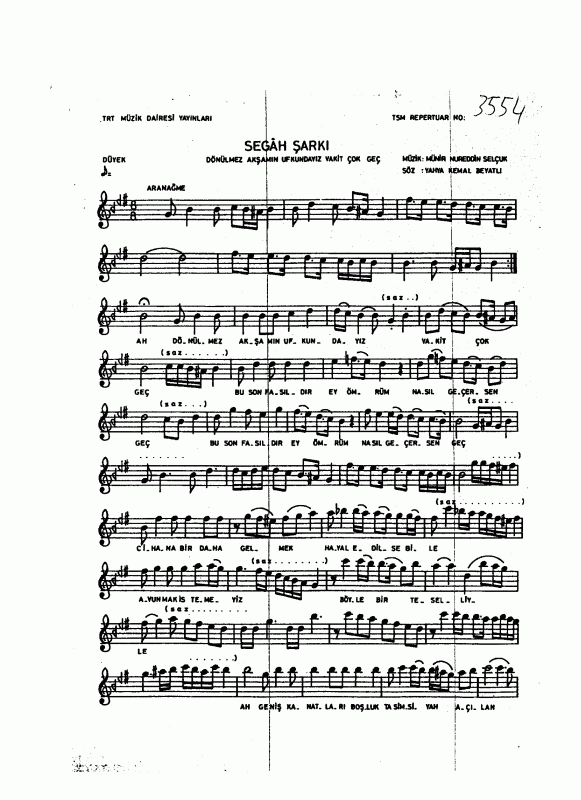
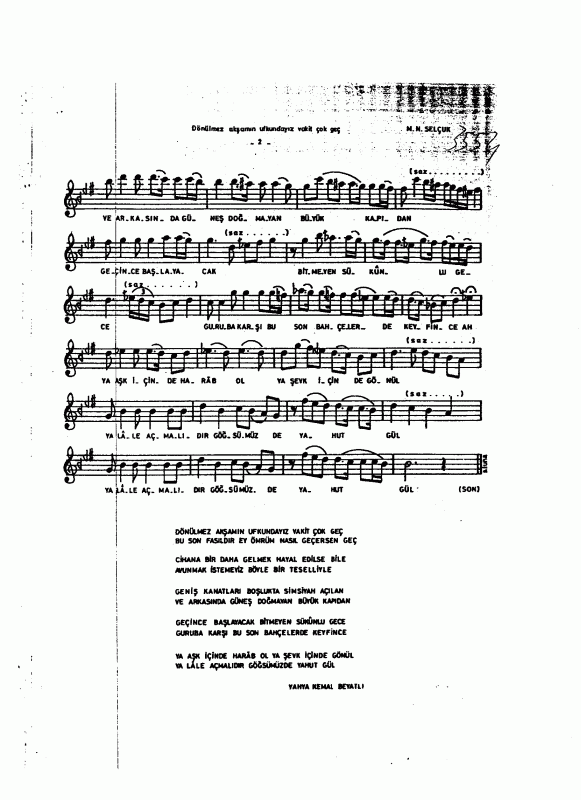
To listen to and understand the Ottoman makam, Serdar Pazarcıoğlu performs here the song (şarkı) "Dönülmez akşam ufkundayız vakit çok geç" ("At the edge of the irreversible evening, it is already late") in the Segah makam. This piece was composed by Münir Nurettin Selçuk, a singer and composer active on the Istanbul music scene from the 1920s onwards, to a poem by Yahya Kemal Beyatlı.
Recorded on octobre 2020, © Serdar Pazarcıoğlu

Segah Şarkı
"Dönülmez akşam ufkundayız vakit çok geç" in the Segah makam by Serdar PazarcıoğluRecorded in October 2020, © Serdar Pazarcıoğlu.
Introduction to Ottoman maqam
In the Ottoman tradition, the term makam refers to the modal system used in classical music, as well as its various components. Without going into detail here, it's important to know that the term makam (ou maqâm) has other meanings in neighboring traditions.
The makam that developed in Istanbul is the result of the convergence of Turkish, Arabic, Persian, and Byzantine traditions. It possesses a whole vocabulary in Persian that describes a reality specific to this Ottoman culture, which must be distinguished from its Persian or Azerbaijani counterparts, although their historical origin is shared.
It should be noted, however, that within the Ottoman tradition itself, the same name, for example rast, can designate three different things (we will retain this threefold spelling throughout the analysis):
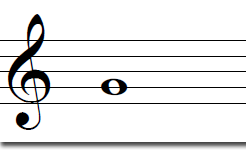
- the RAST degree:
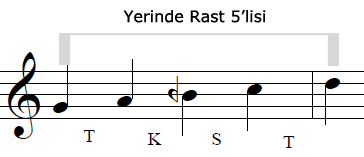
- the rast pentachord (NB: yerinde means that it is here in its "original," untransformed form):
- The makam Rast :
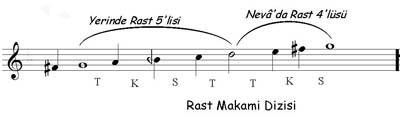
Thus, RAST can be said to be the first degree of the first rast tetrachord that makes up the makam Rast.
The Degrees in Ottoman Makam
Here is a table summarizing the names of the degrees within the two octaves in which Turkish makam unfolds:
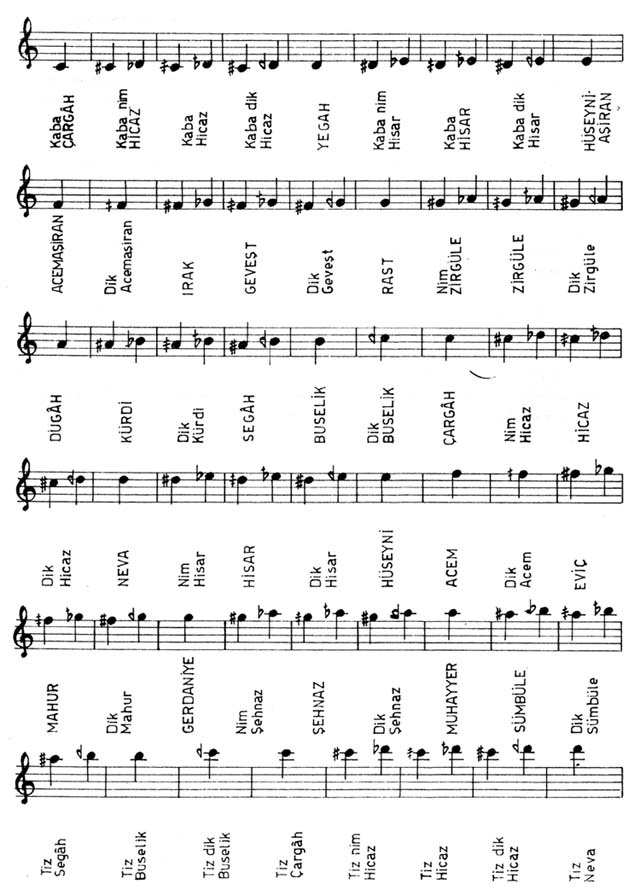
The degrees (perde, pl. perdele) in Ottoman makam
Transposition et notation des degrés et intervalles
In this study, we prefer to use traditional vocabulary because it allows for easy navigation within the musical space while avoiding problems related to transposition. Indeed, depending on the singers' vocal range, the entire system is transposable; thus, RAST remains RAST even a tone lower.
It seems necessary here to review the notation. Ottoman music has been written for a century using Western notation thanks to a set of additional symbols. The notes are most commonly named DO RE MI etc., except when there might be doubt about the nature of the note, in which case we immediately switch to their vernacular names.
Intervals in the Ottoman Makam:
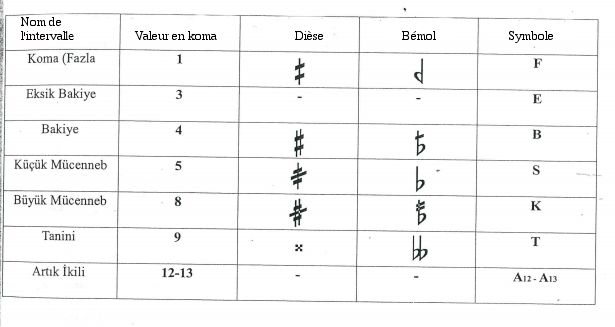
It should also be noted that the pitches do not necessarily coincide with the Western reference frame. Thus, the main transposition of instrumental music, the bolahenk, is transposed a fourth lower; therefore, RAST, written as SOL, is heard as RE (293.7 Hz).
Similarly, if transposed to süpürde (a whole tone lower), RAST will still be written as SOL but heard as DO (261.6 Hz).
How the Makam Works
The makam ("place" or "space" in Arabic) as a system is an open-ended collection of several makam (in the sense of modes). It becomes audible through movement within and between these different spaces.
These modes are characterized by their scale (dizi) but especially by their seyir, a melodic development specific to each. Thus, two makams of the same scale constitute two distinct makams if one begins its progression on the root and the other on the fourth.
Let's take Uşşak and Beyati as examples:
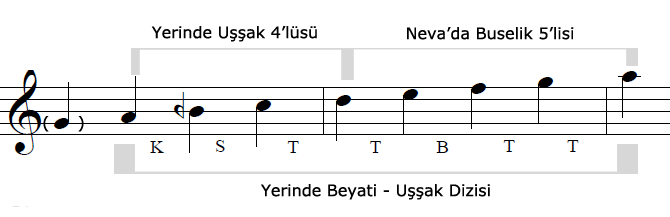
The workings of the makam. Practical illustration on the Uşşak and Beyati scale by Ruben Tenenbaum (recorded in October 2020, © R. Tenenbaum)
Uşşak begins its progression around the root, then ascends to the fourth and descends again. It is said to be ascending.
While Beyati begins directly around the fourth and descends to the tonic. It is said to be ascending-descending.
These developmental zones are structured around polarized notes, which are also the point of junction of the trichords, tetrachords, or pentachords contained within the makam. Indeed, if we break down the Uşşak and Beyati scale, we find a tetrachord of uşşak and a pentachord of buselik, both structured around the fourth.
Thus, the scale of a makam can be understood as the sum of a tetrachord and a pentachord, which are themselves limited in number.
The theoretical description using tetrachords is the most widespread. It is quite functional, and all makams have been described in this way. However, this structure should not obscure the fact that within this framework, we find motifs that allow us to identify makams and more precise melodic patterns, which are less frequently verbalized.
Segah Şarkı - Dönülmez akşam ufkundayız vakit çok geç
In the title of this piece, Segah Şarkı Dönülmez akşam ufkundayız vakit çok geç, we find a first level of information that reveals the makam, in this case Segah, and the form, şarkı, which designates a song (or a lied).
Then comes the first verse of the poem, which distinguishes it from the hundreds of other Segah Şarkı.
The Segah makam
Segah is said to be ascending, because it begins its development on the root note and must rise to develop.
Its root (karar) is SEGAH and the subtonic (yeden) is KÜRDI. It is composed of the trichord of segah on the SEGAH degree and the tetrachord of rast, which alternates with the tetrachord of buselik on the NEVA degree:
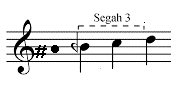
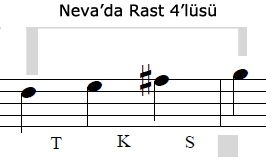
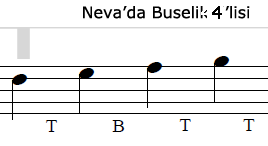
The first phase of development revolves around the SEGAH degree, polarized between RAST and NEVA.
The polarisationthen shifts towards NEVA with the alternation between rast and buselik, before finally returning to SEGAH, which is reinforced from below with KÜRDI.
Makam Segah, explained in practice by Ruben Tenenbaum (recorded in October 2020, © R. Tenenbaum)
The usul (rhythmic cycle) used is Duyek:
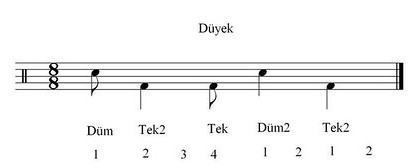
Dönülmez akşam ufkundayız vakit çok geç :
This musical piece was composed by Münir Nurettin Selçuk, a singer and composer active on the Istanbul music scene from the 1920s onwards.
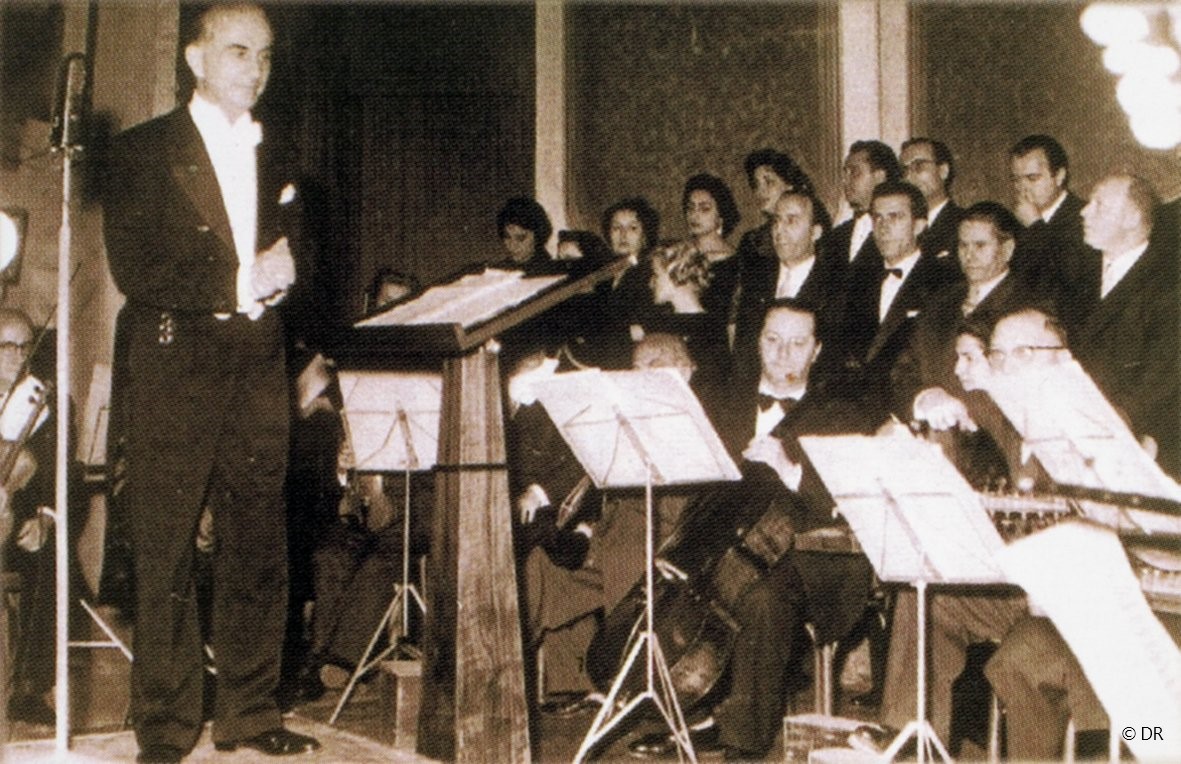 Münir Nurettin Selçuk in concert © DR
Besides his early, acclaimed recordings, Münir Nurettin Selçuk is known for his influence on Western classical music, particularly for introducing choirs into Turkish music (today, many choirs are still active throughout Turkey). He is also credited with the first solo concert, singing in tails in front of the orchestra, whereas traditionally the singer was part of the ensemble.
Here he composed on a poem by Yahya Kemal Beyatlı, the first verse of which gives the name to the musical piece:
Modal Analysis of Segah Şarkı - Dönülmez akşam ufkundayız vakit çok geç
We have a solo version by Serdar Pazarcıoğlu, and another for an ensemble where he is joined by Samet Pazarcıoğlu on clarinet, Sadullah Hepgüler on kanun, Erdal “Eco” Ercan on darbuka, and Serkan Aktaş on vocals. This version of the piece by Serdar Pazarcıoğlu and the ensemble was recorded in October 2020.
We offer a comparative modal analysis of these two versions, first the ensemble version and then the solo version, by breaking down their development.
Modal Analysis of the Ensemble Version
Aranağme - Introduction - Measures 1-6
A kind of condensed version of the Segah makam, measures 1-2 revolve around the Segah scale over a Rast-Neva range. The upper section is explored with a half cadence (yarım karar) on Neva in measure 4, followed by a descent to the tonic and a cadence (tam karar) on Segah.
Song - Phrase 1, mm. 7-11
Focusing solely on the Segah scale. The first section relates to Rast, followed by a stabilization of the cadence supported by the yeden (subtonic) Kürdi.
Song - Phrase 2, mm. 12-19
Focusing on the third, Neva. We observe the mobility of the fifth, which alternates between EVIC and ACEM (FA#/FA♮) to form the tetrachords rast and buselik respectively on NEVA.
Song - Phrase 3, mm. 20-23:
The instrumental response, Saz payı, recalls the first part of the aranağme, concluding on SEGAH and introducing a Segah motif on EVIC (in practice, we would say that we have modulated to Evic, even though the entire makam is not expressed). We enter the modulating section of the piece, called meyan.
Song - Phrase 4, mm. 24-27:
Segah on EVIC in the first two bars, then the introduction of SÜMBULE, which adds color without actually presenting an existing makam; this is the diminished tetrachord of segah (eksik dörtlü). Saz payı forms a half cadence on EVIC.
Song - Phrase 5, mm. 28-35:
From measure 28, emphasis on the GERDANIYE scale leading to the Mahur makam. The same pattern continues in the instrumental section up to measure 35, which ultimately concludes with a Segah motif (çeşni) on the octave (TIZ SEGAH).
Song - Phrase 6, mm. 36-43:
The music meanders in the Segah register in the upper register. Concludes on EVIC.
Song - Phrase 7, mm. 44-48:
Emphasis on GERDANIYE leading to Mahur (mm. 44). Introduction of the Hicaz tetrachord on NEVA (mm. 45), then Hicaz on GERDANIYE, reminiscent of the upper part of the Hicazkar makam:
Song - Phrase 8, mm. 49-55
The ACEM and KÜRDI appear, introducing Kürdilihicazkar, and the rhythm stops in measure 51.
Variation from the solo version in measure 53: in the solo, Serdar Pazarcıoğlu already introduces the EVIC degree, which will allow the return to Segah; whereas here, he arrives directly in the following measure with Segah.
Song - Phrase 9, measures 56-63
Landing phrase in Segah towards the conclusion. The singer makes a slight variation that leans towards Hüzzam in the first instance. Hüzzam is close to Segah, but it presents a tetrachord of hicaz on NEVA.
Song - Phrase 10
Repetition of the first verse and concluding section.
Scores
In addition, here are the published scores of this composition: