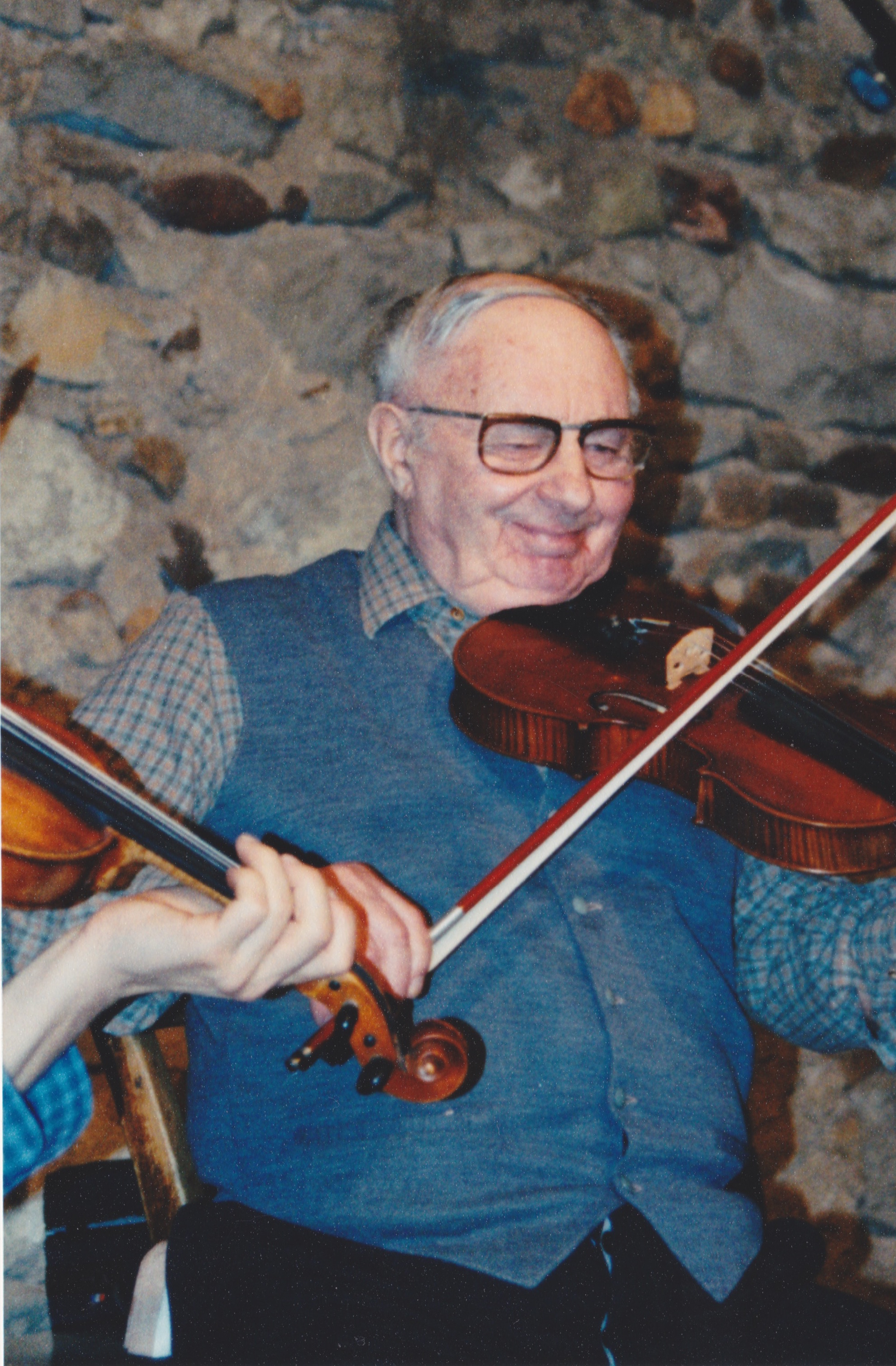
Joseph Perrier (1911-2003) was a renowned fiddler from Champs-sur-Tarentaine , a commune in Cantal located on the edge of the Artense plateau , above Bort-les-Orgues.
He worked there as a carpenter and farmer , but had a significant musical activity at different periods of his life, playing at many balls, weddings and various events. The last period of this career, from the 1970s until his death, was largely spent in the company of many young "revivalist" musicians, attracted both by his great musical qualities and by the warmth of Joseph's welcome, and particularly that of his wife Germaine.
In the teeming and multicoloured world of the popular violin of Artense, Joseph stood out for his inimitable, clear, powerful and vibrant sound, as well as for his ability to assimilate and stylise a varied and very extensive repertoire . Thus, under his bow we find many local bourrées from Artense, sometimes from the repertoire of his father or uncle, who were also fiddlers, but also Viennese or musette-style waltzes, all sorts of tunes from "Auvergne folklore" or more recent compositions called "neofolklore", as well as tunes from old traditional songs, notably the tunes of revelhets (or "éveilez", quest songs from Holy Week).
Until the end, Joseph remained eager to learn new tunes. Thus, his repertoire bears the trace of his various musical companionships, from the tunes of "brilliant dances", a legacy, with a "classical" influence, of his mentor Joseph Rivet (1899-1966), to the final encounters with the young fiddlers from elsewhere that we were in the 1990s .
His violin technique was extensive, including frequent démanchés, very characteristic glissés and vibrés, varied and very controlled bow strokes: tied playing "en coule" on certain bourrées, very precise détachés and martelés, incisive attacks, contrasts between ample notes and rapid détaché. Like most fiddlers, Joseph played his entire repertoire in the key of D, and in G for a few tunes.
In his playing, we can note the expressive use of intonation nuances (micro-intervals), particularly on the third and fourth degrees of the scale . The variation of the fourth degree (more or less raised by attraction of the fifth degree) often takes place as a nuance, without fundamentally altering the very major modal color of his repertoire. On the other hand, in a certain family of melodies, mainly bourrées from the local repertoire (including those that are the subject of this study), oscillations of the third degree lead us into a more confusing terrain for the modern ear. These variations in the position of the index finger, often during the same melody or between two interpretations of the same tune, install an ambiguity between major, minor, and intermediate value (sometimes called "neutral" third). These colors are not an isolated phenomenon, because they can be found in other fiddlers and singers of the Artense, and well beyond.
Joseph Perrier has been recorded and filmed very often. He can be heard on the vinyl " Violoneux et Chanteurs Traditionnels en Auvergne " (33 rpm Chant du Monde 1977), the box set " Cantal: Traditional Music " (2 audio cassettes AMTA 1991) and especially the cassette " Music of the Canton: Champs-sur-Tarentaine " (audio cassette AMTA 1987). A filmed portrait of Joseph was made by Luc Roche " Joseph Perrier: Violoneux de l'Artense " (VHS Héritage Production - AMTA 1995), and he also appears in the film "Des violons en sabots " by Francis Lapeyre (DVD L'Harmattan 2013). Some of these publications are difficult to find today, but many audio recordings can be consulted on the Interregional Oral Heritage Database .
Text: Jean-Marc Delaunay
Photo credits: Alain Barse, 1995, Association Les Brayauds - CDMDT63. Violin meetings at Gamounet, 1995.