Association DROM
24 rue de Gasté
29200 Brest
09 65 16 71 21
recherche@drom-kba.eu


Educational portal for Modal Music

France

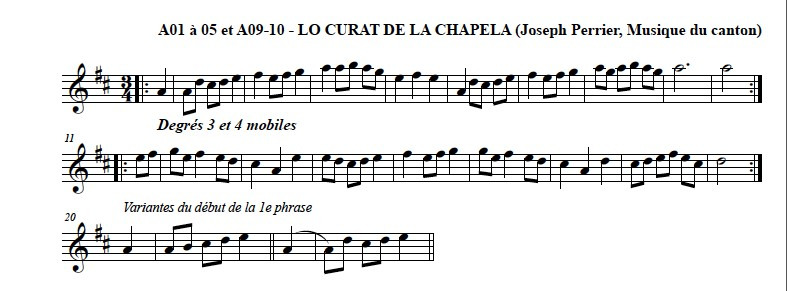
Lo curat de la chapela

  • Genre :
    Dance music
  • Tradition :
    Massif central
  • Piece name:
    Lo curat de la chapela
  • Specifics:
    Bourrée in triple time, instrumental dance tune


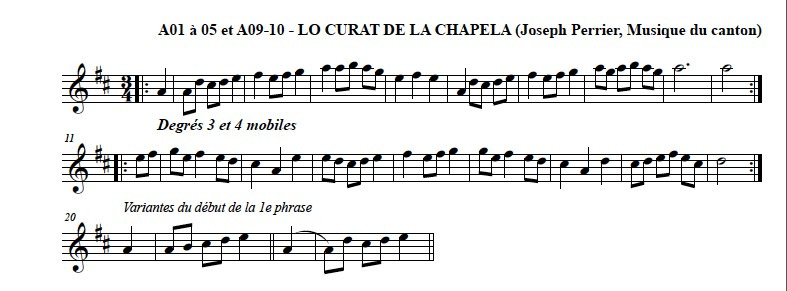
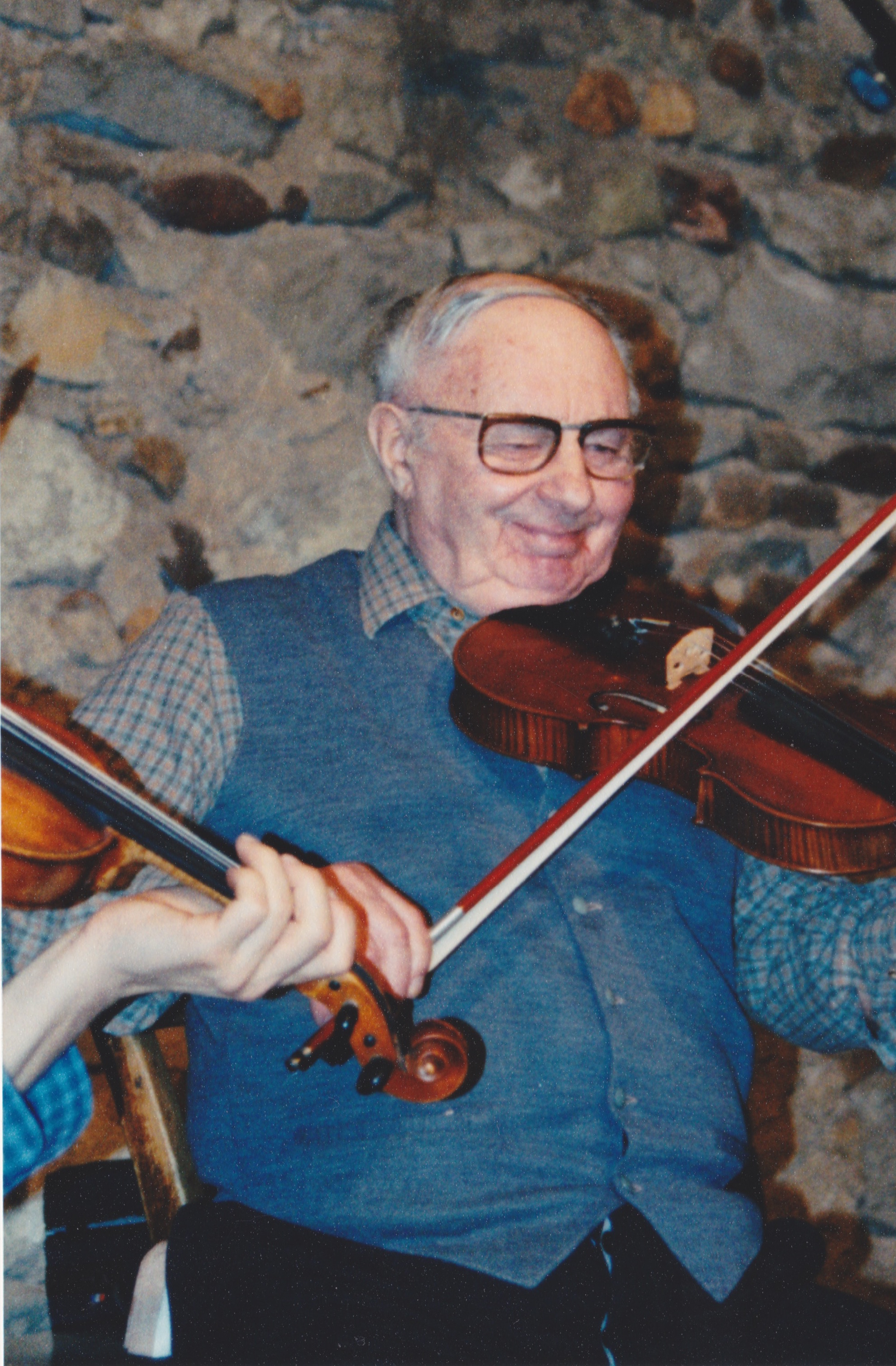
Lo curat de la chapela, "The priest of the chapel", bourrée played in three-time on violin by Joseph Perrier.
Recorded in Pérol, town of Champs-sur-Tarentaine, Cantal, circa 1986, by Eric Cousteix.

Originally published in the audio cassette «Musique du canton – Champs-sur-Tarentaine» (AMTA 1987), then put online on the Base Interrégionale du Patrimoine oral.  Recording reproduced courtesy of Eric Cousteix

This highly developed bourrée is the culmination of a vast repertoire of related bourrées. This study proposes to trace the path of melodic evolution of these three-time bourrées from the Massif central, from the simplest with the bourrée La calha, to the most developed, with Lo curat de la chapela.


Piece introduction

Introduction of Lo curat de la chapela

This bourrée is one of the most developed melodies in its style and, for this reason, it was nicknamed «La dentelle» (The Lace) by one of the young musicians friends of Joseph Perrier.

Joseph Perrier remembered only the beginning of the lyrics in Occitan:

Lo curat de la chapela
Fasi
á dançar la 'Lisabet

« The priest of the chapel made Elisabeth dance »

Joseph Perrier, Lot curat de la chapela song. Eric Cousteix's recordings

I have never met these words elsewhere. In the case of a very local verse, as is often the case for bourrées, perhaps is it the place called «La Chapelle» (the chapel), on the town of Condat, about twenty kilometers from Champs-sur-Tarentaine?

Examination of the vast repertoire of Joseph Perrier reveals plenty of related bourrées' melodies. Although frequently declined in several more or less similar versions, they are nevertheless individualized: the sung verses allow the musician to differentiate them, even when they sound alike. For example, lyrics with a different number of verses induce characteristic rhythmic details that point to a version of the tune.

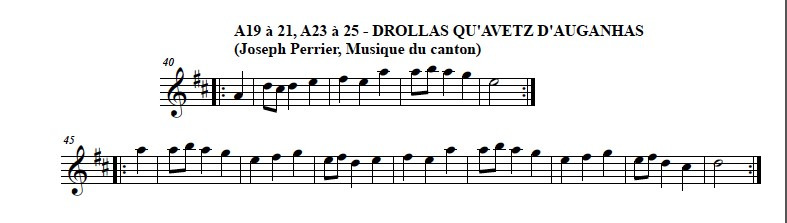
Thus, we can try to trace a melodic path of evolution from the simplest to the most developped, from « La calha » to « Lo curat de la chapela » including « Dròllas qu'avetz d'auganhas », « Chas la mair Antoèna », « En passant per la plancheta », « Las bravas e las laidas », all these tunes figuring in Perrier's repertoire and that we will listen to.

This broad repertoire is found in the region of the Massif central, considered in a very wide way. Here is the musical geography of these three-time bourrées in the Massif Central, schematically:
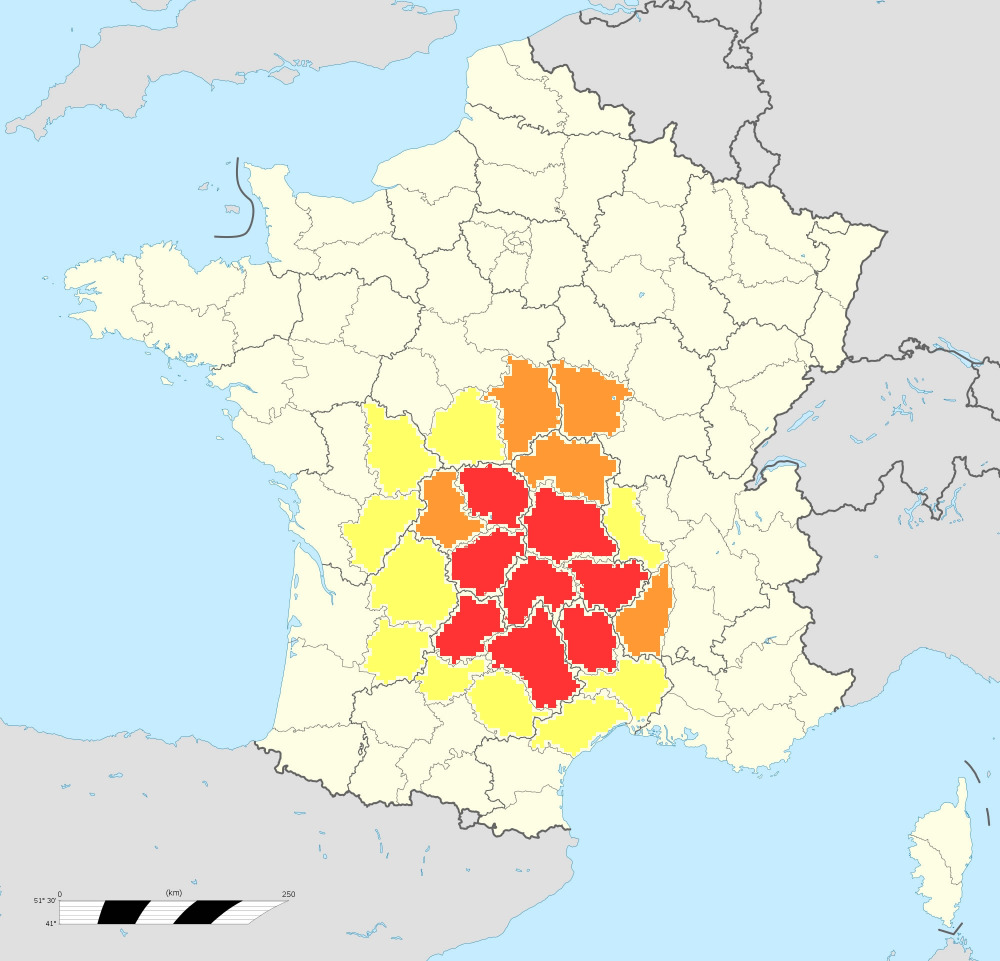
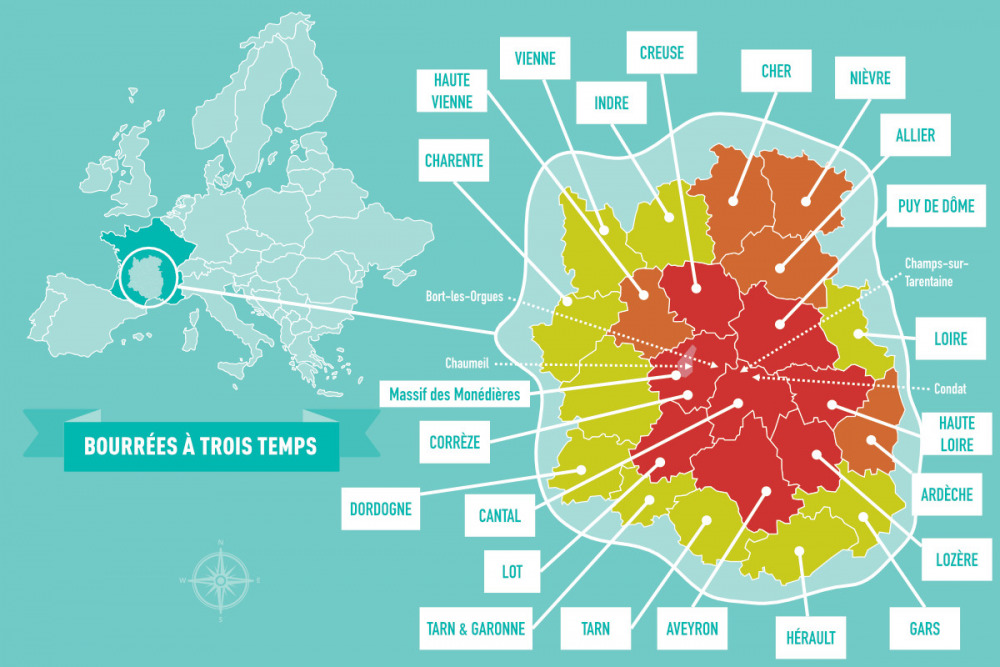
 
Bourrés à trois tempsThree-tempo bourrées

On these maps, I have indicated (very roughly) the departments in which traditional repertoire collections have shown three-time bourrées, as far as I know:

  • in red, when these bourrées are a fundamental element of the repertoire,

  • in orange, when they are more secondary, or present especially in a part of the territory,

  • in yellow, when it is a more sporadic or anecdotal presence.


Melodies evolution

Study of a family of melodies all related to each other, diversified from a simple archetype

As we deepen knowledge of three-time bourrées' repertoire, it is clear that most of the tunes are found in multiple variations. We are also led to make connections between related themes, although they are different in appearance.
Thus, the two melodies of bourrées which are the subject of this work, Lo curat de la chapela and La calha ("The quail"), although very different, can both relate to a family of simpler bourrées, of which the well-known La calha could be the archetype.

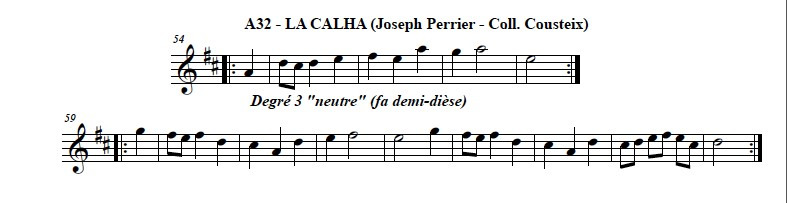
Here is the bourrée La calha in its interpretation by Joseph Perrier:

La calha, by Joseph Perrier. Recording courtesy of Eric Cousteix

But we can still broaden the search, this melody, La calha, having itself two-tempo versions, of which we can find an obvious melodic antecedent in a song dating back to the seventeenth century.

Starting from this, it would be possible to trace a hypothetical evolutionary tree, whose different branches would lead to several distinct families of traditional songs.
Some versions would play the role of «missing links», allowing to capture the similarities between the tunes, through their rhythmic, modal and melodic diversity.

This is what we will try to do, by discovering this repertoire of the three-tempo bourrées of the Massif Central.

Warning on transcripts

We give to listen in this work a large number of musical pieces accompanied by transcriptions. Where a piece could not be heard, it is as far as possible exposed through a transcript.
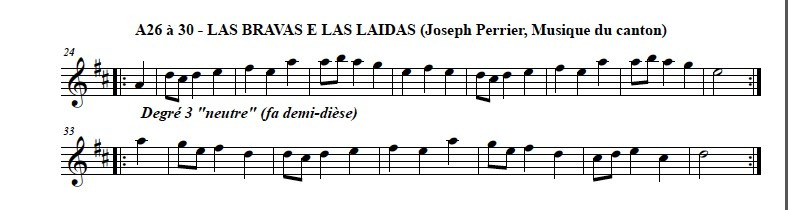
This series of transcriptions aims to bring together numerous melodies, sometimes very different, but that can be linked to the same «family tree». Whatever their original tone, all the melodies here have been transcribed and transposed in D key, to be more easily compared.

In the case of melodies transcription from sound recordings, We only focused on noting a main melodic line, leaving aside the ornamentation. Some melodic variations were taken into account, but not exhaustively, and the micro-intervals were not detailed either. As most sound sources are audible, we have to refer to them to understand the reality of the interpretations.
Structure

Melodic Development and Rhythmic Transparency

Related Melody Variants in the Works of Joseph Perrier, Henri Lachaud, and Antoine Bouscatel

We will examine some features of this branching evolution, drawing on a corpus of several dozen related variants and melodies around "La calha" (from both written and audio sources). The extensive repertoire of the lone fiddler Joseph Perrier included a remarkable number of melodies belonging to this family (sometimes with interpolations): La calha ("The Quail"), the simplest; Las bravas e las laidas ("The Beautiful and the Ugly"); Dròllas qu'avetz d'auganhas ("Girls Who Have Hazelnuts"); Chas la mair Antoéna; En passant per la plancheta ("Passing by the Plank"); and finally, Lo curat de la chapela ("The Priest of the Chapel"), the most complex.

Let's listen to this collection for the first time:


La calha ("The Quail"), by Joseph Perrier. Recording by Eric Cousteix. © Cousteix / BIPO
 
 
Las bravas e las laidas (The Beautiful and the Ugly), by Joseph Perrier (violin). Recording by Eric Cousteix. © Cousteix / BIPO
"Las bravas e las laidas" (The Beautiful and the Ugly), by Joseph Perrier (vocals). Recording by Eric Cousteix. © Cousteix / BIPO
 
 
"Dròllas qu'avetz d'auganhas" (Girls Who Have Hazelnuts), Joseph Perrier (violin). Recording by Eric Cousteix. © Cousteix / AMTA (Cassette album "Musique du Canton", 1987)
"Dròllas qu'avetz d'auganhas" (Girls Who Have Hazelnuts), Joseph Perrier (vocals). Recording by Eric Cousteix. © Cousteix / AMTATA
 
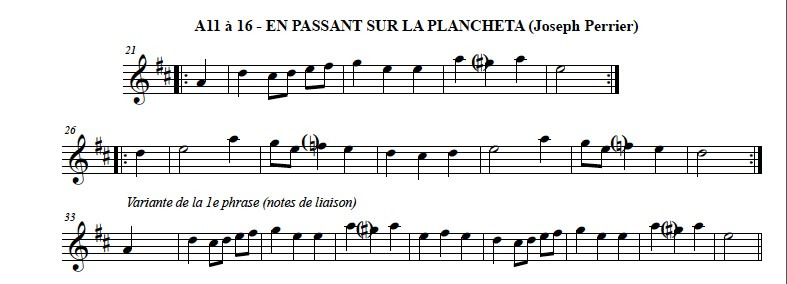
En passant per la planchèta, Joseph Perrier (vocals). Recording by Eric Cousteix. © Cousteix / BIPO
En passant per la planchèta, Joseph Perrier (violin). Recording by Eric Cousteix. © Cousteix / BIPO
 
Lo curat de la chapela, by Joseph Perrier (violin). © Eric Cousteix / BIPO
Joseph Perrier, chant de Lot curat de la chapela. Recording by Eric Cousteix
 

How can we understand the melodic development of these bourrées, which are linked together? I would like to demonstrate this here: 

Melodic development from a series of Joseph Perrier's bourrées, from the simplest to the most elaborate, by Jean-Marc Delaunay. © CRMTL

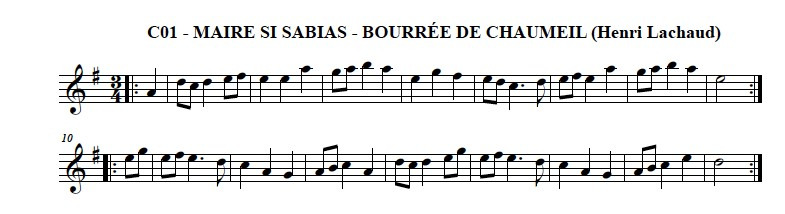
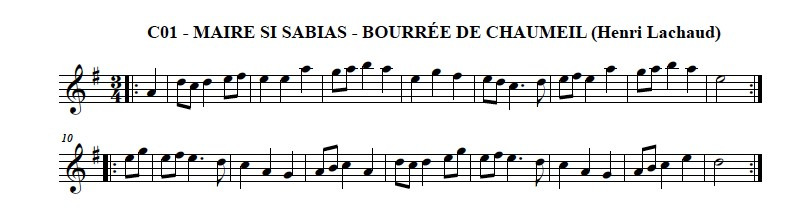
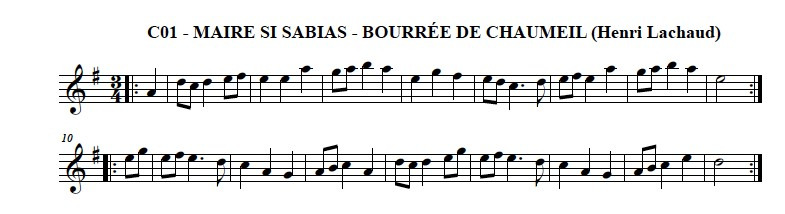
Another key example of this work is the Monédières bourrée, Maire se sabias ("My mother, if you only knew"), played on the violin by Henri Lachaud:


Henri Lachaud, Maire se sabias, also known as the Bourrée de Chaumeil. Recorded in 1978 by Olivier Durif

This bourrée, in my opinion, also derives from La calha, via Au bòsc de la fuelhada, another bourrée here performed by Alfred Mouret:


Au bosc de la fuelhada, by Alfred Mouret. Recorded in 1977 by Olivier Durif
 

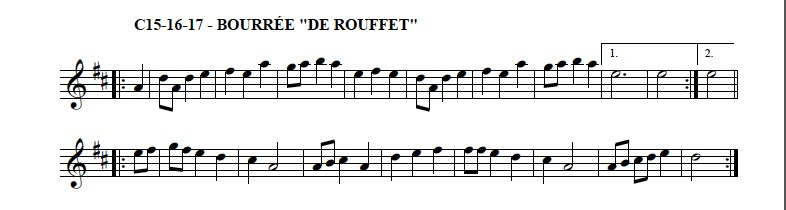
This connection became clear to me when listening to the version by Monsieur Rouffet, a fiddler from Saint-Bonnet-près-Bort in Corrèze, which represented the "missing link" between these tunes:

Bourrée de Rouffet, by M. Rouffet. Recorded by Olivier Durif in Saint-Bonnet-près-Bort in 1975. © Durif/ BIPO
 

Around the version by fiddler Henri Lachaud, Maire se sabias is thus represented by a fairly homogeneous set of versions, very representative of the style of this region in central Corrèze. More details on this bourrée can be found here.

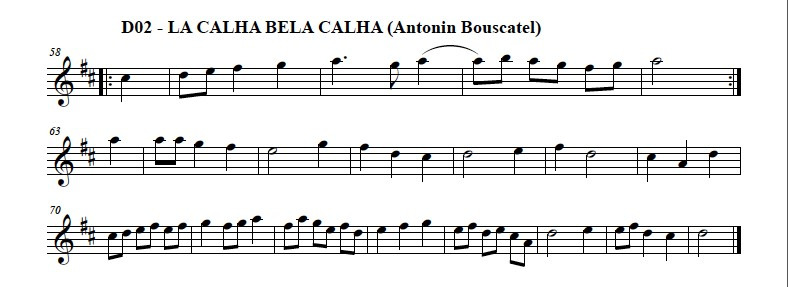
Finally, Antoine (known as Antonin) Bouscatel's interpretation of La calha bela calha ("The beautiful quail," incorrectly transcribed as La caillo bello caillo in the Gallica catalog) on ​​the cabrette (Auvergne bellows bagpipe) is the culmination, in a completely different style, of another branch of our evolutionary tree:


La calha bela calha, by Antoine Bouscatel. Released in 1983, vinyl record "Bouscatel - Roi des cabretaires - Les origines du bal musette" (ed. Musiciens Routiniers). Digitized version source gallica.bnf.fr / Bibliothèque nationale de France
 

This version of a bourrée in 3/4 time, originally very simple and widespread throughout the Massif Central, shows how the inventiveness of folk instrumentalists can transform the sung repertoire through ornamentation and melodic variation. As with "Lo curat de la chapela" by Joseph Perrier and "Maire se sabias" by Henri Lachaud, other instrumental melodies belonging to the same melodic family, the relationship with the sung versions of "La calha" is almost indistinguishable.
To understand this lineage, it is necessary to gather and compare numerous versions, some of which are the "missing links" that illuminate the kinship between two dissimilar melodies.

Other recordings allow us to trace this melodic lineage of "La calha" within the Auvergne and Rouergue musicians' circles in Paris.

In the documentation for this article, you can consult numerous other versions that I relied on, drawing from various sources: recordings of collected fiddlers and singers from Auvergne and Limousin, old commercial recordings on discs (cabrette, accordion), scores from older written sources, as well as my transcriptions of this entire repertoire. 


Going back to the sources: "rhythmic transparency"

Several melodies of old or traditional songs are related, although their rhythms differ: their lyrics share the same structure.

The bourrée de La calha (or "l'esclopeta," meaning "the sabotée" in Occitan) is widespread throughout the Massif Central in its triple-time form. The best-known version is that of composer Joseph Canteloube, who harmonized it in his "Chants d'Auvergne" (Songs of Auvergne), and published around the same time (1920s) in the songbook of "La Bourrée," a group of musicians from the Massif Central region living in Paris. This group served as a model for all other folk groups in Auvergne and Limousin, and this version was thus widely disseminated. Here is the sheet music and a version performed by Jean Chabozy in 1977:

 
La calha, by Jean Chabozy, recorded on March 1, 1977 by Olivier Durif. © Durif / BIPO

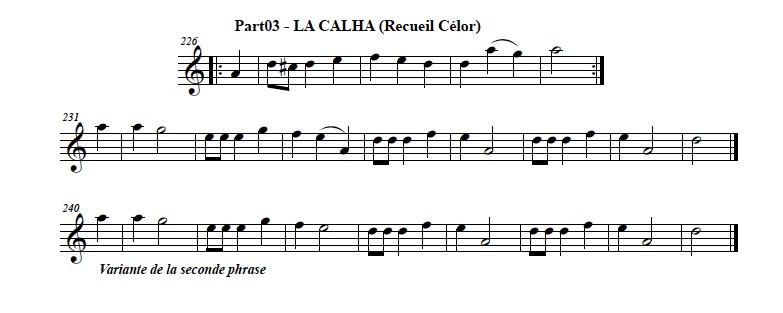
In Limousin, a version in a minor key and with a different structure appears in François Célor's collection at the end of the 19th century:


In its various versions, this song seems to be specific to the Occitan-speaking provinces, from the Massif Central to the Pyrenees, as indicated by the inventory compiled by Patrice Coirault.
Louis Lambert, in 1906, provides Pyrenean versions of "La calha," with similar lyrics, but whose melody is in duple meter.


Despite this rhythmic difference, its melodic line seems close to Canteloube's version.
The songs collected during the Fortoul survey (1852-1876), as well as Emmanuel Soleville's collection, provide very similar versions from Quercy.


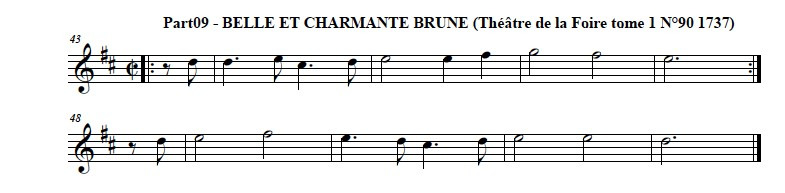
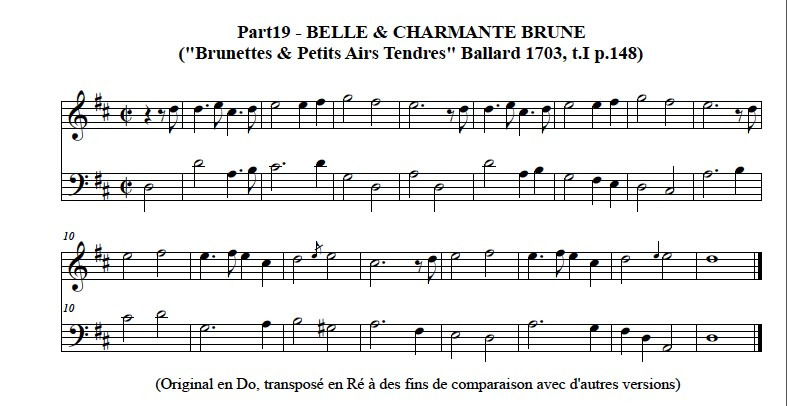
All these binary versions are directly related to a 17th-century melody: "Belle et charmant brune" or "Votre mari est de glace," which dates back to at least 1666 (according to the Recueil de chansons choisies en vaudevilles (…) depuis 1600 Jusques Et Compris 1697, a collection compiled around 1731). This tune appears in various other 18th-century collections, for example, Ballard's "Brunettes et Petits Airs Tendres" (Volume I, p. 148, 1703) or "Le Théâtre de la Foire" (Volume I, tune no. 90, 1721). It was used in various plays.


The lyrics of these different songs share the same poetic structure, namely F6M4 (a six-syllable line ending in a feminine noun, followed by a four-syllable line ending in a masculine noun):

A ! dija-me la calha - Ont as ton niu
Sus-naut sur la montanha - Tot pres dau riu
(common version)

« Belle & charmante brune - Pour qui je meurs
Si je vous importune - De mes langueurs
La plainte en est commune - A tous les cœurs »
(Ballard, Brunettes)

By examining this style, quite rare in the French repertoire, we uncover melodic similarities between several families of traditional songs, partly studied by Marlène Belly (1977, “'Le miracle de la muette', un air, un timbre, une coupe”, in J. Le Floc'h (ed.), Autour de l'oeuvre de Patrice Coirault, Saint-Jouin-de-Milly, Modal, 84–99).
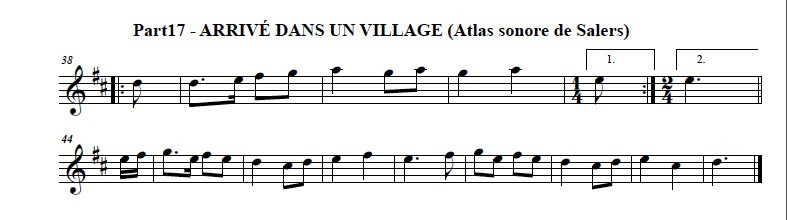
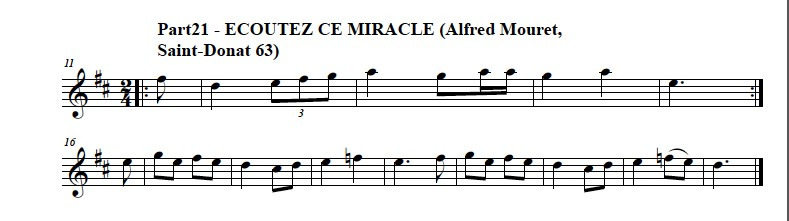
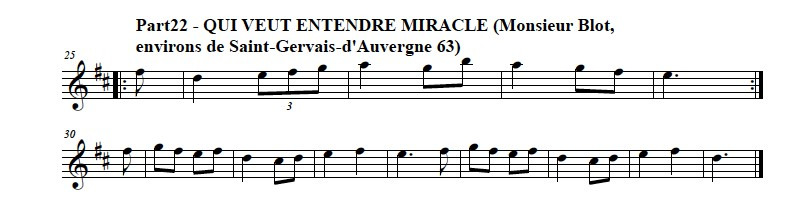
The melodies of some of these lineages have triple meter in 6/8 time. One of these songs, very common in certain parts of the Massif Central (particularly in the Puy-de-Dôme), belongs to the genre of revelhets, or Holy Week begging songs:

« Écoutez un miracle - Petits et grands
Arrivé dans un village - Y a pas longtemps

C'est une jeune fille - Qui n'a que quinze ans
Qui crie de sous sa tombe - Je veux sortir  (...)»

(according to the version widespread in Auvergne)


The melody of this last song closely resembles, despite the difference in rhythm, certain versions of "La calha," as well as another bourrée, even more obviously:

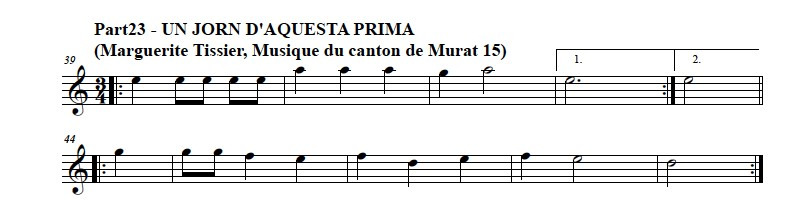
Un jorn d'aquesta prima - D'aquest' estiu   ("One day this spring - This summer")
La bela Margarida - Tombèt al riu    ("The beautiful Marguerite - Fell into the water")

It For example, it is sung by Marguerite Tissier, from the canton of Murat in the Cantal region:


Un jorn d'aquesta prima, by Marguerite Tissier. © AMTA
 

These lyrics are also found in the Aveyron region, sung by Valentin Brugel, to a tune in duple meter, which can be heard here:
https://www.occitan-aveyron.fr/fr/diffusio/source/campouriez/un-jorn-d-aquesta-prima_SRC2140

This further confirms the ease with which lyrics can be transferred from one tune to another, from one measure to another, when they share the same rhythmic pattern.

Thus, the sources available to us can suggest the broad outlines of an evolution (though without certainty): the duple-meter melodies could predate the others, possibly originating from the old brunette tune.
This melodic family would have diversified, serving as the basis for various traditional song lyrics set to duple or triple rhythms, one branch having adapted to a mountain rhythm, or bourrée, in three-beat time, in the Massif Central.

We propose to explore this "rhythmic transparency" (rhythmic diversification of a melodic family) through the following pieces, which demonstrate their melodic lineage with a change of time signature:

-  Belle et charmante brune > La calha (duple time) > La calha (3 time)
Ecouter un miracle (duple time) > Ecouter un miracle (triple time) > Un jorn d'aquesta prima

Played by Jean-Marc Delaunay (CRMTL)


Melodic lineage and rhythmic transparency, by Jean-Marc Delaunay. © CRMTL

Sung bourrées: when lyrics transform the tunes

L'évolution d'une mélodie peut être influencée par des

The evolution of a melody can be influenced by changes in the lyrics. Thus, some Limousin versions of La calha feature interspersed refrain elements and repetitions, which slightly modify and complicate the structure of the musical phrases:

A ! calha bela calha

Ent as ton niu [bisser les deux vers]

Ent as ton niu m'amor [3 fois]

Ent as ton niu

Ô caille, belle caille

Où as-tu ton nid

Où as-tu ton nid m'amour

Où as-tu ton nid

(collectionb by François Célor)

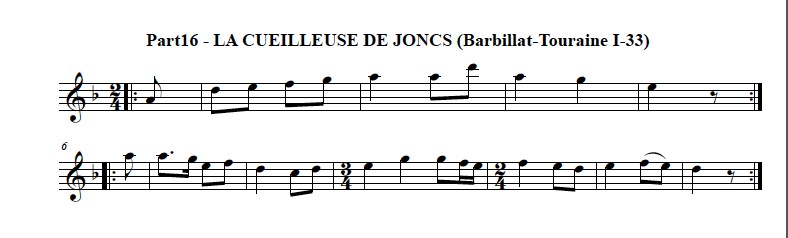
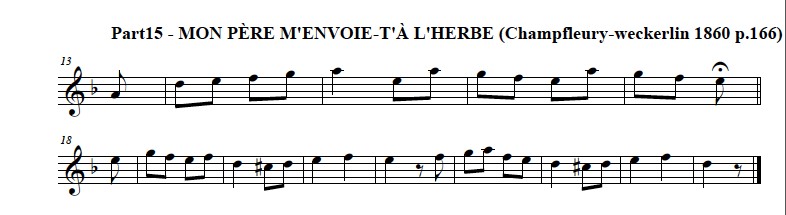
Examples of this phenomenon can also be seen in two versions of a song in duple meter, La belle qui trouve le nid de l'alouette (type 107 in the Coirault catalog). The melodies of these two versions, belonging to our family (very close to "Listen to a Miracle," mentioned above), are modified by refrains and repetitions of verses, which distance either the first or second phrase from the archetypal form:

1)    La cueilleuse de joncs (Berry, recueil Barbillat-Touraine, I-33) 

"Quand j'étais seule chez mon père - Enfant petit
Il m'envoya seulette - Les joncs cueillir
Malirette - Les joncs cueillir"

Part16

2) Mon père m'envoi-t-à l'herbe (Lorraine, recueil Champfleury-Weckerlin p. 166)

"Mon père m'envoi-t-à l'herbe - Au bois joli - Au bois joli
Je ne cueille point d'herbe - Je cherche un nid
Le serviteur que j'aime - N'est point ici"

Part15

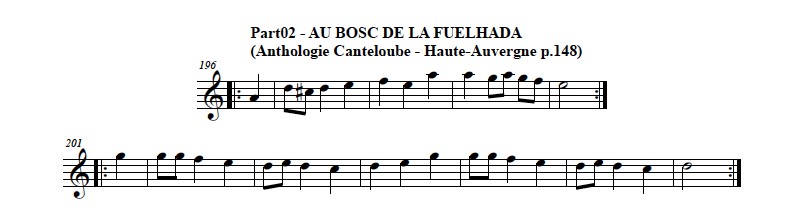
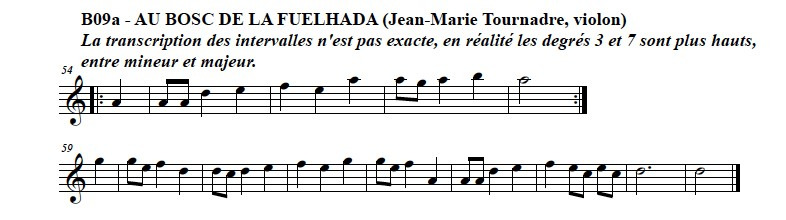
Furthermore, The adaptation of a new verse leads to changes in the melody when the number of syllables differs: thus, "Au bòsc de la fuelhada," whose tune is often very close to "La calha," generates a small melodic development in the first phrase due to its break, which includes two additional syllables in the second line:

Au bòsc de la fuelhada - Ma miona li es

Ma miona li es - Que li garda

Ma miona li es - Que li languit

Au bois de la feuillade - Ma mignonne y est

Ma mignonne y est - Qui y garde

Ma mignonne y est - Qui y languit

(from Canteloube, collection of « La Bourrée »).

Part02

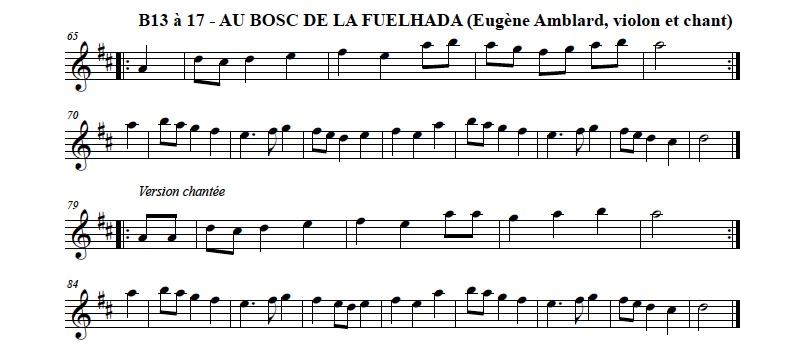
In this version, the lyrics are associated with phrases of different lengths (8 then 6 bars). The same lyrics, slightly altered by the repetition of certain words, give a more uniform 8-bar structure in versions common in the Artense region:

Au bòsc de la fuelhada - Ma miona li es

Ma miona li es - Que li garda que li garda

Ma miona li es - Que li garda e li languit

Au bois de la feuillade - Ma mignonne y est

Ma mignonne y est - Qui y garde qui y garde

Ma mignonne y est - Qui y garde et y languit

This version is the one sung by Eugène Amblard in Picherande, in the Puy-de-Dôme department:

Eugène Amblard, Dins lo bosc de la fuelhada. Recording by Eric Cousteix. © Cousteix / BIPO

B13 17

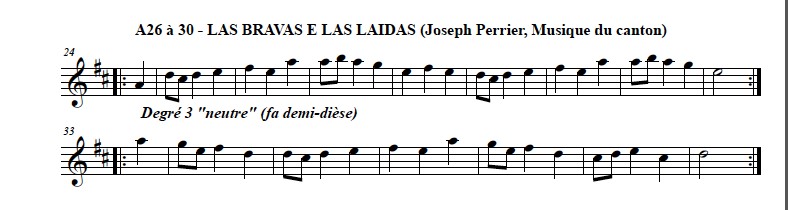
We can also observe "Las bravas e las laidas" ("The Beautiful and the Ugly"), which has phrases of 4/6 bars in Joseph Perrier's version and 4/8 bars in André Gatignol's. Let's listen to their interpretations:

Chas la maire Antoèna - Las bravas by André Gatignol. Recorded by Eric Cousteix in Saint-Genes-Champespe © Cousteix-AMTA / BIPO

Las bravas e las laidas, by Joseph Perrier (violin). Recording by Eric Cousteix. © Cousteix / BIPO

Las bravas e las laidas, by Joseph Perrier (vocals). Recording by Eric Cousteix. © Cousteix / BIPO

A26 30

While maintaining the same melodic base, new verses develop this base, with a first line of 7 syllables instead of the previous 6, always At Joseph Perrier's, in two other bourrées:

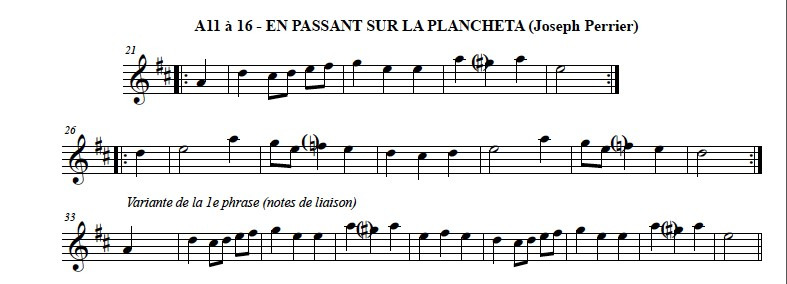
En passant sur la plancheta - Lo pé m'a mancat (...)  "En passant par la planchette [petit pont] - Le pied m'a manqué
Here we see a F7M5 cut:

En passant per la planchèta, Joseph Perrier (vocals). Recording by Eric Cousteix. © Cousteix / BIPO

En passant per la planchèta, Joseph Perrier (violin). Recording by Eric Cousteix. © Cousteix / BIPO

Similarly, in our main work, Lo curat de la chapela (Joseph Perrier), the melodic base is developed: 

Lo curat de la chapela - Fasià dançar la Lisabet    "Le curé de la chapelle - Faisait danser Elisabeth"
Here the rhythmic pattern is F7M8.

Adapting new verses to a tune can also, even without adding extra notes, modify the rhythmic values ​​to match the accentuation of the text. For example, a long note value will be inverted with a short one to better fall on the stressed syllable of the word.

It can also be observed that certain versions within our melodic family occasionally resemble bourrées belonging to other lineages, through the borrowing of phrases: for example, the second phrase of "Au bòsc de la fuelhada," in the most common versions (see Eugène Amblard's above), adopts a melodic profile very similar to the first phrase of the well-known bourrée "Son davalats los garçons de la montanha" ("They came down, the boys, from the mountain"). This bourrée can be heard in a version played by Jean-Marie Chassagne here: http://patrimoine-oral.org/dyn/portal/index.seam?page=alo&aloId=36117&fonds=3&cid=3044 (Interregional Oral Heritage Database, collected by Eric Cousteix).

Similarly, when Joseph Perrier plays his version of "En passant sur la plancheta," another well-known tune from 19th-century collections, his first phrase seems borrowed from the melodic family of "La calha," combined with a second phrase that remains typical of "La plancheta." We present here, for the record, his violin versions of these two bourrées:

La calha. Joseph Perrier, violin. Recording by Eric Cousteix. © Cousteix / BIPO

En passant per la planchèta, Joseph Perrier (violin). Recording by Eric Cousteix. © Cousteix / BIPO
Representations and analyses

Variations, Modal Colors, and Melody Lineages

From Sung Bourrées to Instrumental Versions

Instrumentalists embellish and develop bourrées melodies, creating more complex versions.

In general, sung versions of bourrées are archetypal forms, quite simple because they are syllabic in style: one syllable of the lyrics usually corresponds to a single note of the melody. This repertoire, known to all with its lyrics, serves as the basis for instrumental interpretations which can be much more developed and ornamented, whether on the violin, the cabrette (a type of bagpipe), or the accordion.

Henri Tournadre, a fiddler from Champ-sur-Tarentaine (in the Cantal region of Artense), used the term "doubling the bourrées," which refers to the practice of "double" in Baroque music, that is, a highly ornamented version full of rhythmic embellishments (short note values), played or sung after a first, "simple" verse.

Here is an excerpt from his testimony and his explanation of this practice of "doubling the bourrées":

 Henri Tournadre, dance tunes for voice (continued), June 26, 1978, in Marchal (Cantal). Researchers: Durif, Gabriel et al. Copyright DR, CRMTL collection

This testimony is taken from a long interview in which Henri Tournadre sings numerous songs, accompanied by researchers and musicians Gabriel Durif, André Ricros, Alain Ribardière, and Olivier Durif, which can be found at the following links:
- Oral Heritage Portal, accessed December 16, 2020, http://stq4s52k.es-02.live-paas.net/items/show/6390.
- Interregional Oral Heritage Database: http://patrimoine-oral.org/dyn/portal/index.seam?aloId=20671&page=alo&fonds=4

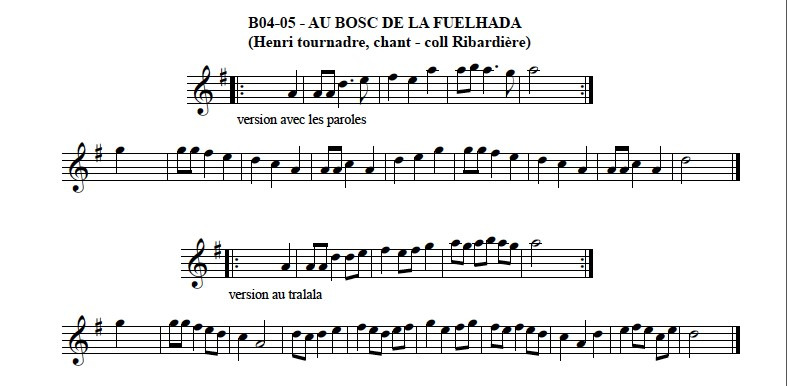
This technique is often found among experienced dance singers from the Massif Central, such as Henri Tournadre (from Marchal, Cantal) or Jean Chabozy (from Larodde, Puy-de-Dôme): after stating the simple theme with its lyrics once or twice, they continue "au tralala," that is, singing in onomatopoeia ("Tra ladélidéla, tradéla lon ladéladéline...") with all these "diminutions," often in stepwise motion, which directly reference the instrumental versions of these tunes.

Henri Tournadre, "La fuelhada" (La feuillade), song and tralala. Recorded in Champs-sur-Tarentaine, 1975-76, by Olivier Durif. © Durif / AMTA
Henri Tournadre, "La fuelhada", song and tralala, second version. Recorded in Champs-sur-Tarentaine, 1975-76, by Olivier Durif. © Durif / AMTAAMTA
 
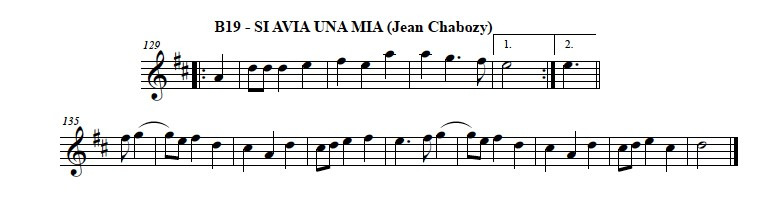
Jean Chabosy, Si ieu n'avia una mia (If I Had a Friend), recorded by Olivier Durif in Tauves in 1977 © Durif / AMTA
 

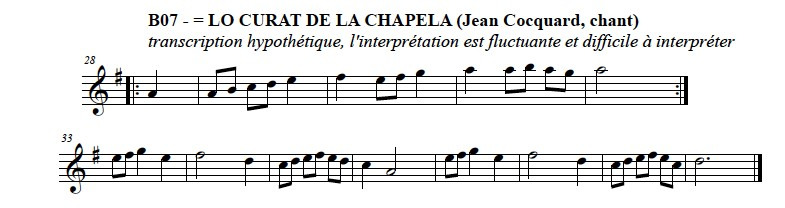
And here is Jean Cocquard's version of Lo curat de la chapela, along with its transcription:

Lo curat de la chapela au tralala, by Jean Cocquard. Recorded in 1988 in Lanobre by Olivier Durif.


The rhythms generated by the lyrics, initially simple and abrupt, eventually transform into long, supple flourishes that constantly rise and fall within the scale.

These "doubled" versions can be associated with a very legato instrumental performance (continuous sound of the bagpipes, flowing bowing on the violin) as well as a very detached one (the staccato playing of some accordionists, the detached style of the violin). While some fiddlers favored one of these playing styles (for example, the systematic flowing style of Antoine Chabrier, a fiddler from Riom-ès-Montagnes, Cantal, whose complete recordings can be heard here: http://patrimoine-oral.org/dyn/portal/index.seam?page=alo&aloId=28984&fonds=3&cid=613), others, such as Joseph Perrier, Léon Lemmet, or Alfred Mouret, played some of these "doubled" tunes with flowing bowing, and others with detached bowing (more rarely, by mixing the two types of bowing within the same tune).

"Modal Transparency"

A traditional tune can be found in different modal colors: the mode is not constitutive of its melodic identity.

The example of our family of bourrées highlights a remarkable phenomenon, which seems to me quite general in the traditional music of the Massif Central region (but observable well beyond), and which we can call "modal transparency." Indeed, for the same melody, we find versions using very different scales and modal colors, while it can remain very recognizable by its melodic shape and the lyrics associated with it.

It can be noted that versions in minor modes are more frequent in older written collections (Canteloube, Célor, Chéze-Branchet-Plantadis, etc.), and become much rarer in more recent collections, and even in recordings by Auvergne musicians from the interwar period, released on 78 rpm records.The major modal character is dominant in all instrumental versions, this evolution perhaps being due to the technical constraints/facilities inherent in certain instruments, in which playing in minor keys was common.

In any case, the shift of a melody from one mode to another seems to me a fairly old and widespread phenomenon in traditional repertoires. Among some fiddlers, particularly in the Auvergne region of Artense and Cézallier (Joseph Perrier, Alfred Mouret, etc.), one sometimes encounters reminiscences of minor colors in the form of a "neutral" third or a high minor third, but often in an unstable form; we will address this point later.

Demonstration of various modal colors: microtonal variations on a basic melody, by Jean-Marc Delaunay. © CRMTL 2020

The fundamental structure of the scale

The fixed degrees of the scale (1, 2, and 5) constitute the framework of the melody, which remains constant across versions.

Comparing different versions, through their modal and rhythmic diversity, reveals a fixed framework, a "structure" formed by certain fundamental degrees, linked by more fluctuating notes that provide the modal color.

Playing a traditional instrument allows one to intuitively grasp this framework, as it is embodied by key fingerings, often related to the instrument's very structure. For example, on the violin, this framework corresponds to the open strings and their octaves, which are played with the ring finger of the left hand. For a melody in the key of D, this gives the notes: A -- D E - A, or the degrees: V (low) -- I / II -- V (in violin fingering: open string – 3rd finger – open string – 3rd finger).

On a hurdy-gurdy or bagpipe, we also find the great importance of this series of degrees, which have a privileged relationship with the drones (with which they are related by unison, octave, fifth, or fourth). This framework constitutes the fixed structure of what is generally called the plagal form of a mode, a form that is predominant in the music of the Massif Central: that is to say, many melodies extend over a range of about an octave, the first degree or tonic being located in the middle of this octave.

It must be added, however, that even these "strong" notes, theoretically fixed, are sometimes, in the hands of some fiddlers, "pulled upwards" with a strong vibrato that masks the fact that they thus escape the intonation defined by sympathetic pitch (resonance of the open strings). Joseph Perrier, in particular, uses this effect of the beat, of the conflict with the resonance of the strings, to obtain a higher, more resonant and brilliant A, very characteristic of his sound. This can be heard in the playing of the main piece of this study, Lo curat de la chapela (musical piece at the top of the page, transcription below).


Variable Degrees

The other degrees are more variable: their variations (by semitones or microtonals) establish the modal color of the melody.

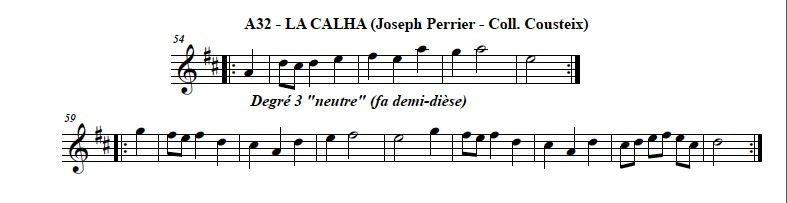
The other degrees vary more or less depending on the melodic version, especially among singers and fiddlers, whose instruments allow for all microtonal nuances. Thus, the third degree can be high or low, giving the melody a major or minor character, but also sometimes "in-between," with a "semi-sharp" F (that is, about three-quarters of a tone above the E of the open string). In this case, the modal color is perceived as somewhat disconcerting to modern ears.
Joseph Perrieruses this fingering for most of the bourrée family tunes we are studying: sometimes, he does so consistently throughout a performance. But more often, it is only occasional, in certain passages of a melody that is otherwise performed in a major mode, as for example in these two interpretations of "La calha" and "En passant per la plancheta":

"En passant per la plancheta," by Joseph Perrier, vocals and violin (recording by Eric Cousteix)
 
La calha, by Joseph Perrier (Eric Cousteix Recording)
 

It is also noticeable that the use of these modal colors could vary depending on Perrier's interpretations of the same melody at different times.

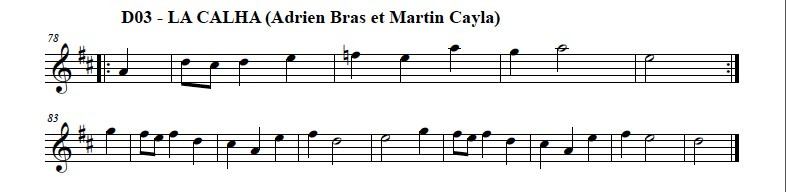
In a more conventional style, a version for cabrette (a type of bagpipe) and accordion (Martin Cayla and Adrien Bras) sees the melody shift from major to minor from one phrase to the next, confirming the ease of this modal shift of the third degree in our family of melodies.


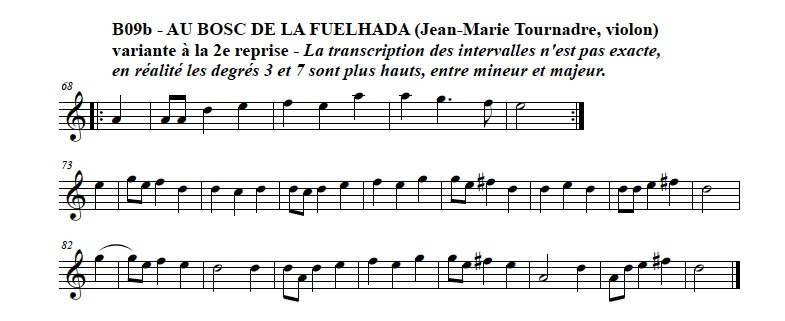
The seventh degree is also variable: the major seventh, known as the "leading tone" in classical music, a semitone below the tonic, is of course very common, but often softened by being played or sung slightly lower than the note of the tempered scale (for example, on the violin in the key of D, it is low C-sharp, which is the natural, resonant major third of the open A string). On the other hand, solfège transcriptions of old field recordings include a low subtonic, a tone below the tonic (C, in the key of D), especially in minor modes (see the collections of Célor, Canteloube, etc.).

In recordings of singers and fiddlers, one can sometimes hear this degree in an untempered version, that is, slightly higher than the theoretical C (this is C+, which is the natural minor third of the open A). However, the seventh degree in the "in-between" position (i.e., C "half-sharp") seems to me much more common among fiddlers.

These three nuances of the subtonic are often confused by modern listeners, and the resulting scales are mistakenly considered a "G mode" or Mixolydian mode. Careful listening reveals that this mode is actually quite rare in its true form: accordionists from a regional musical background, even those steeped in the music of fiddlers (such as Jean Ségurel in Corrèze, who himself began his career on the violin), systematically choose the major mode, and never the "G mode," when transposing traditional tunes to their instrument. Despite this, the rather low subtonic (a quarter tone or a minor tone below the tonic) is a very common marker of traditional violin music.

In the audio examples given here, it can be heard frequently among musicians from the Monédières region of Corrèze, such as in Henri Lachaud's "Maire se sabias" (below), and also in the Artense region (Jean-Marie Tournadre - also below - André Gatignol, etc.), but never in the music of Joseph Perrier.

Henri Lachaud, "Maire se sabias," also known as "Bourrée de Chaumeil." Recorded in 1978 by Olivier Durif
 
Jean-Marie Tournadre, Au bosc de la fuelhada. Champs-sur-Tarentaine, 1975 (Recording courtesy of the artist)
The fourth degree can also take several positions: one can often find an augmented fourth (G sharp in the key of D) as an accidental, by attraction in a melodic embellishment around the high fifth degree (see, for example, "L'esclopeta" in the version by the bagpiper Victor Allard).
 

Beyond this possibility accessible to instruments capable of chromaticism, fiddlers exploit other, more subtle microtonal nuances. A fourth degree slightly higher than equal temperament seems to me a very common case: it is explained by consonance, this note being frequently melodically related to the second degree (still in the key of D, it is a slightly raised G that I call G+, which is the natural minor third of the E on the open string of the violin). Joseph Perrier uses it quite systematically.

More surprisingly to the ear, the fourth degree can also be in an "in-between" position, three-quarters of a tone below the fifth degree (G "half-sharp", the note giving the characteristic color of hunting horn music). Some fiddlers use symmetrical fingering, identical on the two highest strings of their instrument: the seventh and fourth degrees, both played by the middle finger of the left hand, are then in the same position (for example, C+ and G+, or C half-sharp and G half-sharp); the same is true for the sixth and third degrees, played by the index finger.

The sixth degree is less common in these melodies, at least in the lower part of the scale. However, it is frequent in the higher register, at the top of the scale. It can be slightly lower than the note of the equal-tempered scale, particularly when it appears in the lower register. The fiddler Alfred Mouret often used an "in-between" sixth degree (B-semiflat) in the upper register of the scale (a note played with the little finger on the E string).

Melodic lines: the supporting degrees of phrases

By comparing the main notes on which the melodies are based, we can identify subfamilies of tunes that are more closely related to one another.

The evolution of the pattern of supporting notes (longer notes on strong beats and rests in phrases) constitutes another factor in the evolution of melodies.
Some versions emphasize a new degree at a point in the musical phrase, thus causing the evolution to branch off towards new variants. One could try to trace a kind of family tree of our melodic family, ordering all the variants according to their proximity based on this criterion. I have only glimpsed this work, which requires an overview and detailed examination of the hundred or so versions I have been able to collect. I will therefore only give a few examples here.

The beginning of the first phrase is on the upbeat, and the first strong beat is most often on the tonic. Very often, the upbeat is on the lower fifth degree, so the melody begins with an ascending fourth movement from V to I. The phrase then continues its ascent, resting in the second measure either on the third or the fourth (more rarely on the second or the fifth), thus creating a range of melodic nuances.
Next, there are two possible patterns: a passage through a climax (IV or V) followed by a descent and a rest on the second; or a rapid ascent and an emphasis on the high fifth, on which the rest occurs, seemingly suspended in mid-air. In this latter pattern, the high sixth and fourth degrees (often augmented by the strong pull of the fifth) serve as embellishments and revolve around the fifth.

The variations can thus be classified according to the main features of their melodic movement. The same applies to the second phrase: the instrumental versions of La calha and all those derived from Au bòsc de la fuelhada fall into two main categories:

- In the first category, this phrase begins around the high V and descends to rest on the II, as in Eugène Amblard's version of Dins lo bòsc de la fuelhada ("In the wood of the foliage"):

Eugène Amblard, Dins lo bosc de la fuelhada, recorded by Eric Cousteix
 

- In the second category, which includes the Corrèze versions of Maire se sabias as well as certain Artensian versions (Lo curat de la chapela, etc.), the phrase begins with a motif resting on IV and II, creating a completely different atmosphere.

Musical universe

Musicians and singers, books and recordings

Bibliography and discography of works cited

Most of these works can be consulted and downloaded from the Gallica website of the French National Library (https://gallica.bnf.fr/accueil/?mode=desktop) or other libraries, except for those that have been reissued in facsimile in recent decades.

Collections of traditional songs: Auvergne and Limousin

          Célor Collection:

Popular songs and bourrées collected in Limousin by François Celor (Pirkin) (Brive, Roche Printing, 1904, Extract from the Bulletin de la Société scientifique, historique et archéologique de la Corréze (Bulletin of the Scientific, Historical and Archaeological Society of Corrèze), Volume XXVI). Published in several installments in this journal during the 1890s.

          Lemouzi Collection:

Popular songs and chants of Limousin - texts collected by Jean-Baptiste Chèze, Léon Branchet and Johannès Plantadis (Tulle, Lemouzi Review, No. 136, October 1995), facsimile of the original edition (circa 1914).

          Collection of « la Bourrée » :

Collection of LA BOURRÉE – Popular Songs and Dances of the Massif Central – Music revised and arranged by Joseph Canteloube (5 successive editions from 1927 to 1935)

          Canteloube Anthology:

Anthology of French folk songs, grouped and presented by country or province (Volume II, Issue IV, Auvergne) (Paris, Durand, 1951)

          Songs of Auvergne:

Songs of Auvergne, collected and harmonized by J. Canteloube (2nd series) (Paris, Heugel, 1924)

Collections of traditional songs: other regions

          Lambert Collection:

Popular songs and chants of Languedoc (...) by Louis Lambert (Montpellier, Imprimerie centrale du Midi, 1905) (reprinted in Facsimile: Marseille, Lafitte reprints, 1983)

          Champfleury-Weckerlin Collection:

Popular Songs from the Provinces of France - Notes by Champfleury; Piano accompaniment by J. B. Wekerlin (Paris, Bourdillat et Cie, 1860)

          Barbillat Touraine Collection:

Popular Songs of Lower Berry by Emile Barbillat and Louis-Laurian Touraine (Châteauroux, E. Rey, 1930-1931) (facsimile reprint, La Châtre, Centre de musiques et danses traditionnelles en Berry, 1997)

          Fortoul Survey:

Popular Poems of France, collected by the Committee for Historical Works (1852-1876)

          Solleville Collection:

Popular Songs of Lower Quercy by Emmanuel Soleville (Paris, H. Champion, 1889)
 

Old Song Collections

          Fairground Theater:

The Fairground Theater, or The Comic Opera. Containing the best pieces that were performed at the fairs of Saint-Germain and Saint-Laurent. (...) Collected, reviewed, and corrected. By Mrs. Le Sage and D'Orneval. (10 volumes, 1721-1737)

          Collection of Historical Songs:

Collection of selected vaudeville songs. To serve as a historical anecdote from 1600 up to and including 1697 (Manuscript, circa 1731)

          Ballard's Brunettes:

Brunettes or tender little airs with double bass and basso continuo; interspersed with dance songs; collected and arranged by Mr. Ballard, sole printer to the King, etc. (Christophe Ballard, Paris, 1719-1730)
 

Other Books and Articles

          Coirault Catalogue:

Directory of French Songs of Oral Tradition, vol. I: Poetry and Love (1996) - II: Social and Military Life (2000) - III: (Religion, Crime, Entertainment 2006), by Patrice Coirault et al. (National Library of France, 1996-2006)

          Article by Marlène Belly:

"The Miracle of the Mute: A Tune, a Timbre, a Cut" by Marlène Belly - Proceedings of the Colloquium Around the Work of Patrice Coirault, edited by J. Le Floc'h, Saint-Jouin-de-Milly, Modal Publishers, 1997, pp. 84-99.

Musicians and Singers Mentioned

Most of these musicians and singers can be heard online on the Oral Heritage Portal:
http://patrimoine-oral.org/
Information on fiddlers was compiled by Olivier Durif in "Le violon populaire en Massif Central" (Popular Fiddle in the Massif Central), a document downloadable from the website of the Regional Center for Traditional Music in Limousin, here: http://crmtl.fr/ressources/patrimoine/le-violon-populaire-en-massif-central/ .
This information has also been made available online and supplemented with sources from other regions on the violoneux.fr website: http://www.violoneux.fr/wiki/Accueil.

Fiddlers:

Joseph Perrier, Henri Tournadre (Champs-sur-Tarentaine), Jean-Marie Tournadre, Jean Cocquard, Léon Lemmet, Antoine Chabrier, André Gatignol, Alfred Rochon, Eugène Amblard, Alfred Mouret, Jean-Marie Brandely, Léon Mazières, Henri Lachaud, Julien Chastagnol, Jean Chastagnol, Baptiste Porte, Etienne Malagnoux, Elie Chamberet, M. Rouffet (probably Marcel Rouffet), Michel Meilhac, André Rigal.

Singers:

Jean Chabozy, Henri Tournadre (Marchal), René Mondoly, Léon Branchet, Jean Vacher, Maria Ischardt, Marie Fayet, René Roche, Marguerite Tissier..
 

Recordings including the pieces mentioned:

This collection primarily features cabrette and accordion music from the 1920s to the 1960s, including recent CD reissues; some tracks are available online on YouTube or Gallica.

Allard and Aigueperse - L'Escloupeto (The Quail)
https://www.youtube.com/watch?v=bU0t8c80fJw

Antoine Bouscatel - "Bourreyo de la Roquebrou: Caillo bello caillo" – 1906
https://www.youtube.com/watch?v=eV7RIDJwyms

https://gallica.bnf.fr/ark:/12148/bpt6k127306s.r=bouscatel?rk=42918;4

Adrien Bras and Martin Cayla - The Quail

Traditional Music of Auvergne and Rouergue (CD Marianne Melodie 2003)
 

Aimé Doniat - The quail

https://www.youtube.com/watch?v=hJ3o9MY-lpE&list=OLAK5uy_mSYQi5L6DVnPXYzE9FH9s3OzyVjinsfvg&index=16&t=0s

Michel Meilhac and his minstrels, Bernard Meilhac, Gaston Rivière, Jean-Louis Fournier - The quailille

https://gallica.bnf.fr/ark:/12148/bpt6k8825555b/f2.mediahttps://gallica.bnf.fr/ark:/12148/bpt6k8825555b/f2.media

Ernest Jaillet, Paul Faye, Lucien Faye – L’escloupeto

https://www.youtube.com/watch?v=k6n8OlMXO8Y

Fredo Gardoni, Puig et Baiz - The Quail

https://www.youtube.com/watch?v=CQpJ4Dh2vIU

Péguri - The Quail

Aveyron Musicians in Paris 1926-1977 (CD Conservatoire Occitan CMDT Toulouse Midi-Pyrénées 2001)

André Thivet  - The Quail / The Escloupeto

"100% Auvergne – André Thivet" Box Set (4 CDs Marianne Mélodie, 2019 compilation)

François Vidalenc - The Quail

"Music from Auvergne, François Vidalenc plays the diatonic accordion" (33 RPM Record, Musiciens Routiniers – Discovale, 1980)

http://patrimoine-oral.org/dyn/portal/index.seam?page=alo&aloId=20520&fonds=&cid=2161

Jean Ségurel - "And Long Live the Bourrée of Auvergne" (CD) Ritm'o-Columbia (1992 compilation)

"Fiddlers and Traditional Singers of Auvergne," LP released in 1977, Le Chant du Monde.
Collector: Alain Laribardière

Contexte

Fiddlers of the Massif Central

As elsewhere in France, a precious portion of the so-called "traditional" repertoires of Auvergne and Limousin was preserved, before its extinction, on "dead" media: written collections from the 19th and early 20th centuries, and commercial sound recordings from the interwar period (78 rpm records and a few cylinders).

Fortunately, before it was too late, a whole other part of the repertoire, and with it its human and cultural background (memories, stories and anecdotes, know-how, styles and sounds, etc.), was able to be passed on in a vibrant way, through encounters between young musicians and researchers and one or two generations of older folk singers and musicians.

This encounter took place during the "collecting" movement, primarily in the 1970s and 1980s. In particular, the fiddlers encountered and recorded in the Massif Central were born between the late 19th century and the very early 1920s. They were also able to provide accounts of the activities of fiddlers from the previous generation. The information we provide here about the contexts of their music therefore pertains to this period (very roughly 1860-1940).

Brief Historical Context

The Violin in the Massif Central

The density of popular violin playing in these regions of the Massif Central during the late 19th and early 20th centuries is quite surprising: fiddlers from the Artense region claimed to have the instrument in almost every home, and at that time, one could buy violin strings at the tobacconist's in Egliseneuve-d'Entraigues, a small town in the Artense.

Of course, many young people tried their hand at it, but not all became the equals of the great fiddlers, some of whom, renowned beyond their local area, could even attract the attention of "city fiddlers" who would travel to hear them (according to an account of Léger Gatignol, known as "Trénou," a fiddler from the commune of Besse-en-Chandesse, 63).

Dozens of instrumentalists were encountered during fieldwork in the Massif Central, to which must be added, in even greater numbers, the fiddlers who have since passed away, as mentioned by witnesses.es dizaines d'instrumentistes ont été rencontrés lors d'enquêtes de collectage en Massif Central, auxquels il faut ajouter, bien plus nombreux encore, les violoneux disparus évoqués par les témoins.

In his work, Le Violon Populaire en Massif Central - Les violoneux et leur musique (Sources: Investigations and Documents), Olivier Durif provides a preliminary inventory of these musicians, along with biographical information. This work is available here: http://crmtl.fr/ressources/patrimoine/le-violon-populaire-en-massif-central/
This inventory has since been adapted and integrated into the website http://www.violoneux.fr/

The violin has a long urban history as an instrument associated with dance, from the guilds of minstrels, instrumentalists and dance masters who enlivened all the festivities of the Ancien Régime, to the dance orchestras of the early 20th century.

In contrast, the development of widespread violin playing in rural areas of several regions of France appears to be a relatively recent phenomenon, coinciding with the beginning, in the early decades of the 19th century, of industrial violin production, particularly in Mirecourt. This mass production then flooded the country with inexpensive violins, often sold by mail order, which equipped all the popular musicians. Catalogs offer a wide range of qualities and prices, from student violins to concert violins, including powerful-sounding dance violins.

There are also some examples of locally made instruments crafted by fiddlers, ranging from makeshift violins made from salvaged materials for lack of anything better, to instruments of respectable quality.

Aside from differences in quality, the instruments used by fiddlers generally conform to the standard violin: tuning in fifths is the general rule, even if the pitch varies considerably; many fiddlers whose recordings were collected tune much lower than A440.

Playing Contextontexte de jeu

The Fiddler's Profession

Beyond purely personal practice, for pleasure, of melodies borrowed from songs, the bulk of fiddlers' music was geared towards dance: providing entertainment at family or neighborhood gatherings for the "junior fiddlers," playing at café and wedding dances for the more renowned fiddlers, and playing at inn dances or dance halls during fairs and other local festivals for the semi-professionals.

Economic conditions ranged from pure volunteering to paid employment by the organizer, including compensation in kind and payment "by the hat" or "by the dance" directly from the dance audience.

Fiddlers were most often alone, except in the case of certain particularly renowned musicians who played in pairs for fairground dances in the larger towns.

The effectiveness of the "routine" musician (referring to an oral practice of music) depended not only on the breadth and choice of his repertoire, but also on his "cadence." In popular circles, this term refers to the qualities of a good dance musician, including the intensity and projection of the sound, rhythmic precision, and appropriate accentuation, all of which irresistibly draw the audience to dance.
No less important was the musician's talent for entertaining, as he did not simply play his music, but had to be able to constantly maintain and revitalize the atmosphere with songs, jokes, and stories, engaging his audience and making them laugh.

A Question of Learning and Transmission

The Transmission of the Repertoire of Three-Time Bourrées and Other Dances

The Repertoires

Three-time bourrées form the core of the dance repertoire of the Massif Central region. The history of these dances and the tunes that accompany them remains shrouded in mystery. In terms of figures (quite diverse) and steps, many observers have noted sometimes very strong similarities with Spanish and Portuguese dances, and even with some of their descendants in Latin America (certain Bolivian cuecas, for example; see this video: https://www.youtube.com/watch?v=ToJX5N0awa8).

On the other hand, the musical repertoires do not seem to show such an obvious connection. The oldest bourrée melodies in triple time that we know of (under the name "montagnardes," in Lower Auvergne around 1800) are very simple sung tunes, and the slightly later instrumental montagnardes that we know of (same region, around 1820-1840) are based on the patterns of the ballroom dances of their time, recalling, through their arpeggios, the "waltzes" or other German dances popular at the beginning of the 19th century. At first glance, with a few exceptions, the fiddlers' bourrées seem unrelated to these tunes, unless a century of oral transmission has significantly altered them to create a new kind of music from this material.
It now seems likely to me that most of the bourrées collected from traditional musicians are derived from the instrumental evolution of a much simpler sung repertoire, attested to as early as the late 18th century by a few accounts. The subject of this study is, in fact, the examination of an example of this type of lineage.

The other dances played by fiddlers are couple dances, mostly disseminated in the 19th century from Parisian and then provincial salons, and adopted in popular dance halls:waltz (the most common after the bourrées), mazurka, polka, scottish reel, and their variations. Some tunes adapted to these dances, however, are in a more traditional style and seem to be recycled from an older repertoire.
To a much lesser extent, in the interwar period, some fiddlers incorporated more recent dances into their repertoire: dance marches, foxtrots, tangos, etc., which were popular at the time, just as the violin, losing ground, was being supplanted at dances by the accordion.

Some aspects of the repertoire fall outside the realm of dance music, corresponding to other social functions. For example, at weddings, all the movements of the wedding procession, which was on foot, were accompanied by music. Each musician had a repertoire of march tunes, dedicated to this purpose and linked together at will, the melodies themselves sometimes being of diverse origins.
On the other hand, in the Auvergne and Limousin regions where the violin was dominant (Corrèze, the Artense plateau, the Monts-Dore, the Cantal mountains), fiddlers accompanied groups of young people singing "revelhets" during the nighttime Easter egg hunt each year during Holy Week. This custom is associated with a repertoire, specific to this region, of folk hymns and other songs (in French and regional Occitan) on themes such as the Passion of Christ, death, the Last Judgment, etc.

Learning

Instrumental learning was largely self-taught, although some aspiring fiddlers could benefit from a few "lessons" from older musicians. With strong motivation and a keen sense of observation, and persistent practice (often in secret from the family), all that remained for the aspiring fiddler was to seize the first opportunity to demonstrate their budding talents to real dancers.
The repertoire initially stemmed from a family repertoire of songs known since time immemorial, then expanded through listening to other musicians and attending dances. Since oral/aural learning was the norm, melodies were naturally appropriated and reshaped through memorization and subsequent transcription into a personal instrumental style, resulting in a multitude of variations and versions for each tune. Similarly, the technique was not standardized; each musician forged their own vocabulary of bowing techniques, ornaments, scales, etc., according to their ability and models.

Comparison

Maire se sabias - Henri Lachaud

Maire se sabias, also known as "Bourrée de Chaumeil," played on the violin by Henri Lachaud (La Vedrenne, Chaumeil, Corrèze, 1978). Originally released on the LP "Violoneux corréziens" (Musiciens Routiniers, 1979) and reissued on CD (CRMTL, 2001).

This is a bourrée in triple time (instrumental dance tune).

Henri Lachaud, Maire se sabias, also known as Bourrée de Chaumeil. Recorded in 1978 by Olivier Durif

Lyrics in Occitan:

Ma maire se sabias
D'ent' ieu vene d'ent' ieu vene
Ma maire se sabias
D'ent' ieu vene me batriás
Ieu vene de ben lonh
Jugar de ma musica
Ieu vene de ben lonh
Jugar dau violon

Translation (without repetitions):

My mother, if you only knew
Where I come from
You would beat me
I come from far away
To play my music
To play the violin

Commentaire by Jean-Marc Delaunay :

In the absence of a version sung by Henri Lachaud himself, I am providing here the lyrics from the booklet of the album "Violoneux corréziens," with a revision in the first part (based on the version by Jean Ségurel), for a better fit to the melody. These lyrics, like many bourrée verses, are found in other Occitan-speaking regions, adapted to different rhythms (for example, in Provence, Lou rigaudoun del calignaire).

This bourrée is emblematic of the music of Chaumeil and the Monédières, played by all the fiddlers of this region, and later popularized by the recording of the famous Jean Ségurel, who became a star accordionist in the Limousin region after beginning his career on the violin.
I find Henri Lachaud's interpretation particularly captivating for its powerful rhythm and its modal color, reinforced by the ornaments and open string sounds. While the accordion adaptation retains the structure of the melody and its rhythmic power, it comes at the expense of the original sound created by the violin.

Versions of this tune played by fiddlers from eastern Corrèze (Ussel, Bort-les-Orgues), less distinctive in style, led me to understand that, despite its apparent singularity, "Maire se sabias" is related to the melodic theme "Au bòsc de la fuelhada" (or, according to Ségurel, "La petiota Janeta" or "Bourrée des Monédières"), itself related to "La calha."

Interprétation of the bourrée "Maire se sabias" by Jean-Marc Delaunay (CRMTL) :

Bourrée de Chaumeil / Maire se sabias, by Jean-Marc Delaunay. © CRMTL

Retour