


Two works are mirrored: the work is interpreted successively by Jean-Philippe, Denis Sales and Evelyne Girardon.
Song of the oral tradition in French from Ardèche - Haut Vivarais

The rain falls on us
The work, resulting from the oral tradition, is interpreted successively by Jean-Philippe Denis Sales then, after one minute, by Evelyne Girardon.
« La pluie tombe sur nous » [The rain falls on us] by Evelyne Girardon is from the double album "Repertoire", produced by the Beline company in 2005, presenting fifty-five themes from the popular French tradition.
« La pluie tombe sur nous » by Jean-Philippe Denis Sales was recorded in Ardèche, in Cluac (Haut Vivarais), by Sylvette Béraud -Williams from Jean-Philippe Denis Sales on February 17, 1976. The latter, frequently invited for his repertoire of songs to dance, was playing, among other contexts, in balls of weddings.
Evelyne Girardon : introduction of the piece
Evelyne Girardon's version of "La pluie tombe sur nous" consists of three stanzas made up of a verse and a refrain repeated twice.
The strophic form of this song, which alternates between refrain and verses, is frequently found in the sung repertoires of the oral tradition in French.
Presentation of the sung text
| The rain falls on us, what advantage does it hold for you? Your cows will give milk, you will make cheese, You will earn money from it To marry off all your children. |
The rain falls on us, what advantage does it hold for you? This lovely month of May falls asleep on the dew. You will fatten your sheep, At Saint John's Day we will sell them. |
| Chorus: Singing, from rantanplan This lovely month of May that always awakens us. (twice) |
You girls who sleep in the highest room, 1 Listen to the lovers at the door singing, Prepare them a snack, For all these handsome, kind boys. |
Type of song
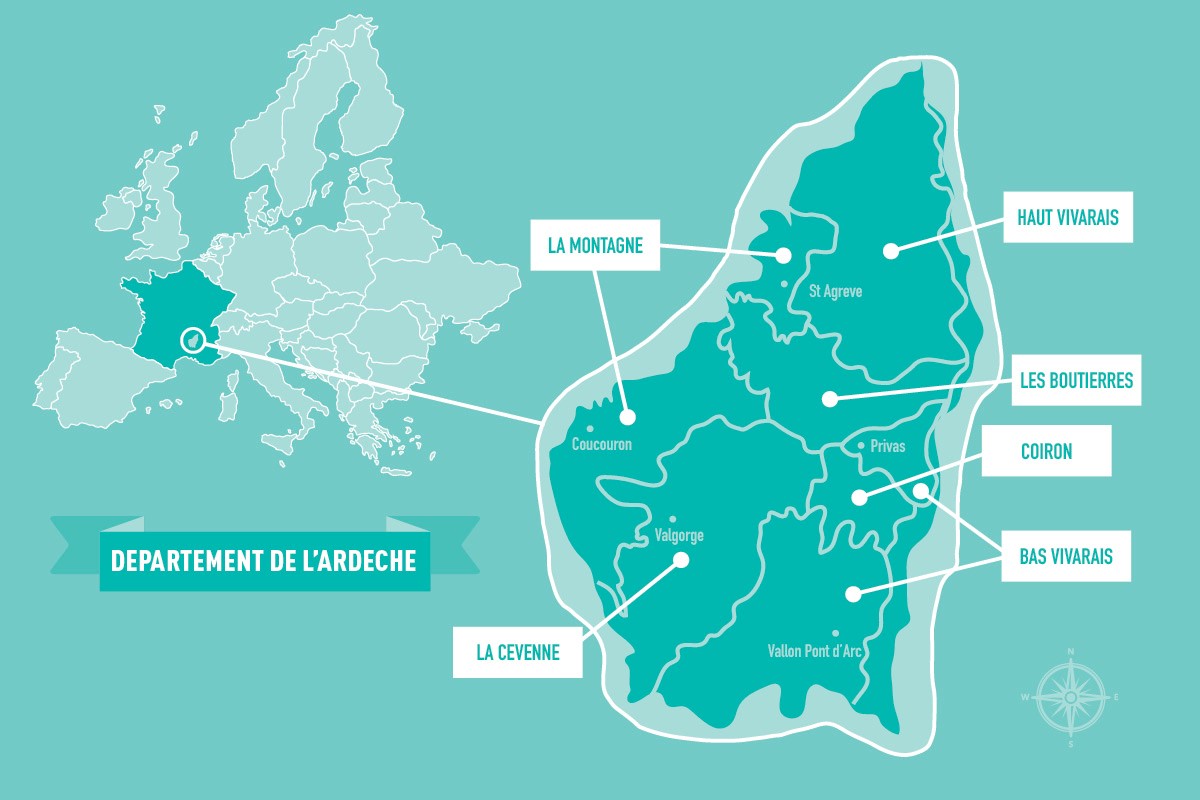
This song belongs to the repertoire of "Quête de mai" songs, which were presented on the night of April 30th to May 1st, from farm to farm, by young people collecting eggs, cheese, and money in exchange for their lucky songs. The proceeds from this round allowed for a meal (consisting of a gigantic omelet) which took place to conclude the evening or on the Sunday following the collection. In this song, wishes are expressed indirectly (successful harvests, children's marriages, etc.), and what is being asked for (cheese, money, etc.) is implied. [...] The custom, which fell into disuse around the 1950s, is tending to reappear in some villages, but few remember the May Day songs.
 "Chants de mai" by Johannès Duffaud
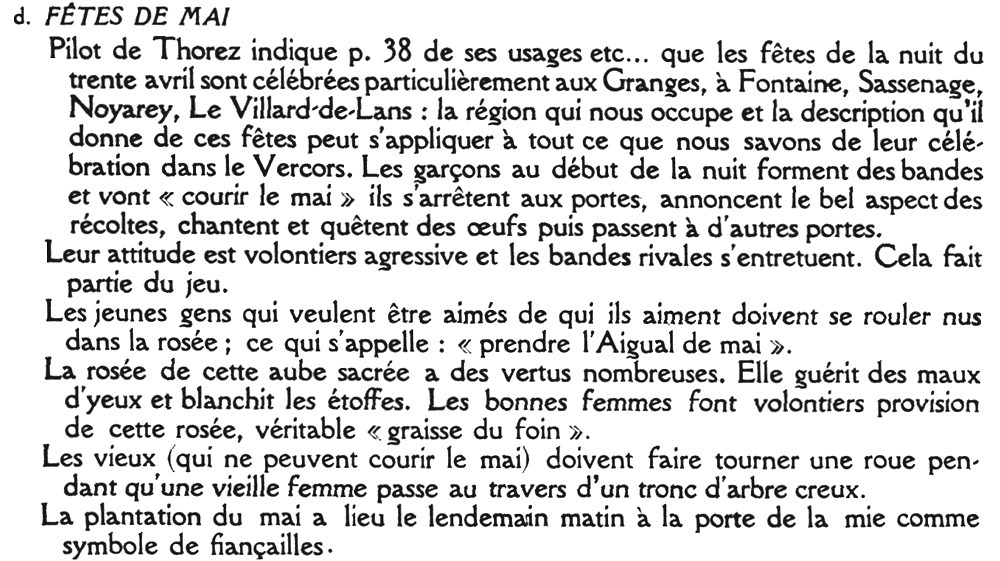 "Les fêtes de mai" Songs from the Dauphiné (Villard de Lans) Marguerite Gauthier-Villars - Editions Roudanez; 1929
1 Version notated in "Recueil de chants populaires du Nivernais" (Paul Delarue - and Achille Millien - Ed FOL de la Nièvre) - Series 6, page 38
2 Text taken from the booklet of the CD "Apprends-moi ton langage" produced by Dominique Laperche and Christian Oller. Vinyl edition: December 1985 produced by the Aigardent association and which includes, among other things, the recording performed by Jean Philippe, Denis Sales, collected by Sylvette Béraud Williams.
The interpreter's perspective on the work: Evelyne Girardon
“La pluie tombe sur nous” is in the mode of D built on the fifth: an authentic mode of D.
The D mode consists of 2 semitones and 5 whole tones divided as follows: 1 - 1/2 - 1 - 1 - 1 - 1/2 - 1
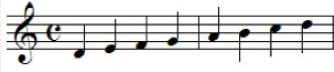
This mode, very widespread in the sung repertoires of the oral tradition, is noticeable in its two forms, authentic or plagal.
In the case of "La pluie tombe sur nous" (The rain falls on us), the sixth appears in two positions (B - Bb), creating a phrasing that ascends through the B and descends through the Bb. The mobility of the sixth does not change the fact that it is a mode of D. Evelyne Girardon: introduction to the work
In the sung version by Jean Philippe and Denis Sales, we note that the 4th degree of the mode (G) also presents another position (G#). This augmented fourth or diminished fifth can perhaps be interpreted as the leading tone of the reciting string (fifth = A).
Solmization
D D A A A G#-G# C C C C B A (repeat)
AA A Bb A G G A - G G G A A F E D
D F E D E F E – E D D D D E
E E A F E D A
D F E D E F E – E D D D D E
E E A G F E D
Évelyne Girardon uses the hand imagined by René Zosso in “Penser modal” (DVD Mustradem).
Another example
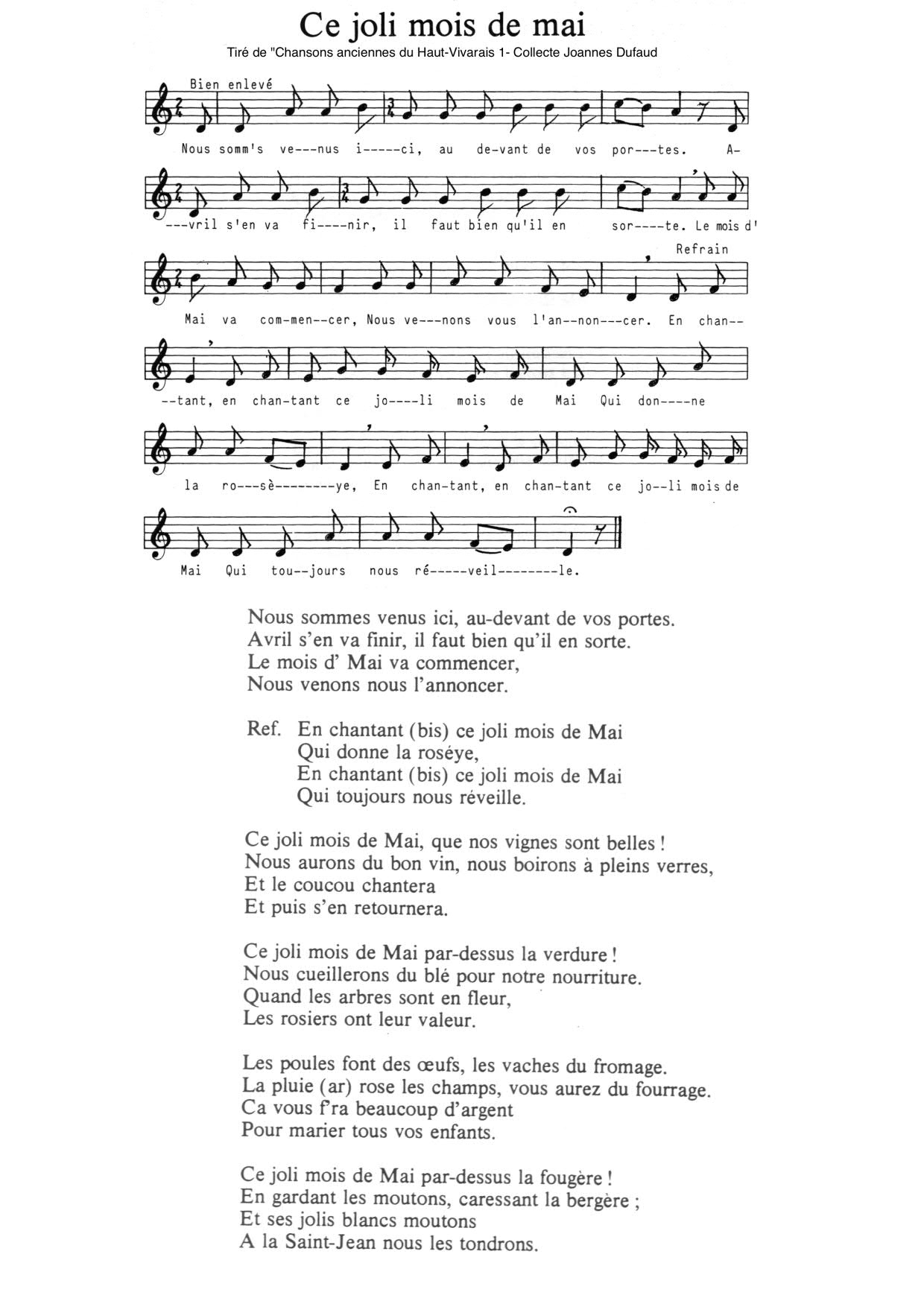
“Ce joli mois de mai” taken from “Chansons Anciennes du Haut Vivarais 1” Joannes Dufaud Collection: this song is an example of an authentic D mode with the sixth degree (B) which does not change.
The melody of this version, collected in the Ardèche region, provides an example of the authentic D mode without variation in the position of the sixth and without mobility of the fourth. This version can be considered a "cousin," a variant of that of Monsieur Jean Philippe, Denis Sales.
Lyrics from another song that presents similarities
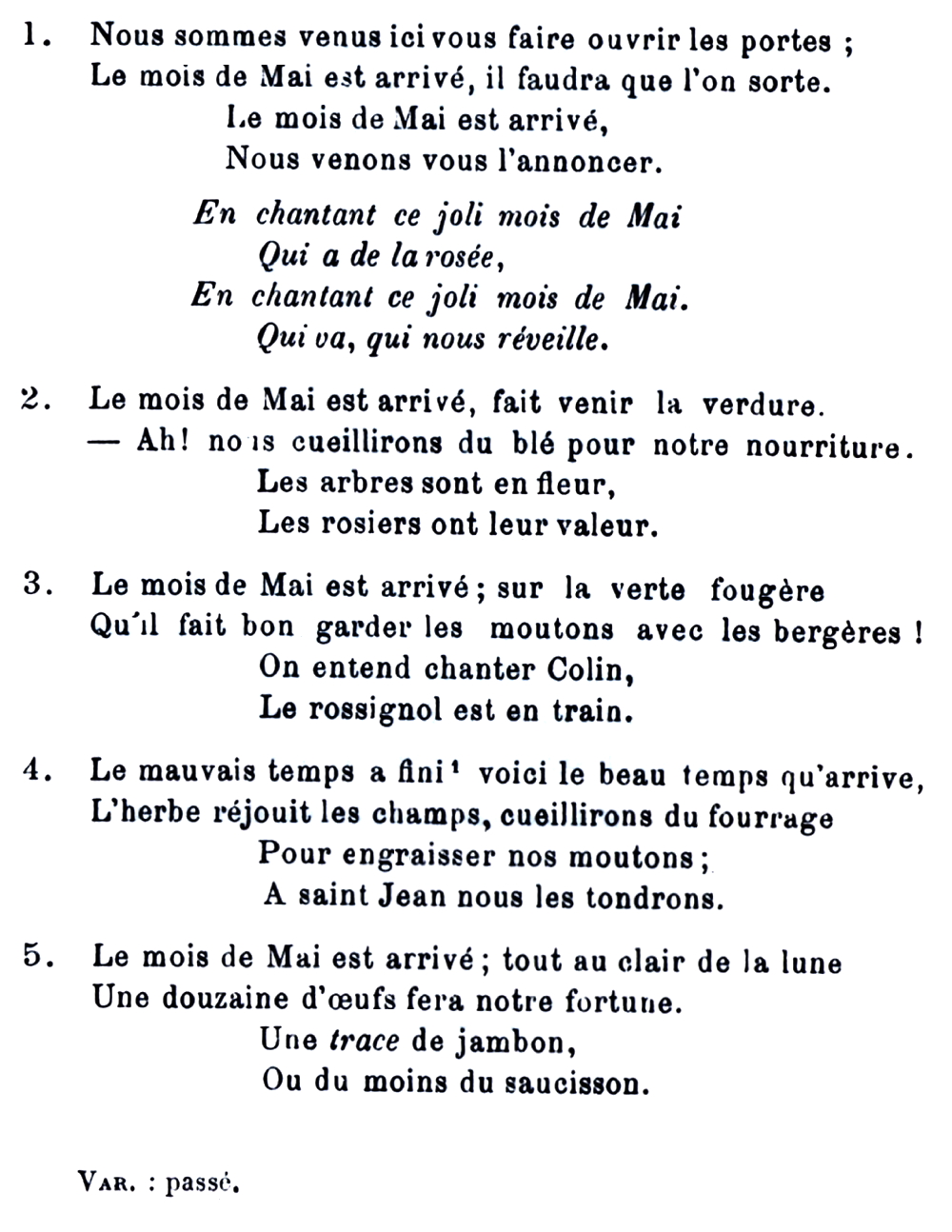
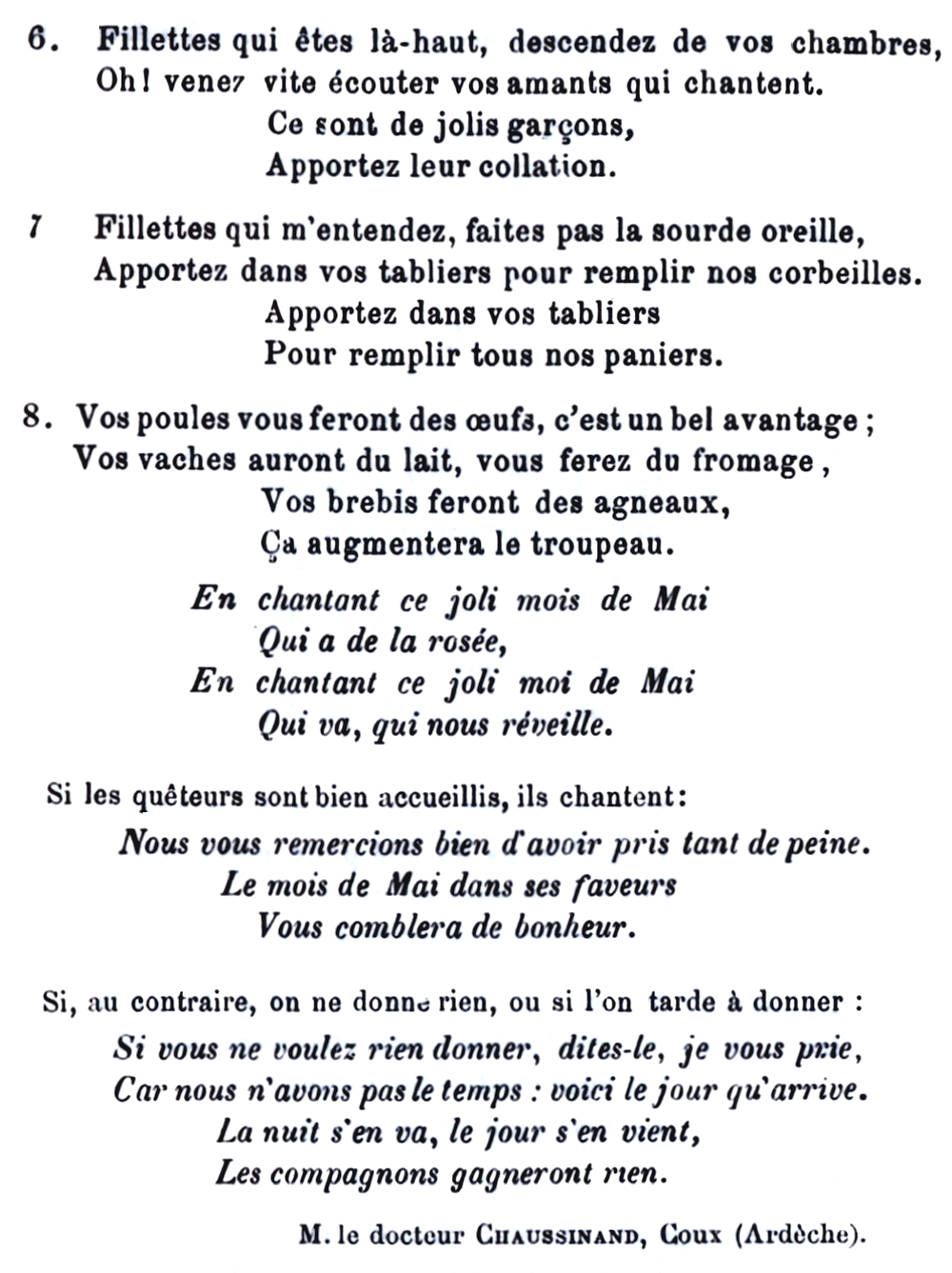
Coux version
Recorded by Louis Lambert (Popular Songs and Songs of Languedoc, published in 1906), collected by Doctor Chaussinand in Coux, Ardèche
No musical notation.
Video 3: Choosing the interpretation
The interpretation
The performer made a choice of polyphonic arrangement.
The song is performed by 5 voices.
Évelyne Girardon sings the melody while another voice acts as a drone, continuously holding the same note. This choice of vocal drone serves to highlight and support the melody.
Evelyne Girardon slows down the melody of the verse to highlight the text and the fluidity of the fourth degree. She also emphasizes that her interpretation of this fourth degree (augmented fourth or diminished fifth) stresses the choice of the drone reference, whereas Denis Sales expresses it in reference to the fifth, as a "leading tone" of this reciting string.
Document: Gregorian Modality - Jacques Viret - A Cœur Joie Publishing
The interval separating the final from the recitative string (the word "dominant" dates only from the 17th century) defines the category of the mode: it is a fifth for the authentic ones (except for the 3rd mode where the B has slipped to C); as for the recitative string of the plagals, it is located a third below that of the authentic ones of the same final (therefore a third above the tonic, except for the mode of G-C and that of E-A, where we have a space of a fourth).
Viewpoint of a general musicologist: François Picard
« La pluie tombe sur nous »- François Picard, May 2018
The reasons for a choice
This song was chosen for several reasons:
• Sung a cappella, it is a fine example of a secular modality in the French tradition
• The recording of an elderly farmer’s performance, collected and published by associative musicians who collect music, is a fine example of the transmission process over the last fifty years.
• Reinterpreted by a professional singer and renowned music teacher, and chosen for the baccalaureate exam, it has become a classic: a work to be studied in class. Its inclusion in the curriculum has ensured its widespread dissemination and an interesting range of interpretations, allowing music teachers in conservatories to explore their understanding of such modal language.
Materials available
The singer, "Monsieur Sales", was recorded in 1976 by a collector, Sylvette Béraud-Williams. The edited recording was released on cassette with a booklet in 1979, then on a folk-trad record in 1985, and subsequently in a collection published with the CNRS in 1987.
Evelyne Girardon produced her own version in 2005 in her album Répertoire d’après l’enregistrement publié par Sylvette Béraud-Williams, still with a bare voice but with a vocal drone, from which a second voice dissociates.
In addition to the recordings, collectors or people close to them produced transcriptions, as well as conservatory professors and musicologists and ethnomusicologists, who produced analyses.
During the development of this Modal Music Portal, the reference performer, Evelyne Girardon, produced her own analysis.
It is clear that while there is a vague consensus that it contains a modal feeling, there is no consensus on the qualification of this mode, nor on what gives it a modal character.
In this respect, this song (in the double interpretation by Mr. Sales and Mrs. Girardon) is exemplary of the secular modality of tradition in the French domain.
References
- Mr. Sales, singing, 77 years old, "The rain falls on us", February 17, 1976, Sylvette Beraud-Williams investigation
- Sylvette Béraud-Williams, Associacien Mont-Jòia (Universitat de Provença), dir., Popular songs from the country of Boutières (Ardèche), Sonògraf, 1979 with audio cassette.
- Sylvette Beraud-Williams, Aline and Dominique Laperche, Christian Oller, booklet accompanying the 33 rpm / cassette / CD Apprends-moi ton langage chansons traditionnelle d'Ardèche, folk trad Media: LP Gatefold L'Airgadent AIG 107, 1985.
- Sylvette Béraud-Williams, Popular songs of Ardèche collected in the Boutières region, Aix-en-Provence: Edisud; [Paris]: Editions du CNRS, 1987.
- Harmonized version by Jean Férole
- Evelyne Girardon, vocals, "La pluie tombe sur nous", based on the recording by M. Sales, arranged with drone, linked with a briolage from Berry, repertoire disc, 2005.
- Olivier Hussenet (vocals) and Cyrille Lehn (piano), baccalaureate documents, CNDP, November 2008.
Denis Sales' version
Description
- Singing unaccompanied vocals
- Male voice
- Text in French
- Syllabic text-melody relationship
- No spoken beat
Transcription
La pluie tombe sur nous, pour vous quel avantage ?
Vos vaches auront du lait, vous ferez des fromages,
Vous en tirerez de l’argent,
Pour marier tous vos enfants.
En chantant
De rantanplan
Ce joli mois de mai
Qui toujours nous réveille. (bis)
A transcription in E minor (one sharp in the key signature) with alternating 2 and 3 beats per measure is published in the booklet; here it is:
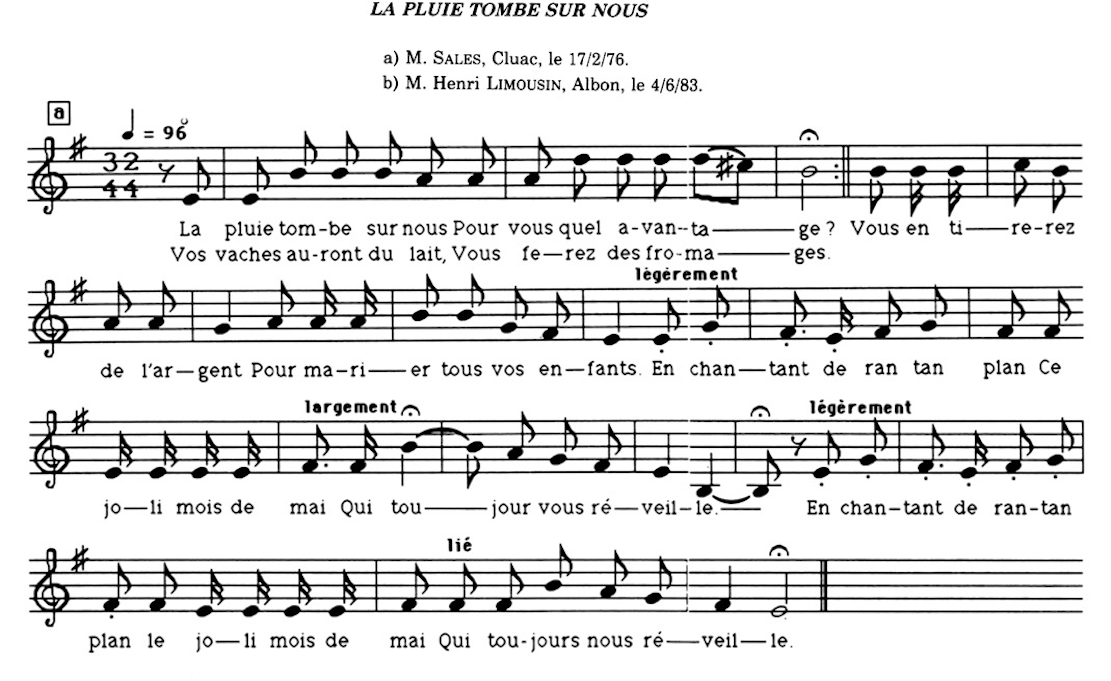
Musical Example 1: Score "La pluie tombe sur nous"
To accurately measure the sung pitches, it was deemed useful to compare several interpretations of the same phrase.
By superimposing them, it turns out that the first phrase, "La pluie tombe sur nous pour vous quel avantage" is exactly the same in both verses.
The details of the process leading from recording to publication are not documented, but it is clear that the technical similarity implies copying during editing. Asking this question allowed us to trace the original recording back to its source, which clearly shows that it underwent duplication during editing.
Original recording by Jean Philippe, Denis Sales, collected by Sylvette Bérault-Williams
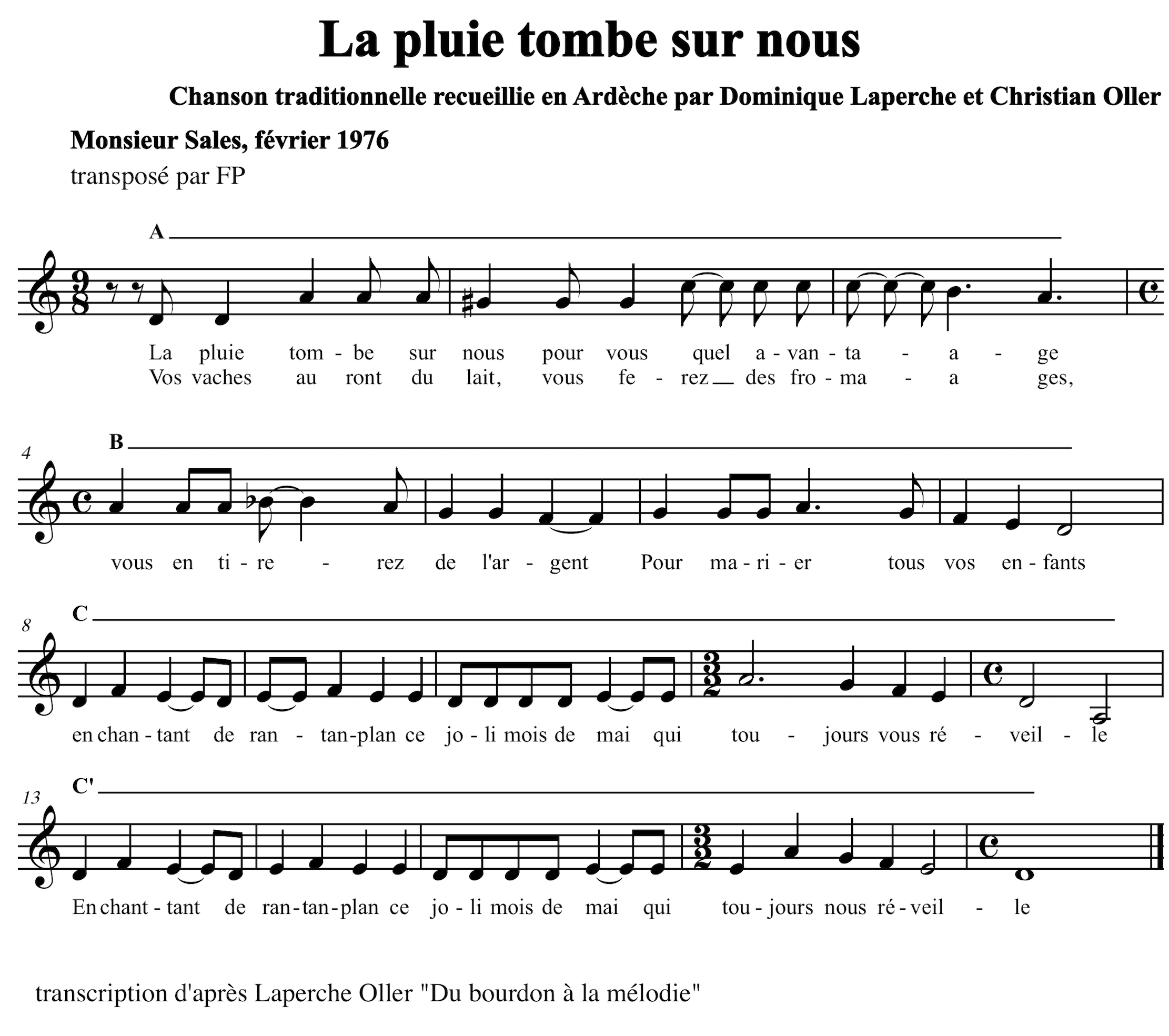
Musical Example 2 "La pluie tombe sur nous" forme (François Picard)
Four phrases can be distinguished in the text:
a) La pluie tombe sur nous, pour vous quel avantage ?
a) Vos vaches auront du lait, vous ferez des fromages,
b) Vous en tirerez de l’argent, Pour marier tous vos enfants.
c) En chantant De rantanplan Ce joli mois de mai Qui toujours nous réveille.
Three phrases can be distinguished musically:
a) D A C A, with G# and B (twice)
b) A Bb A G F, A G F E D
c) D F E D / A G F E D (E)
a) range D C
b) range D Bb
c) range D A (E)
b) and c) are perfectly compatible with a D mode.
The piece begins and ends on D, with:
a) D A
b) A D
c) D D
The general form of the song, if we omit the repetition of the first phrase of stanza II at the beginning of the song, is therefore: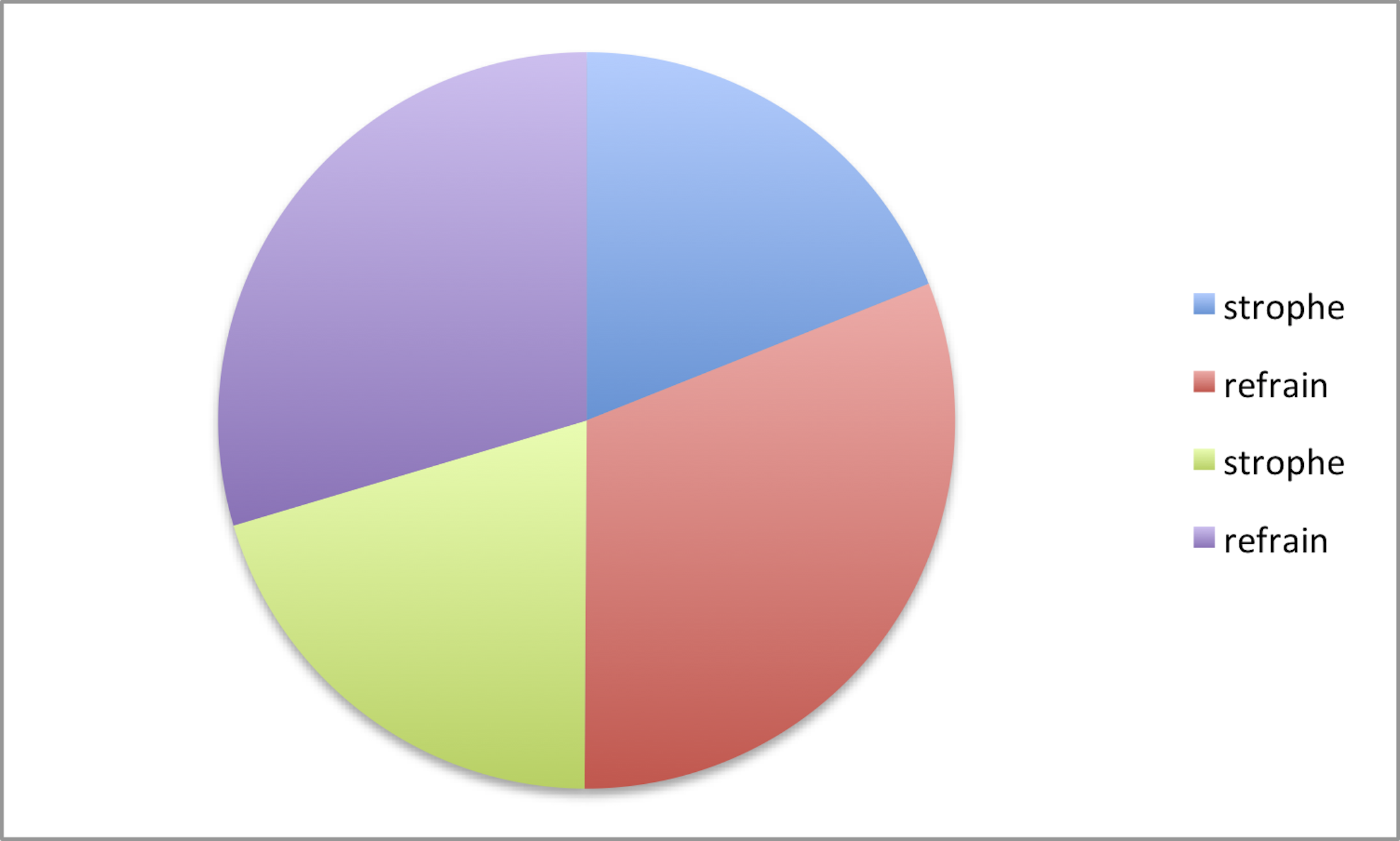 Diagram 1 "La pluie" Denis Sales, form
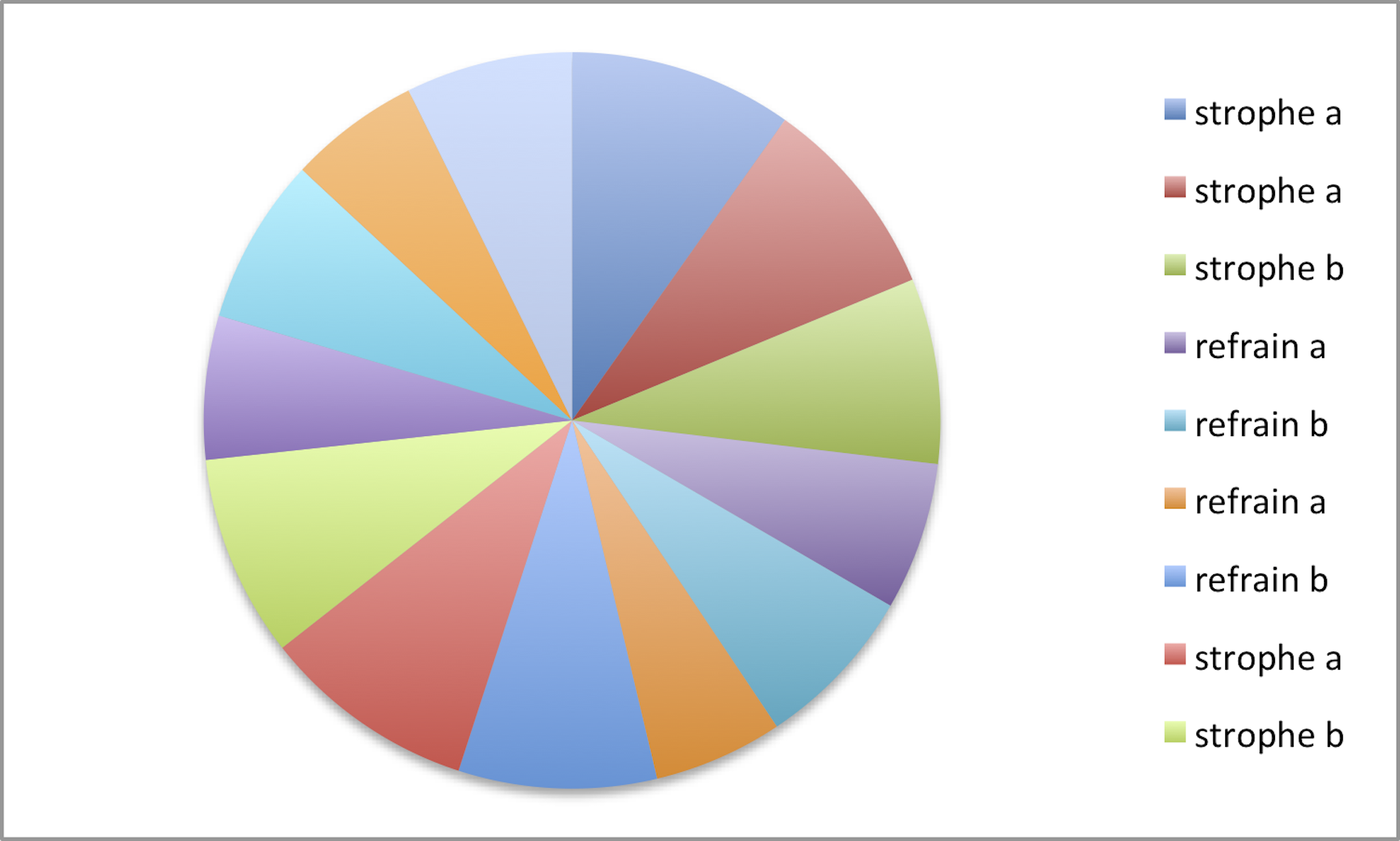 Diagram 2 "La pluie" Denis Sales, form
Musical analysis: three listenings
Let's simplify:
For Evelyne Girardon, the song is in a D-A mode with a movable sixth.
For Olivier Hussenot, we are dealing with an exotic, "Gypsy" or "Hungarian" mode.
For François Picard, the mode is clearly a first mode, or D mode, and the B is naturally movable (flat ♭ or ♮ natural, soft b or flat square). In this, he follows the interpretation of the original 1985 transcription.
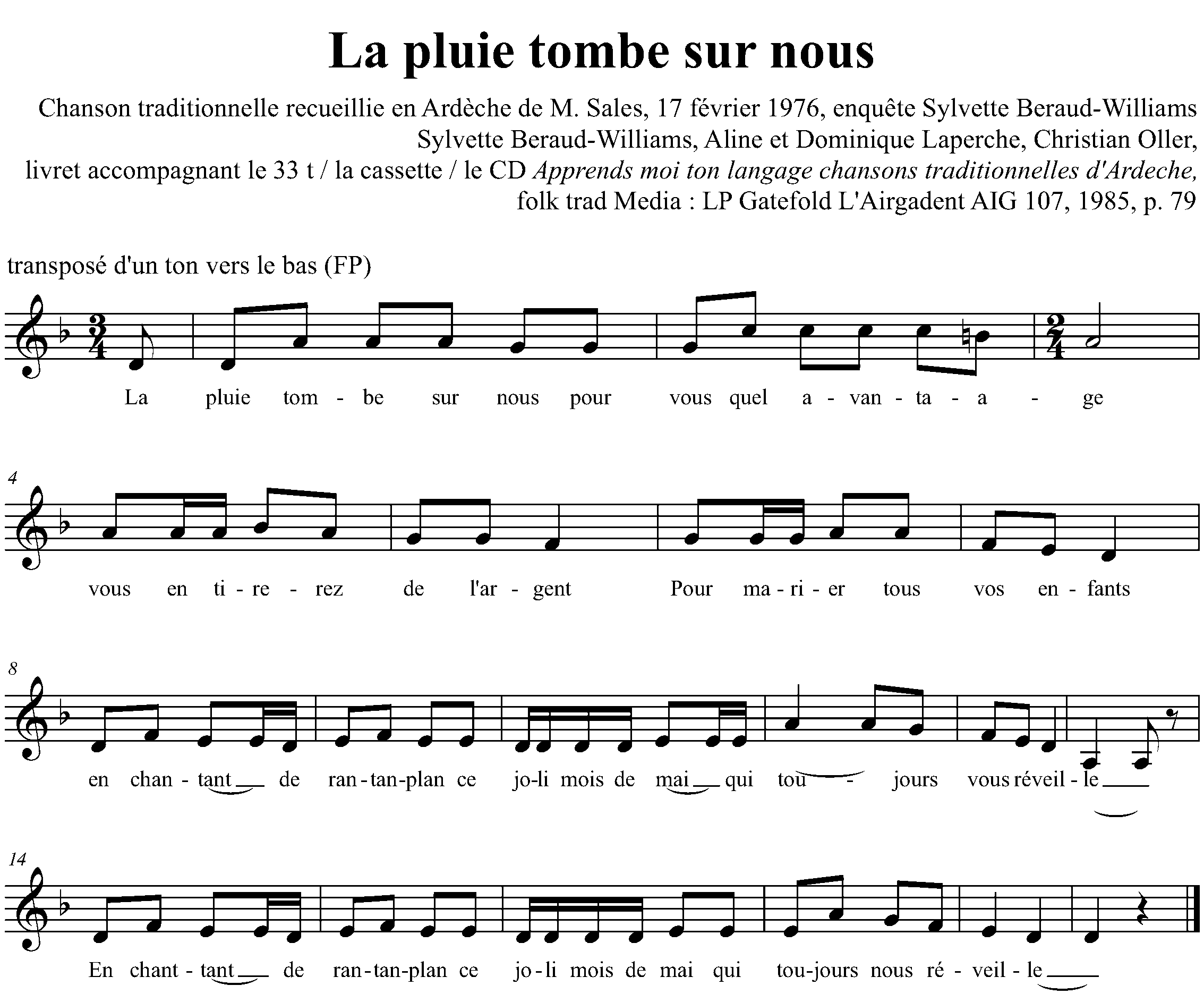
François Picard's adaptation (or rectification) removes the accidentals; note that the beginning and end notes are all D-D: we are in the D mode.
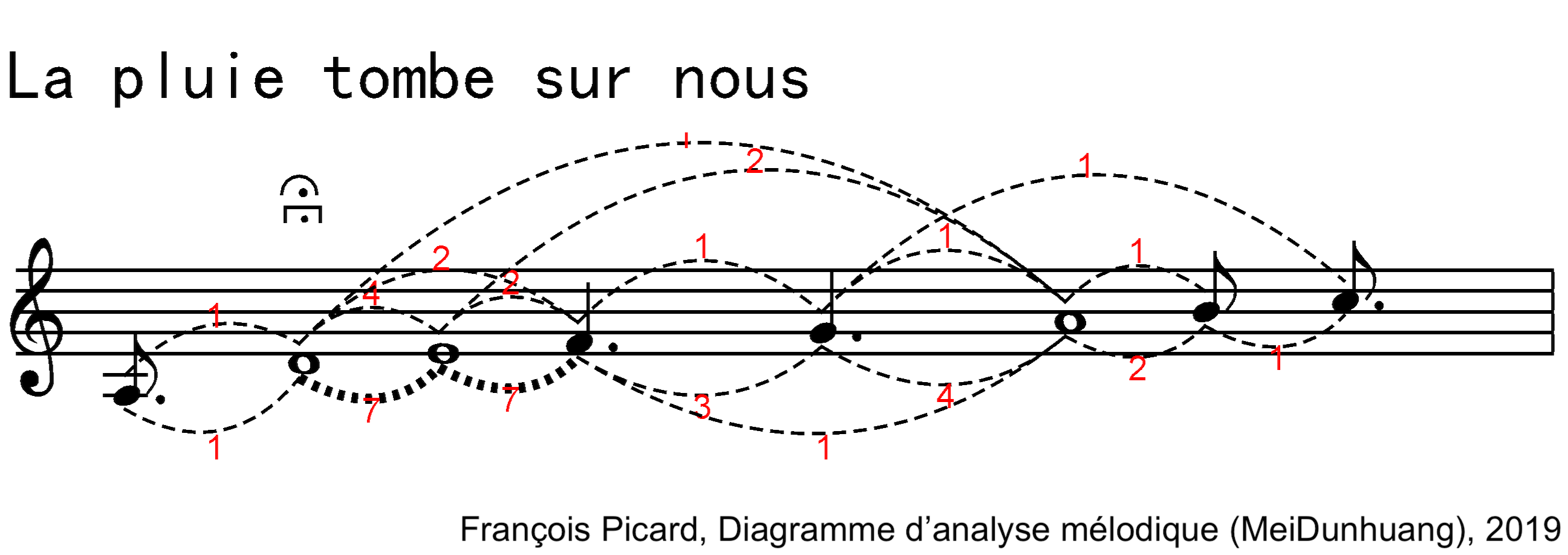 Melodic Analysis Diagram 1 "La pluie tombe sur nous"
The melodic analysis diagram is a synthetic version, obtained here with DunhuangXml developed by Vincent Boucheau for IReMus.
Research in digitized Gregorian chant databases (globalchant.org) reveals other pieces with the same incipit:
 Musical Example 4 « Mittens haec mulier »
 Musical Example 5 « Fortissimorum crucis Christi »
Towards a Different Understanding
Evelyne Girardon’s insistence, whose interpretation (vocal and analytical) increasingly tends to shorten the melodic interval between the fourth and fifth (in the transcription on D, the G# tending towards A), has led to a reassessment of the initial, standard transcription, which flattened the melodic particularity onto a tranquil first tone (the mode of D). A careful listening to Mr. Sales' recording, aided by visualization and pitch measurement tools (Beyhom-Miramon-Bonhoure protocol under Praat), reveals the distinctive feature: starting from the fundamental D, the fifth is perfect (A) and the fourth is high (G#).
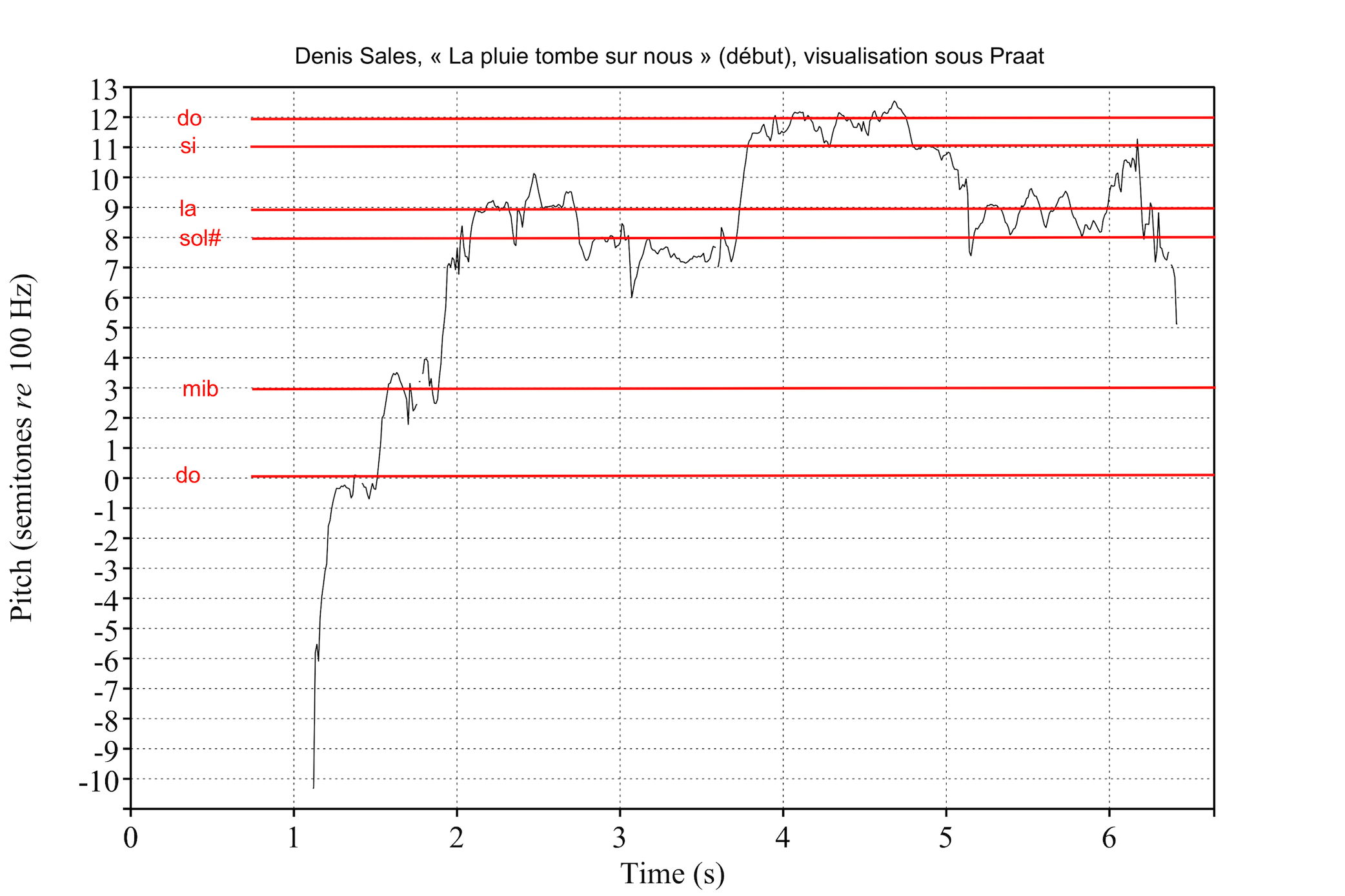 Illustration 1 : M.Sales, beginning of the 2nd verse
If we take this intonation and inflection seriously, we notice that it only affects phrase a, which is otherwise sung unmeasured.
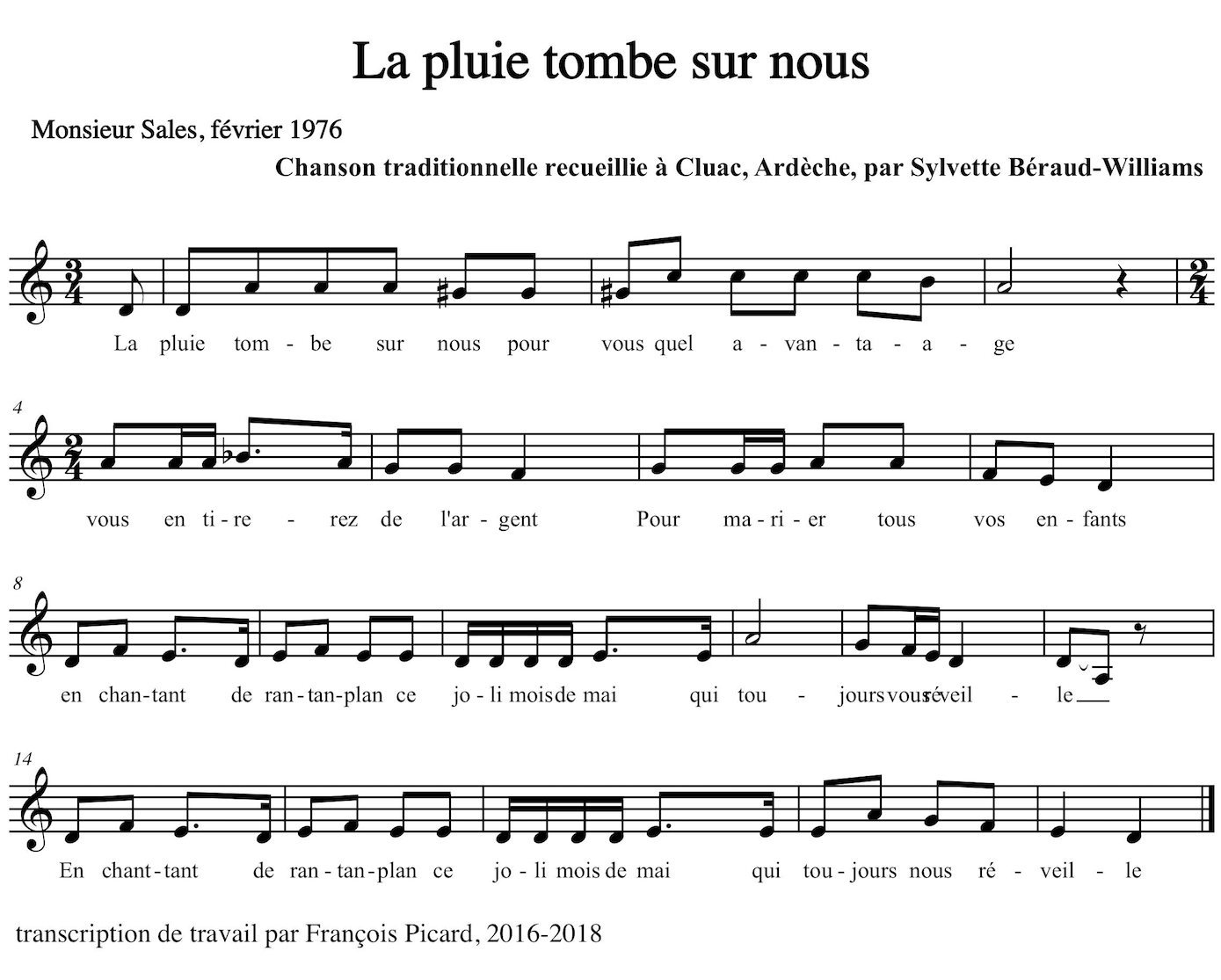 Musical Example 6: "La pluie tombe sur nous" analytical transcription, on D.
If we take seriously the new, more accurate transcription, which served as a model for Evelyne Girardon, we cannot apply the Gregorian chant system, which dictates that ditons, a sequence of two major tones characteristic of the modal core, are solfèged "F-G-A" and that semitones are solfèged "E-F".
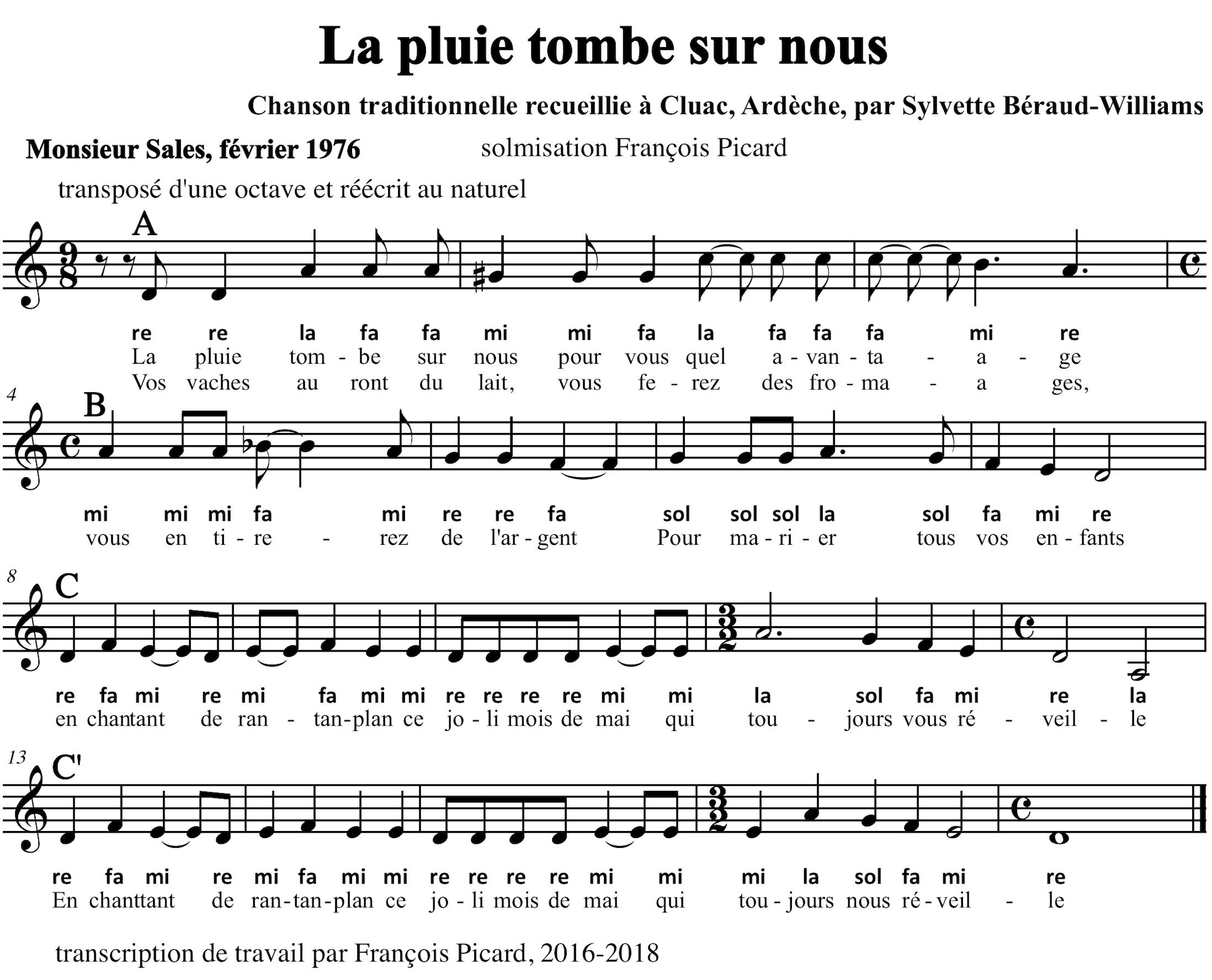 Musical Example 7: Transcription by François Picard based on the collection by Dominique Laperche and Christian Oller - "Du bourdon à la mélodie" music education - by nikkojazz.
This attempt at solmization is unsuccessful; it clearly demonstrates that the diminished fourth G#-A-B-C cannot be equated with a major third when sung. Nevertheless, sections B and C are perfectly compatible with Gregorian solmization.
If we take seriously what the collectors said in 1985 (bibliographic reference p. 31):1) :
It was very widespread in the Haut-Vivarais, the Boutières, on the Ardèche Plateau, and as far as Coux, where a version for eight couples was notated by Lambert.
We are led to examine this song within a substantial, older corpus collected by Louis Lambert:
Louis Lambert, Chants et chansons populaires du Languedoc (Popular Songs and Songs of Languedoc), Paris, 2 volumes, 1906.
This collection has been published in facsimile online:
https://archive.org/details/chantsetchansons01lamb
https://archive.org/details/chantsetchansons02lamb
Since it is easier to recognize lyrics than a theme, and lyrics than a melody, we first find this:
On the night before the first day of May, young boys go from door to door begging for bacon and eggs, to celebrate together the following Sunday the arrival of spring. They do this begging while singing the following song, which they do not sing in its entirety; if they have been generous, they sing the first five verses; But otherwise, they replace this fifth verse with the sixth.
Louis Lambert, Chants et chansons populaires du Languedoc, Paris, vol. 2, 1906, p. 164.
1.Nous sommes venus ici vous faire ouvrir les portes ;
Le mois de Mai est arrivé il faudra que l’on sorte.
Le mois de Mai est arrivé
Nous venons vous l’annoncer
En chantant ce joli mois de Mai
Qui a de la rosée
En chantant ce joli mois de Mai
Qui va qui nous réveille.
We have, of course, recognized the refrain of the song sung by Denis Sales.
It is noted that the song here was not collected directly by Lambert, nor generally attributed to the vast region of "Languedoc", but that it is part of the collection gathered by "Dr. Chaussinand, Coux (Ardèche)".
This collector is "Dr. Chaussinand of Saint-Dizier who, while vacationing in Coux, collected the village songs during the Second Empire."
Janine Jail, http://www.patrimoine-ardeche.com/visites/coux.htm
He was director of the asylum for the insane in 1914, although honorary director in 1902, and vice-president of the Society of Letters, Sciences, Arts, Agriculture, and Industry of Saint-Dizier in 1924.
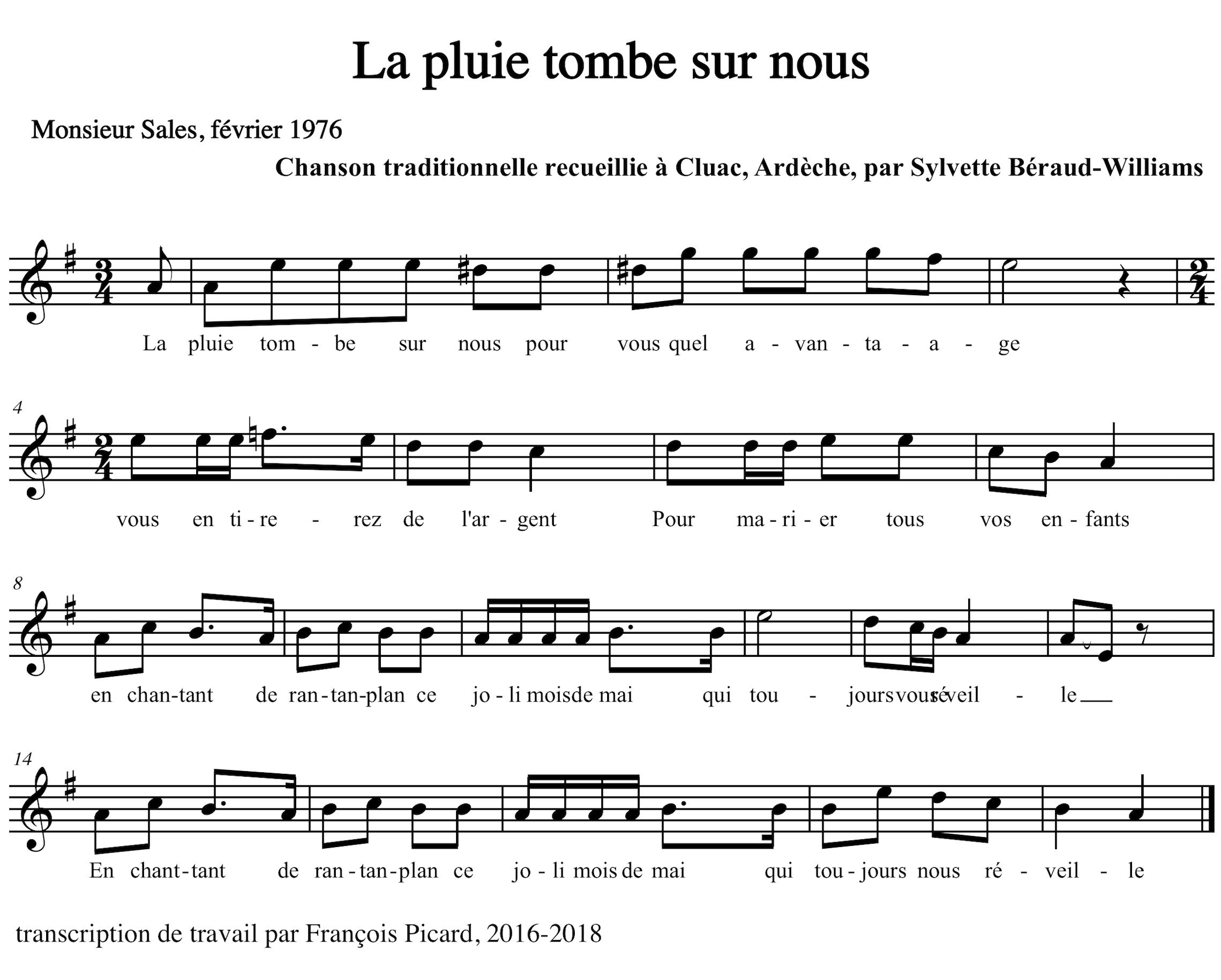 Musical Example 8 "The Rain Falls on Us" analytical transcription
If we now transpose to the final A, we obtain a scale and melodic movements that are found elsewhere in the same collection.
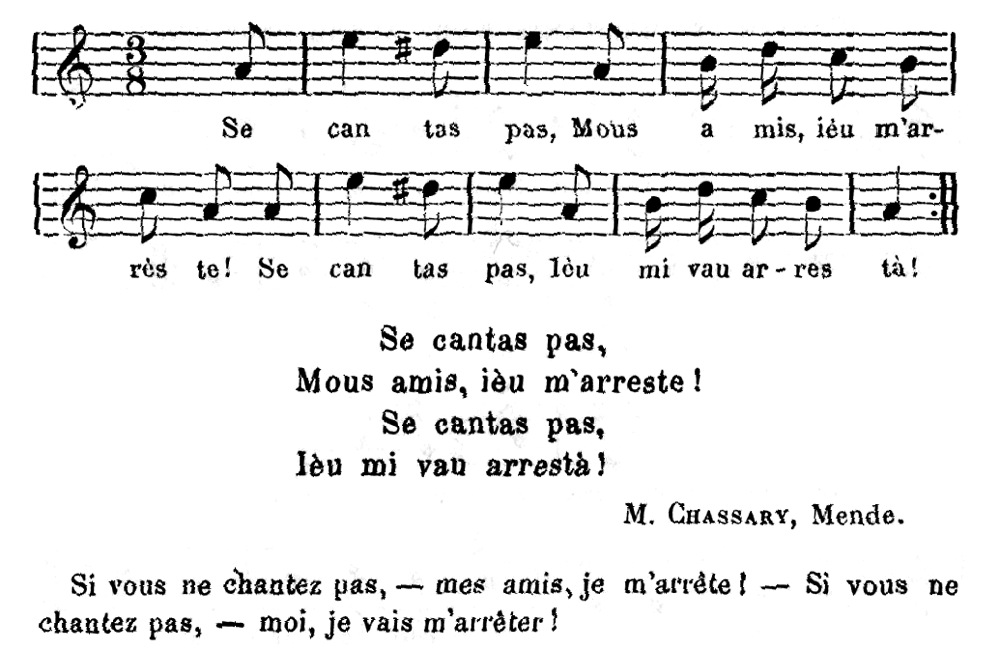 Musical Example 9 "Se cantas pas" Languedoc 2 p. 6
Louis Lambert, Chants et chansons populaires du Languedoc, Paris, vol. 2, 1906, p. 6. https://archive.org/details/chantsetchansons02lamb
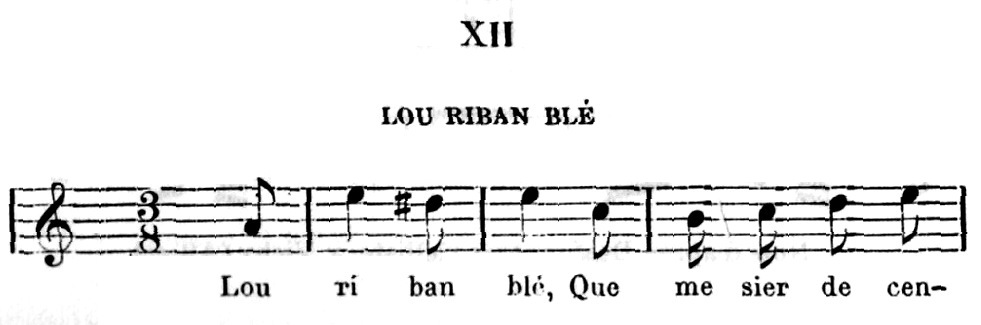
Musical Example 10.1 « Lou riban blé »
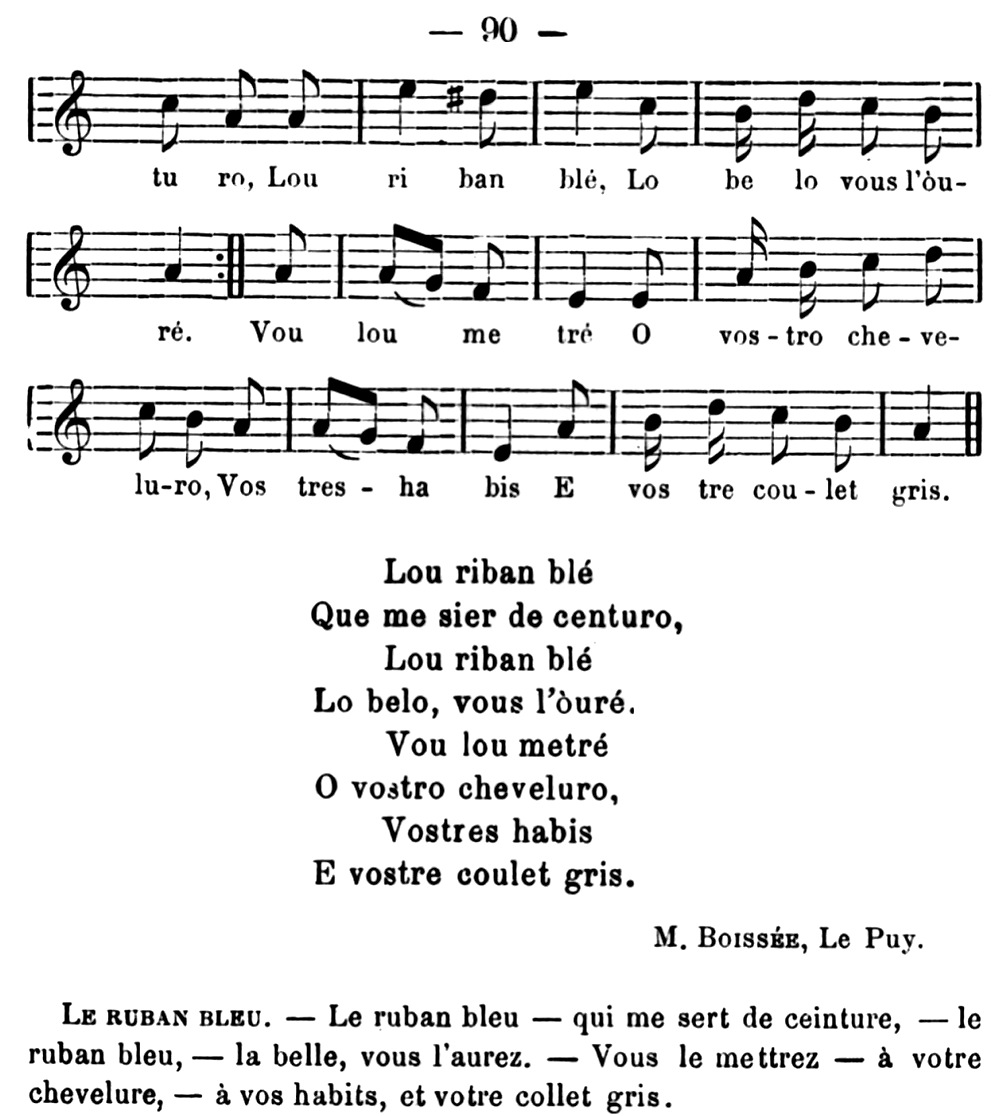 Musical Example 10.2 "Lou riban blé"
Lambert, ibid. p. 88-89 et 97.
Other examples of augmented fourths (noted as A, E, D#) can be found in Lambert’s collection, all located in the Ardèche region.
Finally, if we disregard the tempting lead of the opening line “La pluie tombe sur nous” (The rain falls on us) and focus on the attested context of the May song, we find an example that seems to resolve both the question of form and that of mode: the song “Joli mois de mai” (Lovely month of May).
Joli mois, mois de Mai
"Joli mois de mai", collected in the Ardèche region by Joannès Dufaud (1924- ), edited by Jean-Pierre Huguet, 2000, included in Rassat's collection.
Joannès Dufaud, 300 chansons populaires d'Ardèche, St-Julien-Molin-Molette, Jean-Pierre Huguet, 2000
Origin : Ardèche (Saint-Martial)
Year of arrangement: 2004
French popular songs website
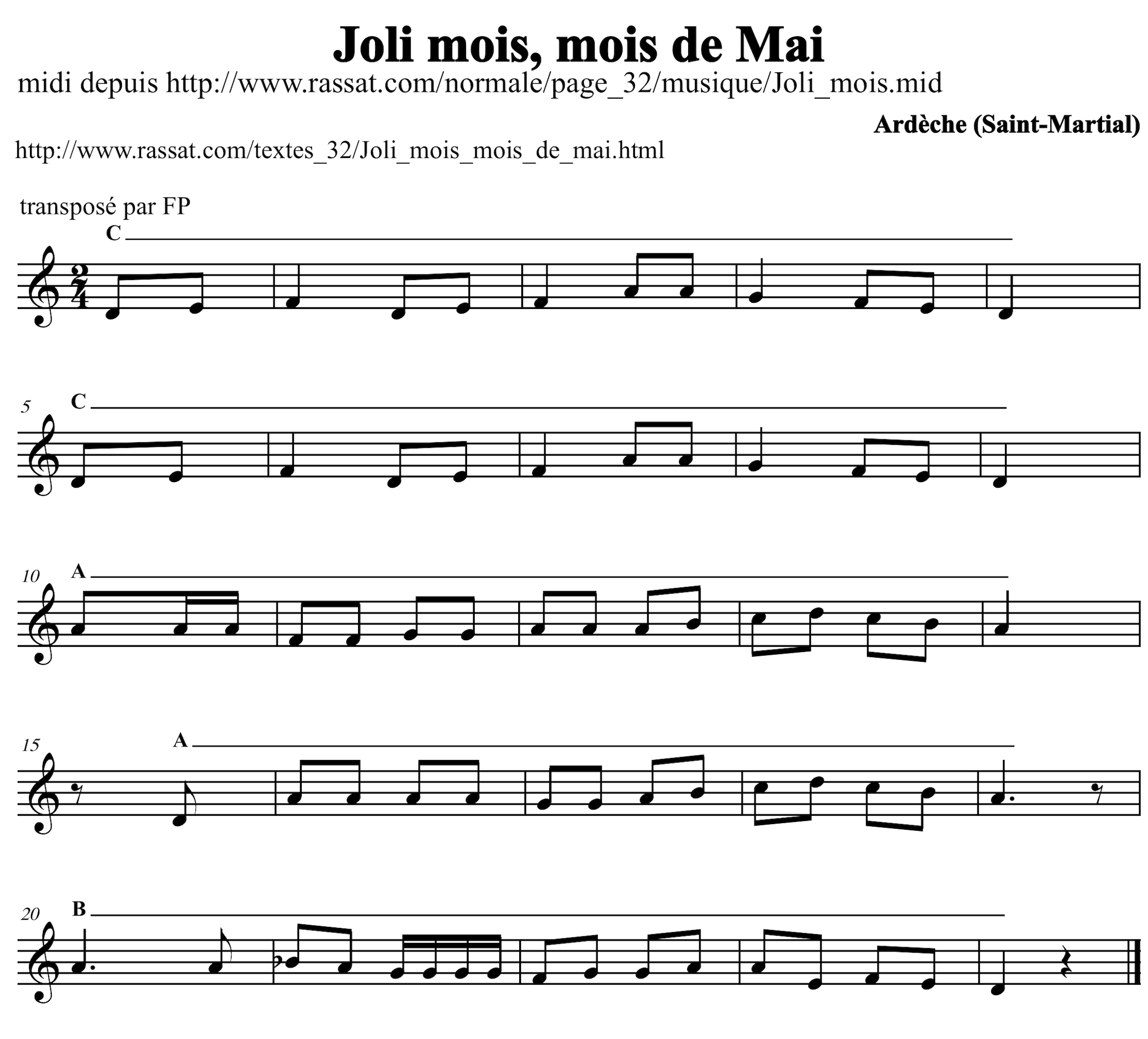 Musical example 11 “Joli mois de Mai” form (Picard) on D
By writing “Joli mois de Mai” on D, the form appears obvious, and like a variation of the song by Denis Sales.
We can thus arrive at a hypothesis that is both genetic and functional: it explains how Mr. Sales' song works, and it explains the system of songs in the Ardèche region (and undoubtedly well beyond).
This system is the formulaic system..
A Formulaic Modality
The formulaic system is that of centonization, well known to folklorists committed to the text.
The term "formulaic" also refers to one of the two observed ways of understanding modality, even in modal systems as established as the Iraqi maqam or Gregorian chant: we observe that two recognized expert performers can say they feel and explain the same mode, one through a set of characteristic formulas and turns of phrase, memorized and classified, the other through a scale with its hierarchy; in general modality theory, the first understanding is called "the formulaic mode" and the second "the scalar mode." It is observed that few musicians and musicologists are able to move seamlessly between the two perspectives, which isn't a major issue, since it doesn't prevent musicians from playing together. More problematic, however, is that few musicians, educators, and musicologists are willing to consider that their vision is not the only one, or at least not the only true one.
In conclusion, Mr. Sales's modality in "La pluie tombe sur nous" (Rain Falls on Us) does not easily lend itself to an explanation based on scalar modality ("it's a mode of D," "the fourth is attracted to the dominant like a leading tone to the tonic") but is brilliantly explained by a formulaic function, made up of borrowings that are not random, but guided by this strange feeling that these fragments appear to belong to the same whole, and not to other melodic sets in the same repertoire, that these fragments are building blocks that can be assembled into A A B C C' ("La pluie tombe sur nous"), but also into C C A A B ("Joli mois de mai"). These building blocks are characterized by phrases ranging from D to A and from A to D, with the third D-E-F and the movable notes B and G.
François Picard, in that lovely month of May 1968+50
***
For François Picard, the song "La pluie tombe sur nous" (The Rain Falls on Us) shares characteristics with other songs from the South of France, particularly from the Ardèche region.