

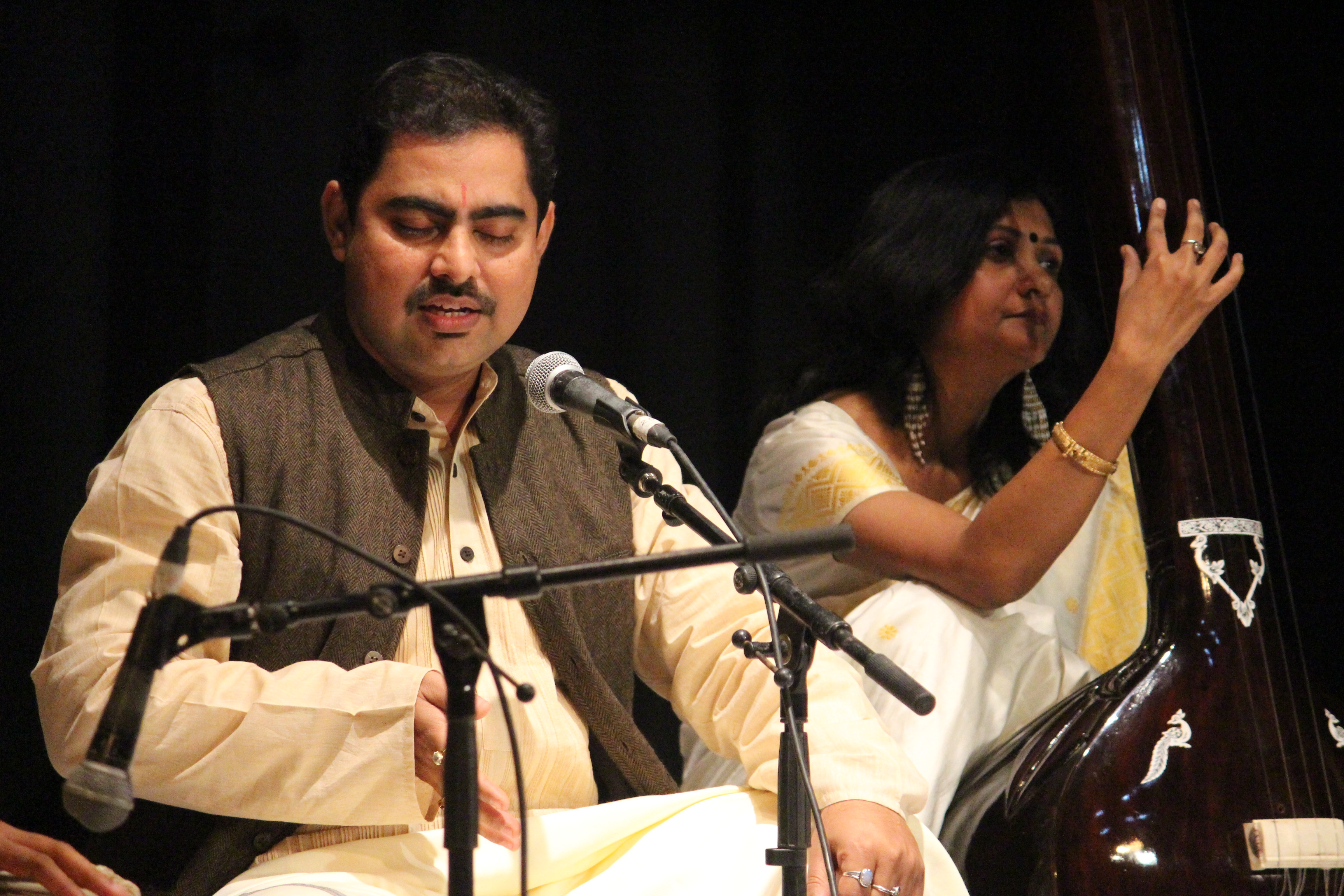

Raga Nat bhairav
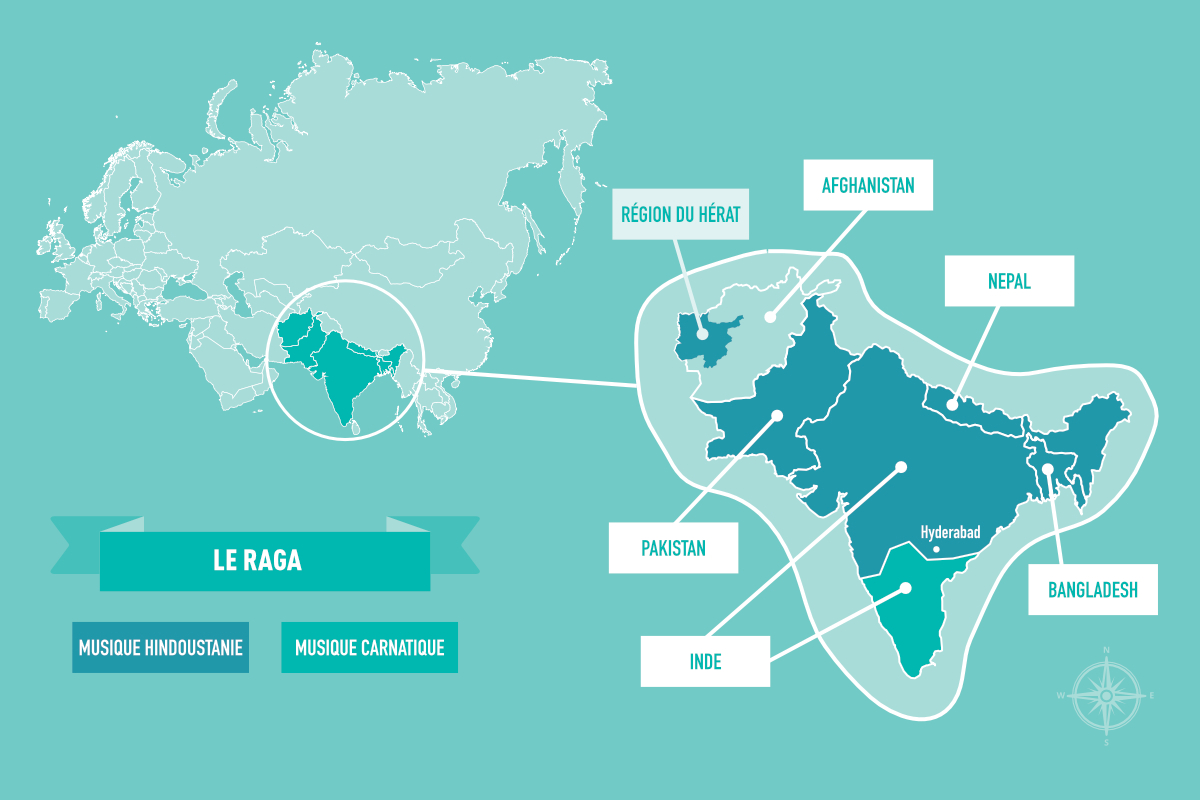
Hindustani music is found in North India, Pakistan, Bangladesh, and, to a lesser extent, in the Herat region of Afghanistan.
Overview of the Work
Khayāl chant in the rāga Naṭ bhairav by Sudhanshu Sharma, recorded in Delhi in October 2017 for this module.
Khayāl is the main vocal genre of Hindustani music.
"Tero gun bhed apār" [Your qualities and your mystery are infinite] is a devotional khayāl chant by an anonymous composer. It is presented within the sixteen-beat metric/rhythmic cycle (tāla) called addha tāla, which is a variation of the basic tīntāla cycle, in medium tempo.
Sthāyī: Tero gun bhed apār
tu nirādhār ke hī ādhār/
Antarā: Anāth ke nāth
dīn ke sāīn
dijo daras sākār//
Your qualities and your mystery are infinite.
You are the defender of the weak.
[You are] the protector of the neglected,
[You are] the God of the poor,
Please take form before us!
Rāga Naṭ bhairav
In Indian classical music, both in the North (Hindustani music) and the South (Carnatic music), modality is embodied by the notion of rāga.
Concept of Raga
Each raga is defined by an ascending (āroha) and descending (avaroha) scale, sometimes different, by dominant notes called vādī (speaking) and samvādī (co-speaking), by a hierarchy of note importance, as well as by characteristic movements (calan) and melodic phrases (pakaḍ). Each raga is also associated with a playing time (prahar) or a season, as well as a dominant feeling (rasa).
A raga is presented as a musical being endowed with its own personality and character.
Henri Tournier's presentation of the concept of rāga
"In Hindustani music, the tālā is a particular system of rhythmic cycles whose concept is very close to the metrics of poetry. The first beat of the rhythmic cycle is the sam. Each rhythmic cycle is characterized by a number of beats (mātrā), distributed in sections (vibhāg) that can be of unequal length."
Rāga Naṭ bhairav
Visual Representation of the Piece
The transcription system, custom-designed for this specific context, presents Indian and Western notations in a complementary manner. For the notation of the unmeasured preludes, ālāp, it draws inspiration from proportional notation, used in contemporary Western music by some composers.
Presentation of the rāga Naṭ bhairav
The Rāga Naṭ bhairav is a variety of the Rāga bhairav, one of the fundamental rāgas of the Hindustani repertoire, traditionally performed at sunrise.
It is a composed rāga, combining elements of the Rāga Naṭ and the Rāga Bhairav.
The main difference from the scale of the latter is the use of a natural second degree (major second) instead of a lowered second degree (minor second).
This is a heptatonic rāga (sampūrṇ) with a lowered sixth degree (minor sixth).
The first and fourth degrees are the important notes of the scale.
The sixth degree is presented with a characteristic slow oscillation (āndolan).
This rāga is recent, having developed in the second half of the 20th century.
The ascending (āroha) and descending (avaroha) scale of this raga and several characteristic melodic phrases are presented below and compared with the ragas Naṭ and Bhairav from which it originates. Performance often presents a more subtle reality.
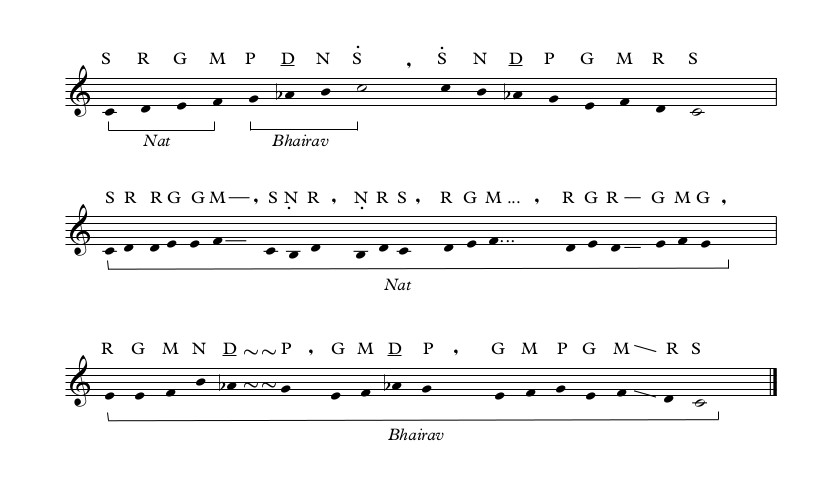
Raga Nat Bhairav scale - Complete Score
Explanation of the Raga Nat Bhairav by Sudhanshu Sharma.
Presentation of the Raga Nat Bhairav by Henri Tournier
Presentation of the Rhythmic Cycle
Regarding the rhythmic cycle, or tāla, it is notated below the melody line. The first beat of the rhythmic cycle is the sam, marked by a cross: X.
Each rhythmic cycle is characterized by a number of beats (mātrā), divided into sections (vibhāg) which may be of unequal length.
The numbers indicated on the second line mark the division of the cycle: 0 signifies an unmarked beat, or khālī, and 2, 3, and 4 indicate the marked beats.
Tīntāla is one of the most common rhythmic cycles in Hindustani music. It is divided into four sections of four beats each.

The Division of the Tīntāla Rhythmic Cycle
The strikes of the tablā are represented verbally by bols, sequences of onomatopoeic sounds that embody the ṭhekā, the basic rhythmic phrase characteristic of a given rhythmic cycle (tāla).
The ṭhekā is the specific arrangement of a tāla. The bols allow for the verbalization and memorization of the rhythmic subdivisions of the cycle. Syllabification is central to both vocal and instrumental learning of Hindustani music.
The bowls of tāla tīntāla are: dha dhin dhin dha / dha dhin dhin dha / dha tin tin ta / ta dhin dhin dha

Saptak Sharma plays an addha tāla, a variation of tīntāla.
Video explaining the rhythmic cycle by Saptak Sharma
Notation System and Specialist's Perspective
The Indian System of Musical Notation
In the context of Indian classical music, notation primarily serves as a memory aid, since learning is mainly achieved through listening, memorization, and repetition. Hindustani music remains, in fact, a music of oral tradition.
The Hindustani musical system is a syllabic system that uses seven notes or degrees, which are abbreviated as shown in the following table. The notes of the Indian system (Sa, Re, Ga, Ma, Pa, Dha, Ni) can be related to the seven notes of the Western scale (do, re, mi, fa, sol, la, si).
However, the reference note Sa has a variable pitch: depending on the singer's vocal range and the instrument played, the fundamental can vary.
The Hindustani musical system places great importance on the intervals between notes, particularly the interval between a given degree and the fundamental, which is continuously recalled by a drone accompanying every performance. The manner of attacking or ornamenting a note, and the way several notes are linked together, are characteristic elements of certain rāga. Not all of these ornaments can be precisely transcribed.
To facilitate transcription and reading, we have here equated Sa with the C of the Western musical system.
In the Hindustani melodic system, the reference note (Sa) and the fifth (Pa) cannot be altered: the first and fifth degrees of the scale are fixed. While the second, third, sixth, and seventh degrees (Re, Ga, Dha, and Ni) can be lowered (komal), only the fourth (Ma) can be raised (tivra).
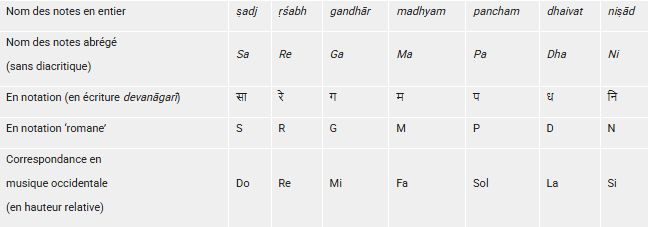
Names of Indian Notes and Their Notation
The scale uses twelve semitones or degrees of adjustable pitch (the concept of śruti or micro-interval) and spans three registers: lower (mandra), middle (madhyam), and upper (tār).
A dot below the note indicates that it is played in the lower register, and a dot above it indicates that it is played in the upper register. The term saptak refers to the series of seven degrees of the scale.
The usual symbols of the Indian notation system, or "sargam" notation (named after the first four notes of the scale), are presented in the following table.
The notation system considered here is the "Bhatkhande" system, which is currently the most widely used system in North India. It is named after the musicologist who developed it, Vishnu Narayan Bhatkhande (1860-1936).
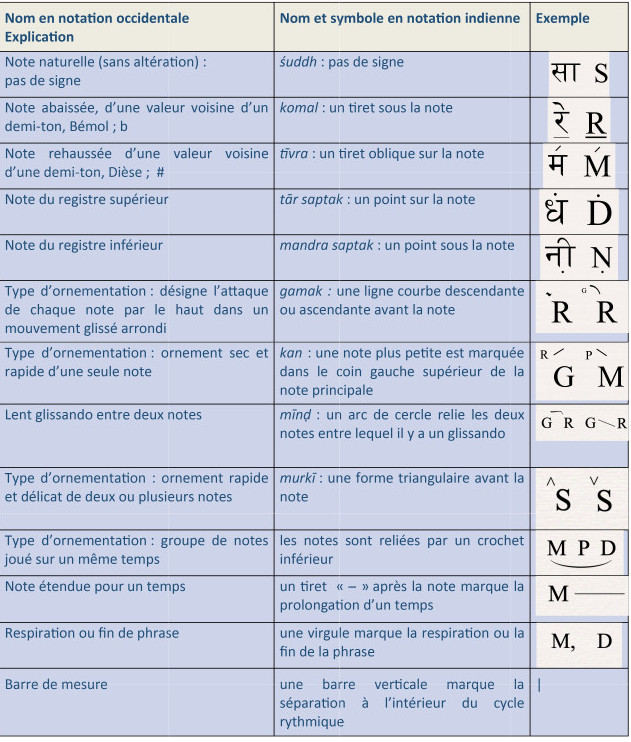
The main symbols used in Indian musical notation (in the Bhatkhande system). The transcription system, custom-designed for this specific context, presents a complementary parallel between Indian and Western notation. For the notation of unmeasured preludes, ālāp, it draws inspiration from proportional notation, used in contemporary Western music by some composers.
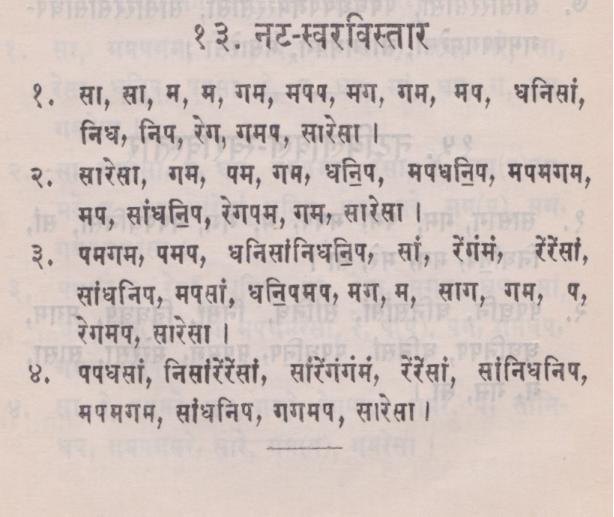
Raga Nat - Swara vistar (melodic movements - combinations of notes) Excerpt from Kramik Pustak Malika - Hindustani Sangeet Paddhati (volume 5) by Pt. V.N. Bhatkhande
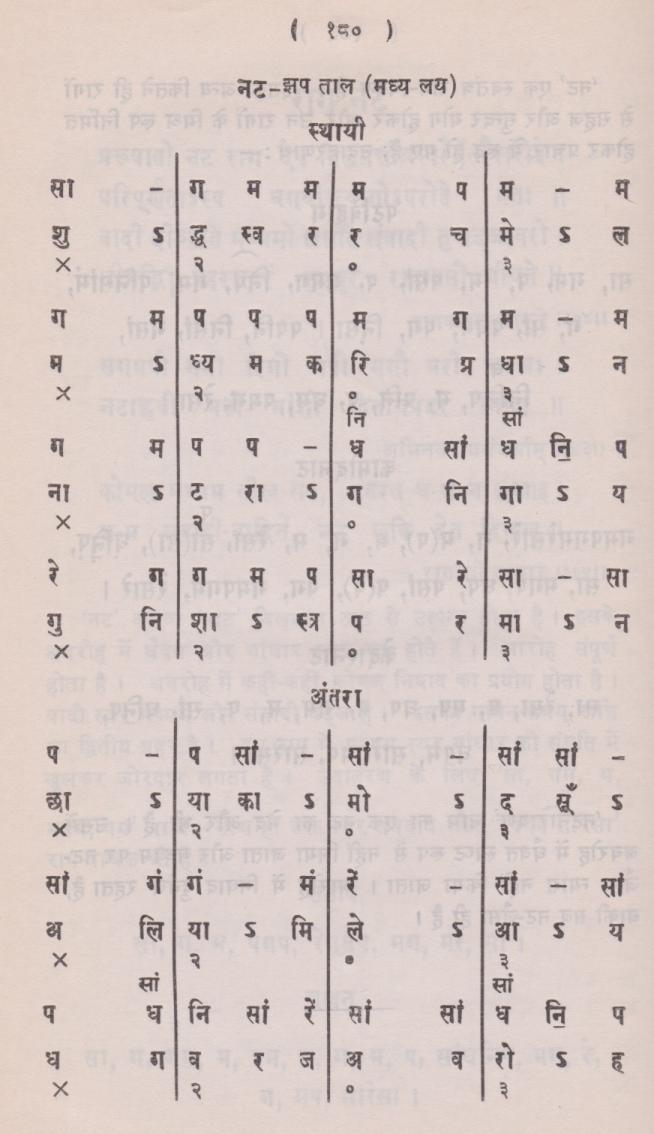
Raga Nat - Composition in Jhaptala (10 beats), Madhya Laya (medium tempo) Excerpt from Kramik Pustak Malika - Hindustani Sangeet Paddhati (volume 5) by Pt. V.N. Bhatkhande
For Indian rhythmic notation, the writing system is that of the musicologist Vishnu Narayan Bhatkhande:
- a unit of time is represented either by a small line, the first letter of a note name, or a horizontal loop
- within each horizontal loop, that is, within each unit of time, are placed the notes and rests.
Since this notation is primarily a memory aid, neither the resonance of the notes, nor the phrasing connections, nor the nuances are indicated.
Henri Tournier on Sudhanshu Sharma's interpretation
Henri Tournier on Sudhanshu Sharma's interpretation
"Sudhanshu Sharma chose a structure for developing the rāga Naṭ bhairav that was adapted to the short duration desired for the custom-made recording for the website.
He begins not with an ālāp but with what is called an aochar, a short sketch that presents the characteristic movements of the raga, in order to establish its identity before developing it further. An ālāp would have required more time to go beyond a simple presentation and truly explore the beauty of the rāga's melodic resources."
Next, Sudhanshu Sharma presents a composition and its poetic text (bandiś) in the raga Naṭ bhairav, accompanied by the tabla, built on a 16-beat cycle called addha tāla, a kind of variation of the tīntāla cycle, the major rhythmic cycle, which can be interpreted, depending on the chosen tempo, as a 16-beat cycle, but also as 32, 8, or 4 beats. Performed at this tempo, this 16-beat cycle is perceived as an 8-beat cycle.
Sudhanshu Sharma first presents the part of the composition that the composition begins around the middle tonic, a section called sthāyī, consisting of a main phrase and a development phrase. Then, the developed section, called antarā, begins around the tonic of the upper register, using ascending movements. This section also consists of a main phrase and a development phrase.
This exposition of the composition, played in variations, concludes with a return to the main section, centered on the middle tonic, the sthāyī.
Then, Sudhanshu Sharma focuses on developing improvised sequences that conclude with this middle section (sthāyī). These sequences, more lyrical than rhythmic, incorporate elements of the ālāp prelude, an improvised piece centered around a single note, with a limited choice of notes. They are developed gradually, in a generally ascending movement. When he reaches the upper register, Sudhanshu Sharma plays the upper part of the composition, its development, and returns to the sthāyī.
Then, at a slightly faster tempo, he develops a more rhythmic style, sung in sargam, the notes of the Indian scale. At an accelerated tempo for the second time, he constructs tān, phrases or garlands of virtuosic notes sung first in sargam, with the names of the notes, and finally in ākār, vocalizing on the vowel "a".
To conclude, he returns to the sthāyī and repeats a short motif from this melody, repeated three times identically, called a tihāī. On the last note of the tihāī, the tabla stops playing, and Sudhanshu Sharma sings a short phrase similar to the movements of the prelude, allowing him to return to the peaceful character of the beginning of his performance.
The improvised elaboration structure proposed by Sudhanshu Sharma is perfectly suited to the context of a short 10'30" presentation: despite this time constraint, it allowed him to present a very complete range of the constituent elements of the rāga Naṭ bhairav.