

The Biniou-bombarde couple François Le Gall - Jean-Marie Le Nouveau.
François Le Gall, from Berné (56), on the bombarde, and Jean-Marie Le Nouveau, from Saint-Tugdual (56), on the bagpipes, recorded two 78 rpm records for Gramophone on 24 August 1932. These two records allow us to listen to the following repertoires:
- Gavotte pourlet (dance; Gramophone catalogue code K 6703),
- Jabadao-Stoup (dance; Gramophone catalogue code K 6703)
- Sonnen eured - En Hanveù (wedding song - lamentations; Gramophone catalogue code K 6704),
- Kousk Breiz Izel ("Sleep, Lower Brittany"; Gramophone catalogue code K 6704).
Today we propose to study more specifically the gavotte pourlet performed by our two players.
Wedding photo with François Le Gall on the bombard © All rights reserved private collection.

The gavotte pourlet played by Le Gall and Le Nouveau (recording K6703)
Pourlet Country
Speaking Vannes language (bishopric of Vannes), the Pourlet region is located in central Brittany, on the border of Cornouaille (bishopric of Quimper), and presents many cultural aspects attributable to these two large cultural areas.
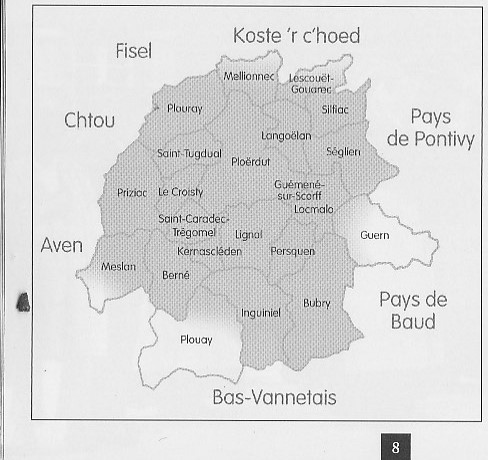
© Dastum Editions
Instruments and scales
Let us first recall the instruments used by F. Le Gall and J.M. Le Nouveau:
The bombard is a popular oboe that plays continuously accompanied by the bagpipe. The bombard has a range of 2 octaves and plays a diatonic scale with a major tendency, with adjustable degrees (in particular degrees 3, 4 and 6).
The bagpipe is a bagpipe, equipped with a melodic pipe (the levriad), playing an octave above the bombard, and a drone that is tuned an octave below the lower tonic of the bombard. The pitch of the notes is relatively stable; possibly, the musician, by the pressure he exerts on the bag, can modify this pitch, but the exercise is difficult! Finally, as a bagpipe, the detached can only be achieved by playing the fingers.
Instruments and scales:
Scale of the biniou :
|
Undertonic |
Degree 1 (tonic) |
Degree 2 |
Degree 3 |
Degree 4 |
Degree 5 |
Degree 6 |
|
A # ↓ |
B |
C |
D |
E ↑ |
F # |
A #↑ |
Bombard scale (one octave below that of the biniou):
|
Undertonic |
Degree 1 (tonic) |
Degree 2 |
Degree 3 |
Degree 4 |
Degree 5 |
Degree 6 |
Degree 7 |
|
A# ↓ |
B |
C # |
D # |
E |
F# |
G# |
A |
We see that the two scales are completely different (see Appendix). Playing this type of formation together might seem like a challenge. Let's hear what happens with our two players, by listening to "Sonnen eured - En Hanved" (K 6704).
Listening 1 Sonnen eured
© Dastum Editions
This is a series of 3 tunes, whose function is to support wedding processions. These tunes are either purely instrumental (No. 2), or borrowed from the sung tradition; this is the case for No. 1 and No. 3. Thus, No. 1, Ketan biskoah moé graet er léz… (“The first time I ever courted…”), was collected in 1968, in Meslan, by Donatien Laurent, and No. 3, “En Hanveù”, was collected in 1956, by Claudine Mazéas, from Julienne Juguet, originally from Kernascleden.
Listening 2 Ketan biskoah
© Dastum Editions
Listening 3 En Hanveù
© Dastum Editions
Analytical transcription
Annotated scores: for easier reading, the score is written in B major for both instruments (the mode closest to the bombarde).
The full document can be downloaded via this link:
Transcription Pourlet notation Le Gall Le Nouveau
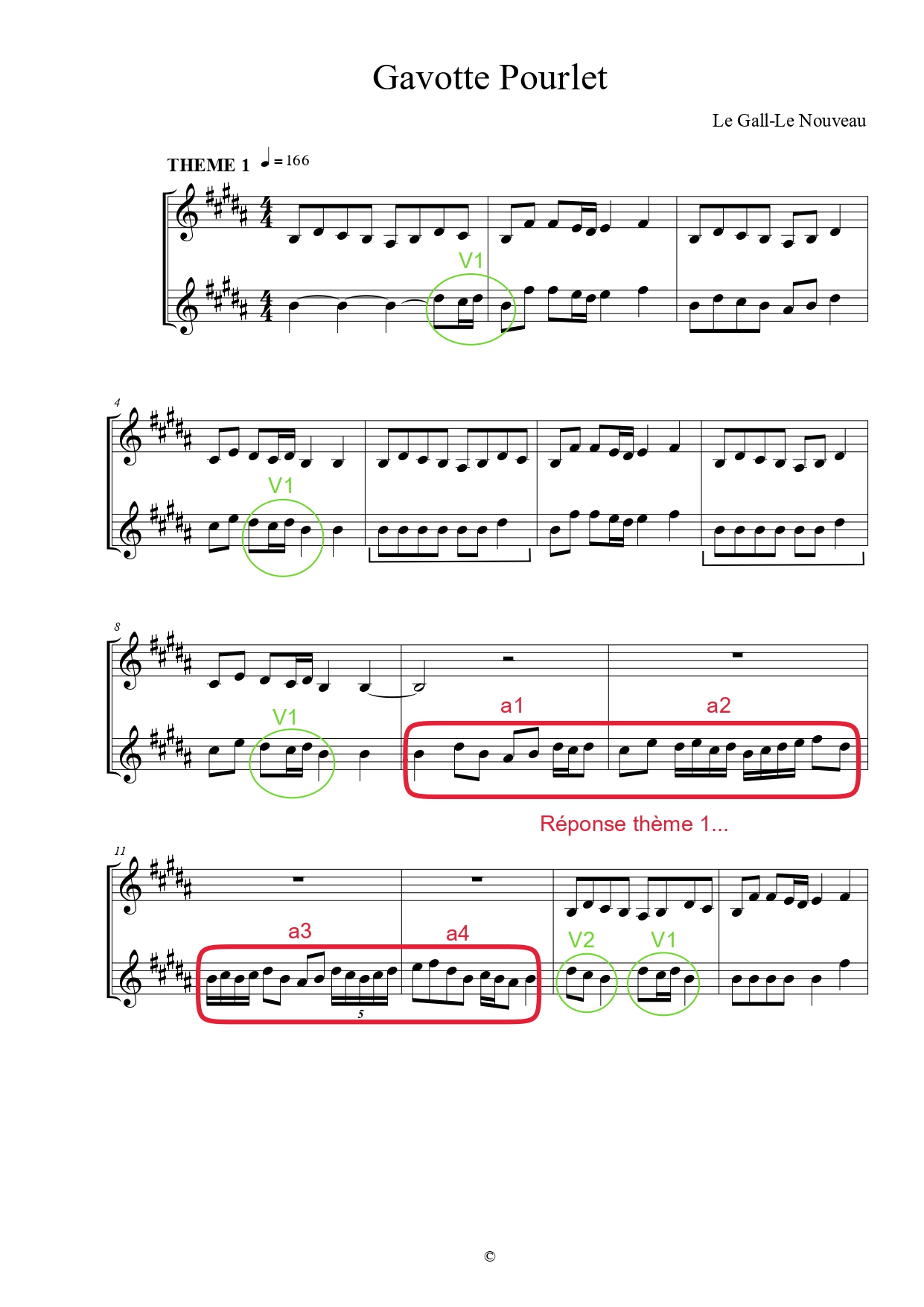
Circled in green, we find the characteristic elements of Jean-Marie Le Nouveau's melodic-rhythmic playing. In the transcription above, we can isolate 1 omnipresent pattern comprising 3 variations; the only difference between these 3 variations is the coining carried out to add flow or on the contrary remove it.
Circled in black, these are the characteristic elements at the end of the sentence. Indeed, while today, we are most of the time used to hear the bagpipe player finish his sentences like this:
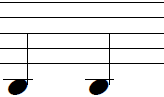
The bagpipe, in our recording, systematically ends in this way, or even with an even more rapid flow (4 sixteenth notes + 1 quarter note).
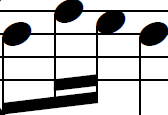
Being absolutely alone in front of the bombarde, the biniou is forced to assume the role of a complete accompanist, a melodist as much as a rhythmist! The fact that he fills the flow until the end of the last measure allows the bombarde to have a clearer reference point to follow, especially when his partner launches into improvisation. A sort of flying goal!
Highlighted in black: piqué play on the tonic. A characteristic element of the bagpipe game, it is recurrent throughout the piece.
Concerning the biniou's response to each theme (red circle), I made the choice not to base the melodic structure of the biniou on that of the bombarde, because its responses are often different, even very distant, especially those of theme 2; it is also interesting to note the responses at this precise moment.
The biniaouer plays on the dance's supports, he adds a beat to the 1st measure, then removes one from the 2nd, then adds to the 3rd, then removes again from the 4th.
Which gives this on V1: 5beats + 3beats + 5beats + 3beats = 16beats
Here is now V2: 5beats + 4beats + 3beats + 4beats = 16beats. We can clearly see that the biniou reveals all his virtuosity, playing on the rhythmic supports of the dance, while crisscrossing between melodic variation and improvisation. However, he first answers: "V1", then "V2" twice in succession. Is this a phrase that he usually makes on this theme, adding variation, or is it the result of instant improvisation during the recording? One thing is certain, by dint of playing this music, he must have stored, recorded in his memory, a stock of motifs from which he draws at any time, while shaping them as he pleases.
Conclusion:
Patterns, ostinatos, piqué playing, varied and improvised responses, flow filling, all these tools describe the playing of the biniou by Jean-Marie Le Nouveau and also by other biniaouerians of this period (cf: Fañch Bodivit). The latter clearly had a melodic-rhythmic playing style that was very distinct from modern playing styles. Perhaps, because of the difference in scales between the biniou and the bombarde, the players had to look for ways to avoid unison… Furthermore, how can we explain the fact that the biniou practically never rises above the third when it accompanies the bombard ? Is it due to the instability of its scale beyond this degree? The art of the biniou seems to be to stay around the tonic to give the bombarde the freedom to shine when it leads.
about the game of Fanch Le Gall
Detailed analysis of the degrees of two instruments
|
B flat |
B |
C# |
D# |
E |
F# |
G# |
A# |
|
|
Bombard |
-10 |
-30 |
+33 |
+27 |
||||
|
Biniou |
-45 |
-60 |
+33 |
+36 |
X |
-50 |
Measuring the scale of each instrument from the recording of the Pourlet gavotte.
This measurement should be seen as an average, because the scale of the bombarde is not always easy to define, due to the mobility of the degrees. The same is true for the bagpipe, even if the scale of the latter is much more fixed.
Analysis of the scale of the bombard:
- 7th degree (sensitive) slightly low, 3rd major degree low, 4th degree high.
We will therefore speak here of a scale with a global major tendency. On the table, the 5th degree of the bombarde is slightly higher, but we will not be interested in its specificity, because this degree navigates between a perfect fifth and a slightly higher fifth (surely linked to the readjustment of the bombarde during rare unisons on the fifth with the bagpipe).
Analysis of the scale of the biniou :
- 2nd middle degree (3/4 tone), 3rd low middle degree (which tends towards the minor), 4th high degree, 5th high degree, 7th middle degree (3/4 tone).
We see here that the scale of the biniou is very different from that of the bombarde. It is relatively close to the Phrygian mode, with an absent 6th degree.