1st section
—Preamble (pish-darâmad), arrangement by Jean During on the rhythmic cycle Gardun of Bukhara in 8/4
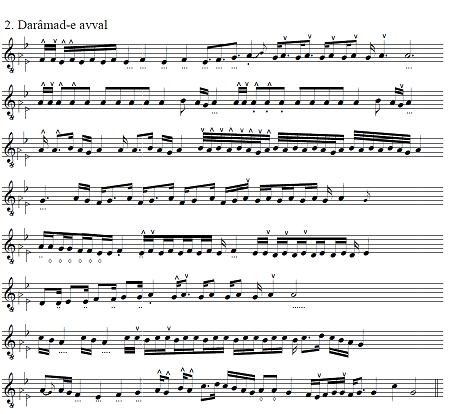
—2'55 Introduction (darâmad): polarization of the A semi-flat. Santur then voice.
Note that the santur follows the melody of the song then "responds" to the phrases of the song as if in "echo" with some variations. This process is called "response of the song": javâb-e âvâz.
—4' Finale on G. Melismatic introduction without text, "mirrored" response of the santur.
—5' Poem (ghazal): by the poet Sa'adi (13th century)
Del az mahabat-e donyâ o âkherat kandam
"My heart has cut itself off from the affects of this world and the beyond"
—Scale E semi-flat F G A semi-flat B C D
—Long response from the santur
—We always stay on the same modal structures
—7'02 We reach the high register before going back down to the starting point.
2nd section
Vocal introduction without words. Polarization of the A semi-flat. The santur responds as if in echo:
—8' conclusion without words
—Tahrir. This melisma is also found in the great gushe Râk
—8'35 We move very skillfully, and in a way that is unusual in Segâh, always on the same ghazal
The melody lands on E semi-flat instead of G (or at most on F) as is the custom in Homâyun. The polarization of the E semi-flat constitutes a great modulation, an exit from Homâyun towards Segâh.
Scale: (C) E semi-flat F G A semi-flat Bb C D.
The final third C E semi-flat is typical of Segâh
The ney responds phrase by phrase to the song but the santur warbles in the background, producing a heterophony.
—10'15 Still in Segâh, a quatrain (dobeyti) by Bâbâ Taher is inserted in the middle of Sa'adi's ghazal
—11' interlude of the ney: brief chahârmezrâb in pulsating rhythm, then free
—11'44 Resumption of song0
—12'45 Still in Segâh, conclusion in the form of tahrir (melisma)
—13'12 Mirrored response of the ney and the santur
—13'52 Passage to the lower octave > return to the ghazal from the beginning
—14'20 Explicit return to Homâyun by the polarization of the A semi-flat
—14'50 Instrumental intermezzo: reng, a classical form inspired by dance tunes. It marks the return to Homâyun, but in the second phase of this mode where the center has moved from G / A semi-flat to C
3rd section
—15'40 Polarization of C: we are in the âvâz or gushe Chakâvak. The same ghazal is presented.
—17'23 Interlude: chahârmezrâb on the santur with zarb on a very fast 6/8. These pieces are often arranged in advance by the performer but can also be totally or partly improvised. They are based on chiro-metric formulas (specific and repetitive hand movements).
—19'48 Resumption of the song: Biâ biâ sanamâ, another ghazal. We are getting closer to the âvâz Isfahân (cf. the Azerbaijani version of Isfahân played by Bahram Mansurov).
—21'45 The sequence of notes Si Do Ré Mib Do Ré... is the essential motif
—23' Tahrir close to that of the gushe Nowruz or Râk
—23'40 Note the typical concluding motif.
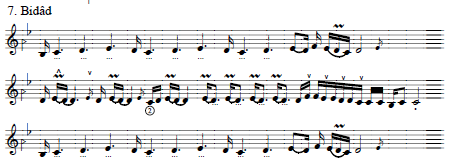
—23'45 The great gushe Bidâd polarizing the fifth (Ré). Same poem.
—24'50 Chahârmezrâb on the santur and ney with zarb (composed by the performers, not improvised).
—26' On a rhythmic background, the song freely states verses. This genre called taqsim muwaqqa' by the Arabs appeared or reappeared recently in Iran. Between the verses, the instruments find themselves on a common theme.
From the new center which is Ré, we moved on to the gushe Bayâte Râje. This is not a common modulation either, but it works well (since it is typical of the âvâz Esfahân), and in any case had been planned by the musicians during their rehearsals, so it is not improvised.
—30'05 Gushe Awj ("culmination" or Oshshâq, two possible names. Scale D E semi-flat F G A semi-flat. After a wordless introduction, the verses are taken from another ghazal
—31' 20 Concluding Tahrir followed by a chahârmezrâb on the ney and zarb
—32'40 Resumption of the song
—33'30 Return to the great gushe Bidâd, still with polarization of the D
—34' Tasnif (here, a semi-classical song, in 4 time). It is originally a popular song from Shiraz, transmitted by Habib Somâ'i (1905-1946)
—38' The audience applauds, but the performance is not over
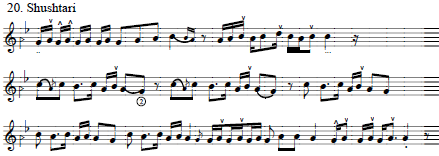
We enter another phase of Homâyun with modal melodies (gushe) typical of the Fars region (Shirâz) which are in the mode (âvâz) Shushtari, attached to Homâyun. Shushtari is close to Esfahân, but whose area of action is the first tetrachord, while in Esfahân it is the second.
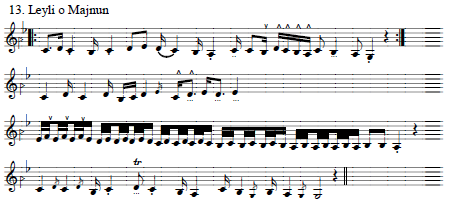
—38'15: Gushe Leyli o Majnun. For some it is one of the most moving melodies in the repertoire. The musicians embroider.
Another poem by Sa'adi:
Faryâd-e man az ferâgh-e yâr ast, habib-e man
Afghân-e man az gham-e negâr ast,
Dard-e del-e man ze hadd gozasht ast
Jânam ze ferâgh bi qarâr ast
My complaint comes from the separation from the Beloved
My lamentation comes from the torment caused by his beauty
The pain of my heart has exceeded the limit
My soul is upset by the distance
—