
Târ (tar)
Iran, Perse
The târ (in Persian ; tar in Azerbaijan) is a long-neck lute, part of the rabâb family. It is the main instrument of art music from Azerbaijan, Armenia and Iran.
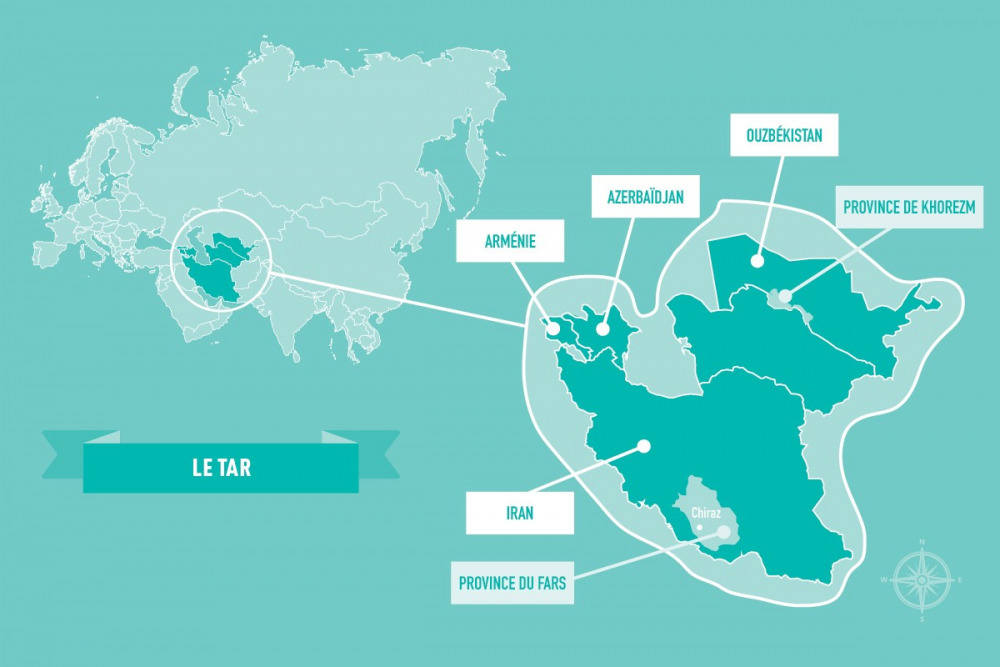
This long-neck lute has a sound box covered with a parchemiun as a soundboard. It was probably born in the Fars (Chirâz) in the eighteenth century under the name of chahârtâr (4 strings, still in use in Afghanistan).
The handle of the rabâb or shidirghu from which it originated was stretched and the upper part of the sound box was covered with skin instead of wood, while it took a rounded shape. This development was probably due to the introduction of metal strings replacing the casing.
The ancient tar, which is still very close to its current Iranian form, used to have five strings: a bass, a pair of medium and a pair of highs. Around 1878, Sadïqjan Asadoghlu gave it its Azerbaijani form, doubled the bass to the high octave, added a low drone plus two double strings in the high. These three rows of strings, located outside the key, are only played empty as a drone, taking up a characteristic feature of rabâb luths. The melodic strings are, in relative pitch (usually one or two tones below the tuning fork): do3-do3/ sol2-sol2/ do2-do3. The low row's tuning varies according to the modes. The resonance strings are frequently tuned sol1/ sol3-sol3/ and do4-do4. The strings are pinched with a small plectrum (mezrab) in bakelite. As in the original prototype, the melodies are played only on the first three rows, the additional strings only being pinched empty.
This Caucasian tar (called "azeri" in Azerbaijan) has a monoxyl mulberry sound box inscribed in a rectangular parallelepiped with rounded corners. The soundboard is made of two separate surfaces covered with a thin and very resistant beef pericardium membrane. The neck has 22 moving ligatures covering an octave and a fourth, giving an original scale among all the music of the Middle East, but which is probably the modification of an old scale, under Russian influence.
Because of its bright and powerful sound, its compactness and its playability, the Caucasian tar has spread to other musical cultures. It has become the instrument of the bards of Khorezm and is played throughout Central Asia, not solo, but to accompany the song.
The Iranian târ, meanwhile, has not spread much, but evolved in a search for perfection of tone and form.