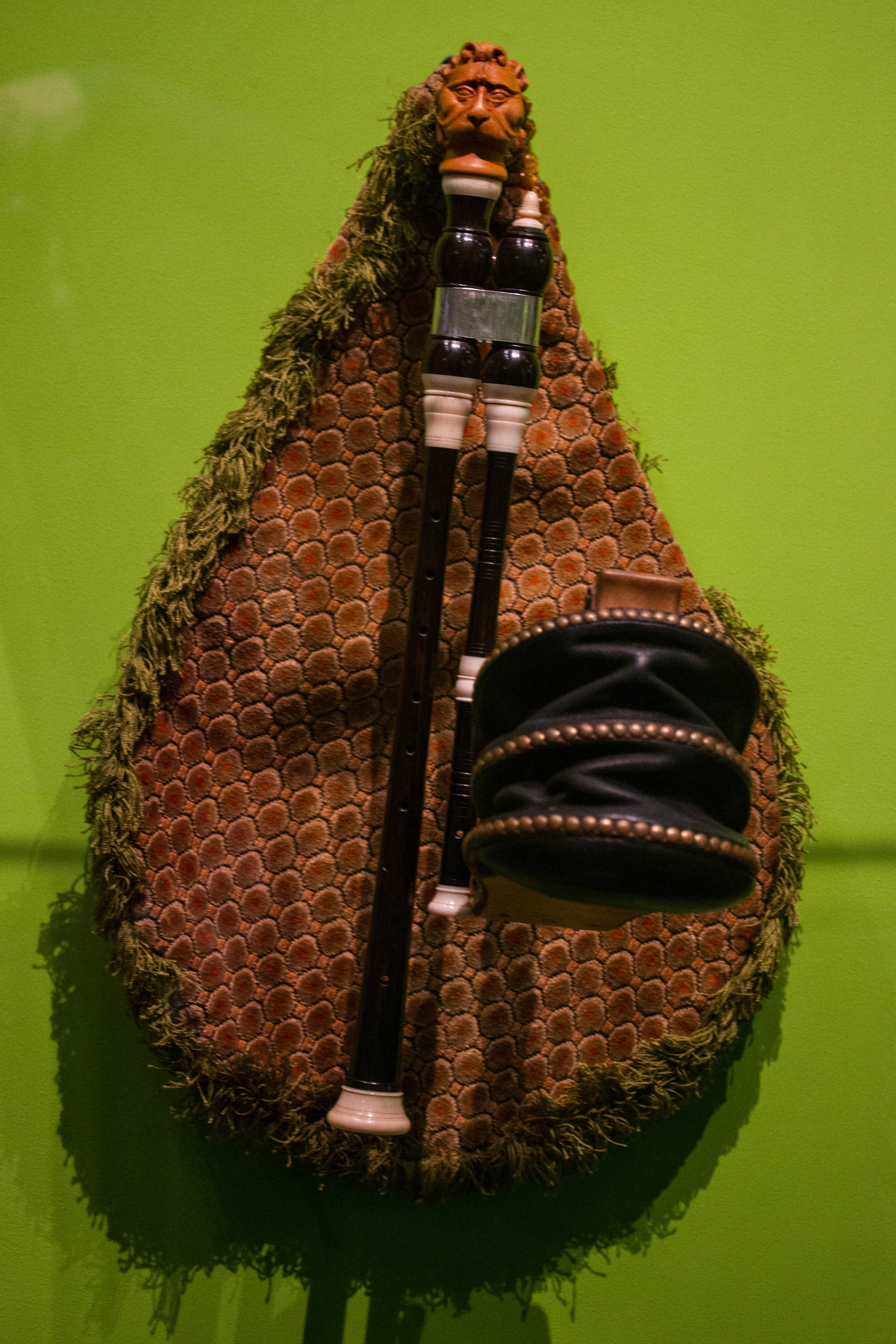
The cabrette: a bagpipe from Auvergne
This is an aerophone instrument from the bagpipe family, that is to say comprising one or more reed instruments played together, and supplied not directly by the musician's mouth, but by means of a bag forming an air reserve. The cabrette belongs to a particular type of French bagpipes, which also includes the musettes called "from central France", the chabrette limousine, the historical bagpipes called "grande chêvre" and musette "de cour", etc. This organological type is recognizable by a double-reed melodic pipe (oboe) mounted parallel to a smaller accompaniment pipe (bourdon or chanterelle), both being connected to the bag by the same piece of wood (case).
The name cabrette (la cabreta) means "goat", in the dialect of Haute-Auvergne (Languedoc dialect of Occitan). Across various other regions, it is a common term to generically designate the bagpipe, independently of a particular organological type: thus in Limousin the "chabreta", the "craba" in Languedoc, the "chieuve" in Berry or the "chèvre" in French.
The cabrette, in its current form, was probably developed in Paris towards the very beginning of the 19th century by craftsmen from the Auvergne community which was very present and organised there. Its design combines characteristics from earlier regional bagpipes that are little known (bore, fingering, particular timbre and scale, playing style, part of the repertoire no doubt) and more learned elements of violin making and aesthetics, borrowed from the court musette which had fallen into disuse at the time (bellows for the air supply, characteristic "ball" case, use of ebony, pocket covered with velvet and decorated with fringes, braid, mother-of-pearl buttons, etc.).
The cabrette has become the symbol of Auvergne music, and has spread to all regions of a very large Auvergne, notably disseminated by the many folk groups created during the 20th century. Its playing was pushed to a very high point of mastery and virtuosity, notably by the musicians of the Auvergne colony in Paris (mainly from Cantal, Aveyron and Lozère), who left numerous recordings in the form of 78 rpm records in the interwar period. Their playing styles and their repertoires are practiced today by many current musicians.